



A firm can have a very experienced team of lawyers, well established procedures and a good client base and still find themselves struggling when several matters come in at the same time. The document review deadlines pile up, contracts build up in the queue and the amount of time that is consumed by the more routine aspects of the work is time that could be better spent on work which requires the actual involvement of a lawyer. Adding on more permanent staff isn’t always the answer.
This is where LPO and legal process offshoring come in. Both can be used by law firms and corporate legal departments to manage their workloads, though they describe different arrangements. LPO is about who does the work, offshoring is about where the work is done.
Getting the distinction clear makes it much easier to compare providers, to assess the level of operational control you have and to determine how sensitive your legal work is. It also enables an organisation to select a support model that is appropriate to its own needs rather than simply assuming that all external legal services work in the same way.
What is Legal Process Outsourcing (LPO)?
Legal process outsourcing is the practice of having an external provider carry out certain legal or legal support work. The law firm or in-house legal department defines the work, agrees on the way it’s to be delivered and remains responsible for any decisions that fall within its own sphere of responsibility.
The provider can be in the same country as the client or in a different country. Location in itself doesn’t determine whether it’s an outsourcing arrangement.
Depending on the provider’s capabilities and the agreed scope, outsourced legal services may include:
- Document review and litigation support: reviewing the records, categorising the documents and identifying the material that needs to be looked at further.
- Contract review and lifecycle support: helping with contract administration, abstraction, tracking, version control and the associated workflows.
- Legal research and document preparation: Providing defined research or preparation support under appropriate supervision.
- Legal operations support: assisting with the management of repeatable admin processes and documentation.
- Data assessment: the process of organising and assessing information in the context of investigations, disputes or other approved legal workflows.
Want to Know More About : Legal Process Outsourcing (LPO): The Complete Guide for Law Firms in 2026
Not every LPO will offer all of these services. An LPO that specialises in contract management will have a very different team and technology set up to one that specialises in litigation document review for example.
Outsourcing can take a number of forms. It could be a one-off project to clear one backlog or it could be a longer term arrangement for ongoing work. In either case the scope of work, responsibilities, quality expectations and confidentiality requirements need to be agreed prior to work commencing.
What is legal process offshoring?
Legal process offshoring is the practice of having legal or legal support work carried out in a country other than the client’s home country. This can be done via an independent service provider or via a team which the organisation itself owns and operates.
Two fairly common models actually.
Third party offshore provider: A law firm engages an independent company in another jurisdiction to deal with certain defined workflows. The provider provides the agreed resources and manages delivery in accordance with the contract and the operating arrangements.
Captive offshore centre: The organisation sets up its own team in another country. That team is responsible for recruitment, employment, management, infrastructure and the running of the centre on a day to day basis (although of course some of the functions may still be supported by external vendors).
Organisations look at legal offshoring for a number of reasons. They may be seeking access to a bigger pool of talent, more capacity during peak periods or a delivery model which utilises time zone differences. Cost efficiencies may also be a factor (although the extent of the savings will vary depending on the work, the level of management required and the overall cost of delivery).
India, the Philippines, Eastern Europe and South Africa are all examples of places that are used for international business services. The appropriate location will of course be one that has the requisite skills and expertise, the necessary language capabilities, is compliant with the relevant regulations and the actual delivery model of the provider.
Aeren LPO describes its operations as being based in Chandigarh, India and provides legal support to international clients. Services offered include managed document review, litigation support, contract lifecycle management and offshore legal staffing. Their website is the source of this information.
For the prospective client the key question is whether the provider’s team, their workflows and their security arrangements are appropriate for the matter.
Legal Process Outsourcing vs. Legal Process Offshoring: Key Differences
All offshoring is work being done in another country. Not all outsourcing is necessarily an overseas arrangement.
The easiest way to see the difference is to separate out the service arrangement from the location of delivery.
| Factor | Legal process outsourcing | Legal process offshoring |
|---|---|---|
| Meaning | Work is assigned to an external provider | Work is performed in another country |
| Location | Domestic or international | Outside the client's home country |
| Team structure | Usually an external provider's employees or contractors | An external provider's team or the organisation's own overseas team |
| Contractual arrangement | A service agreement with a third party is common | May involve a vendor contract or an internally operated centre |
| Operational control | The client sets requirements; the provider manages agreed delivery | Depends on whether the team is external or internally managed |
| Cost considerations | Depends on rates, scope, supervision and rework | Depends on location, infrastructure, staffing and total operating costs |
| Specialist skills | Access depends on the provider selected | Access depends on the overseas talent pool and provider capabilities |
| Scalability | May allow additional capacity without permanent local hiring | May provide additional capacity through a vendor or an internal centre |
| Security responsibilities | Must be assessed under the relevant agreement and applicable rules | Requires particular attention to cross-border access and data-transfer obligations |
| Suitable use | Defined tasks or recurring work that can be delegated | Work that can appropriately be delivered from another country |
The models can overlap but they are not interchangeable. An offshore provider is one type of outsourcing partner. An offshore centre which is internally managed is not necessarily an outsourcing arrangement.
Consider three examples:
- A US law firm has engaged a legal support company based in the US. That’s outsourcing without offshoring.
- The same company have an independent legal support provider in India. That’s a mix of outsourcing and offshoring.
- They open their own legal support centre in India and employ the team themselves. That’s offshoring without it being outsourcing.
These distinctions are important when considering liability, management overhead and the degree of control the legal team is prepared to exert.
Benefits of Legal Process Outsourcing and Offshoring
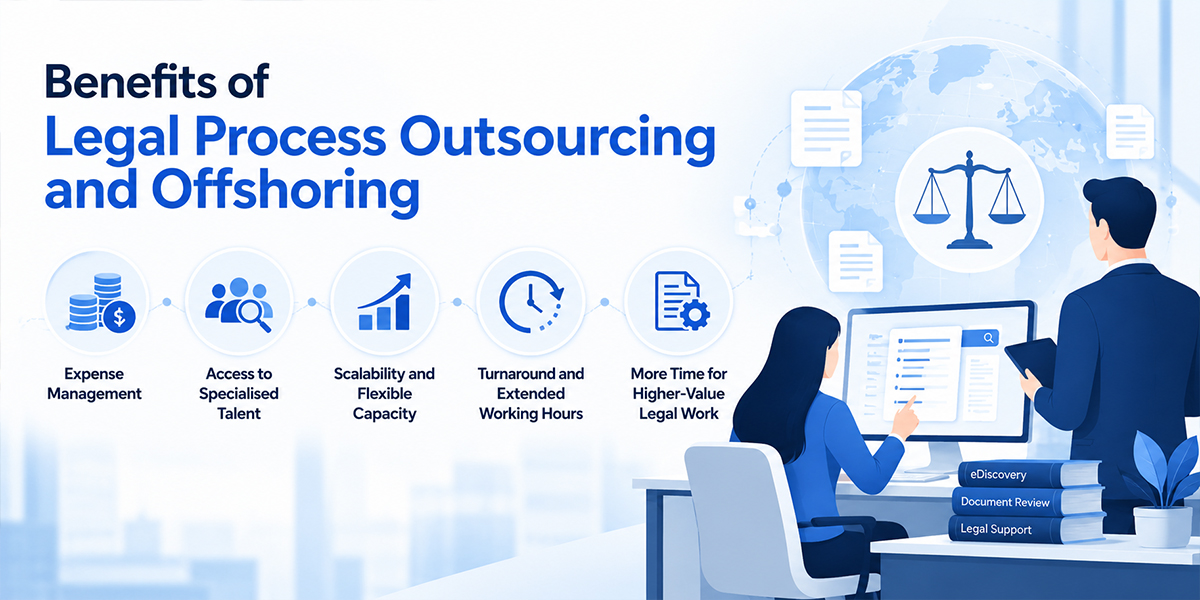
The benefits will of course be dependent on the operating model and the type of work that is being delegated. Neither of the arrangements will necessarily lead to lower costs or better outcomes.
Expense Management
External support can help a company to avoid the need to recruit permanent staff for workloads that are seasonal in nature. Offshoring can also have an impact on staffing and operating costs, depending on where you offshore to and the delivery model you adopt.
The quoted service rate is only one element of the calculation. You have to factor in onboarding, supervision, technology, security, rework and internal management time before you can work out the actual financial benefit.
Access to Specialised Talent
A suitable provider may have experience in document review, contract workflows, litigation support and so on. That can be of benefit if you’re looking for a particular capability and don’t have enough work to warrant having a dedicated team in-house.
Quals and experience still need to be checked. The location of a team in itself doesn’t establish expertise and delegated support doesn’t in any way substitute for the legal judgement of the relevant attorneys.
Scalability and Flexible Capacity
Legal workloads don’t normally come in perfectly predictable volumes. A new dispute, a new regulatory investigation or a new transaction can all result in a sudden spike in work.
An external provider may be the answer to meeting that demand without the immediate need to make permanent hires. The engagement should set out how additional capacity will be requested, how quickly staffing can be changed and what the process is if the scope of the work increases.
Turnaround and Extended Working Hours
Teams working across time zones could provide additional working hour coverage. A task completed by one team with clear instructions and proper handover could be ready for the next team to review at the start of its working day.
This is all about coordination. Confusing instructions, delayed decisions or inconsistent handovers are all capable of eroding any potential time advantage you might have.
More Time for Higher-Value Legal Work
Delegating the appropriate support tasks will free up the attorney to spend more time on case strategy, negotiation, client advice and the kind of decisions that require professional judgement.
A firm with a large document collection might have the provider do the initial review and classification under some agreed protocol.
The lawyers then have the opportunity to focus on the interpretation of the significant evidence and the determination of its effect on the case. The provider is enabling the workflow, the lawyers are still responsible for the legal analysis and the decisions that are assigned to them.
Dangers and Difficulties, and How Aeren Addresses Them
Outsourcing and offshoring both require a very high degree of oversight. Getting the work done overseas in no way removes the requirement to protect the client’s information, to maintain the requisite standard of quality or to comply with the relevant professional obligations.
Data Security and Confidentiality
Legal records can contain personal data, commercially sensitive information, communications protected by privilege and information which is subject to contractual restrictions.
Prior to sharing data, organisations should consider access rights, secure methods of transfer, data retention and deletion, incident reporting and the provider’s ability to meet the particular requirements of the matter.
Prospective clients should check the current status, scope and suitability of the relevant certification or attestation and the controls that will be applicable to their engagement.
Regulatory and Ethical Compliance
Cross border legal support can be used to deal with issues of privacy law, legal privilege, client consent, professional conduct and restrictions on the transfer of data internationally. The requirements in any given jurisdiction will of course vary.
US law firms in particular should be thinking about the relevant professional responsibilities (respect for competence, supervision and confidentiality) when they are outsourcing work. The ABA has a whole section in its guidance on the ethical implications of outsourcing which deals with those very issues.
Quality Control and Accuracy
A provider could end up applying the wrong review criteria if the instructions are not clear or if the reviewers have interpreted them differently. In a big matter small discrepancies can lead to a massive amount of rework.
Agree on the written procedures, examples of correct coding, the escalation rules and the process for sampling and correcting errors. Aeren describes its managed document review service as being based on structured workflows and quality checks. The firm should confirm exactly what the quality control process is going to be for the engagement in question.
Communication and Coordination
Timezone differences can be a problem when you need to make decisions quickly. Differences in terms, in reporting expectations or in internal processes can be the same sort of issue.
A point of contact, clear instructions, regular progress updates and agreed escalation paths will keep the work moving. Service level expectations should be written down rather than assumed.
Vendor Dependency and Knowledge Transfer
Dependence on a single provider can create continuity issues should there be a change in staffing, should volumes suddenly increase or should the relationship simply end.
Documented processes, appropriate access controls, clear ownership of the work product and agreed arrangements for transition all go a long way to reducing that risk. The contract should also deal with data return or deletion and with the transfer of any outstanding work at the end of the engagement.
Outsourcing or Offshoring: How to Decide
Start with the work itself rather than picking a model on the basis of it being cheaper or more flexible.
Use this checklist when comparing options:
- Budget: What’s the total cost (including supervision and rework)?
- Complexity: Can the work be properly defined and assigned?
- Volume: is the workload recurring, seasonal or project based?
- Data sensitivity: What are the confidentiality and cross-border restrictions?
- Turnaround: How quickly does the work need to be completed?
- Control: How much day to day management does the team need?
- Expertise: Are the right people with the requisite skills and experience available?
- Technology: Can the provider work within the required systems and access controls?
- Professional obligations: What client approvals, disclosures or supervision are required?
- Continuity: How will the arrangement cope if the volumes change or if the staffing levels change?
Two fairly common scenarios actually demonstrate how the decision works.
Scenario 1: A small law firm with overflow work
A small firm get a large pile of docs just prior to a case deadline. It may not make sense to go in and hire permanent staff for a temporary job. They could look at an external provider for a defined review task. That would be a domestic or offshore provider depending on the budget, data constraints and level of oversight required.
Scenario 2: A corporation with high-volume contract review
An in house legal team will be dealing with a constant stream of supplier and customer contracts. They could assess an external offshore team, set up their own offshore centre or blend in house staff with external support. The right route will be determined by the volume you expect, the level of control you require, your existing infrastructure and the cost of each of the options.
Neither model is in any way universally superior. A very well designed domestic outsourcing arrangement might be the right thing for one organisation and a completely different arrangement (offshore team or some hybrid of the two) might be the right thing for another.
How to Choose a Top LPO Company
Looking for the best LPO company is a good place to start, but rankings and marketing claims in no way substitute for proper due diligence. You need to assess the provider in the context of the actual work you require them to do.
Lawyer Qualifications and Domain Expertise
Ask who is going to do the work, what relevant qualifications and experience they have, how they are trained and who is going to be their supervisor. Experience in a similar workflow is often more useful than a general claim of legal expertise.
Information Security and Certifications
Review the documented security controls, access management, confidentiality agreements, incident response and any independently verified certifications or attestations. Make sure the arrangements cover the systems, locations and services that are part of your engagement.
Case Studies and Client References
Look for relevant examples of similar work and ask for evidence to support any claimed outcomes. Client references can be of use in some cases (where disclosure is allowed) but be mindful of confidentiality and don’t confuse general marketing claims with verifiable results.
Clear Pricing and Pilot Options
Work out exactly what the pricing model is (hourly, headcount, volume of documents, stage of project etc). Find out about onboarding, any additional work, supervision and rework charges. A small pilot may be useful to test the workflow prior to a bigger commitment.
Technology and Workflow Management
Check how the provider takes in the work, assigns it, tracks it and reports on it. If you’re using any particular platforms or integrations then you need to check that they’re compatible, that the provider has the appropriate access and that there are no additional costs associated with that.
Scalability and Continuity
Ask about how staffing changes are managed, how knowledge is retained and what happens when the workload increases. The provider should be able to describe their escalation and transition processes in full and without making any unrealistic delivery promises.
Why Consider Aeren LPO?
Aeren LPO is a legal process offshoring partner not a law firm. Their published service offering includes managed document review, eDiscovery, litigation support, contract lifecycle management, cyber incident response review and offshore legal staffing.
These services would be of relevance to law firms and in-house corporate legal teams who are looking for some additional support with respect to certain workflows. The right place to start is a conversation about the work in question, the level of capacity required, the timescales involved and the degree of oversight that the client is prepared to maintain.
Before you go any further, prospective clients should check out the particular team’s experience, delivery model, security controls, quality processes and pricing. That will go a long way to helping you determine whether Aeren’s offering is appropriate for the engagement.
Legal Process Offshoring Trends to Watch
A couple of developments are having an impact on how legal teams assess offshore support
- AI assisted document review: the technology can be used to help classify, prioritise and search through large document sets but the outputs will still need appropriate validation.
- Managed legal support: the firm may be happier with a defined set of services and a defined delivery process rather than recruiting in for each individual temporary requirement.
- Contract lifecycle management: recurring contract workflows can provide opportunities to standardise the administration, tracking and reporting.
- Stronger data governance: clients are looking at access controls, cross border data management and the evidence that the provider can provide around their security posture.
- Measurable service quality: clear reporting, agreed performance metrics and documented escalation procedures make the external arrangements much easier to monitor.
AI should be part of the workflow and not a guarantee of accuracy. Companies should define which tools are acceptable, how sensitive information is protected and who is responsible for checking the output prior to it being used.
Conclusion: Choosing the Appropriate Legal Support Model
Legal process outsourcing and legal process offshoring are two distinct things. Outsourcing is about who does the work. Offshoring is about where the work is done. A firm can use one or the other or indeed both, depending on its own business requirements.
The decision should come down to the type of work, expected volume, confidentiality requirements, available expertise, level of supervision and total cost. A provider that suits a temporary document review project may not be the right choice for a long-term contract management arrangement.
For law firms and corporate legal departments evaluating additional capacity, Aeren LPO offers legal support services that include managed document review, litigation support, contract lifecycle management and offshore legal staffing. Explore Aeren LPO’s services to discuss your requirements and determine whether its legal process offshoring model fits your team’s workflows.
FAQ’s
Legal process outsourcing is the assignment of work to an external service provider. Legal process offshoring is the performance of work in another country. A firm can outsource work either domestically or internationally. It can also offshore work by running its own overseas centre (i.e. it doesn't outsource the work to a third party).
It can be done securely of course, but security is entirely dependent on the particular arrangements. The provider will need to be assessed in terms of access controls, encryption, confidentiality agreements, incident response, data retention and data transfer out of the jurisdiction. You will also need to check whether client consent or some other form of approval is required prior to sharing the data with a provider in another country.