


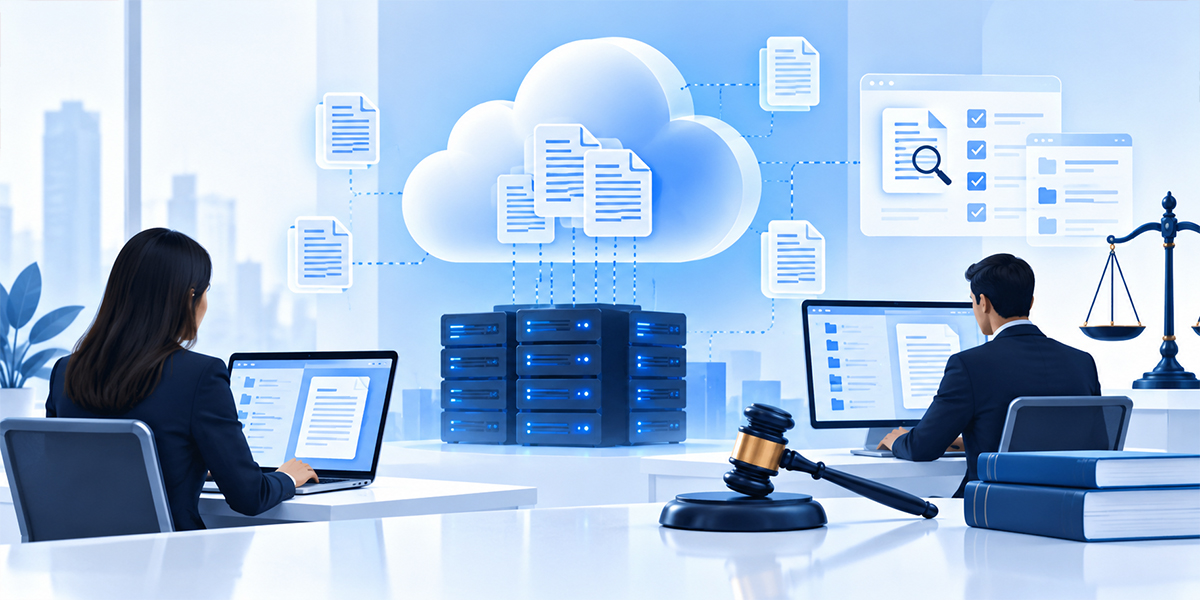
A law firm’s technology requirements can change quickly when a major litigation matter lands on its desk. A collection that starts with a few email accounts may soon include shared drives, chat messages, contracts, and years of business records. Before attorneys can begin reviewing those documents, the data must be collected, processed, and organized.
For firms handling several matters at once, this creates a practical problem. Their existing infrastructure may be perfectly adequate most of the year but struggle when multiple discovery projects overlap. Buying enough hardware to cover every possible surge can be expensive, particularly when that equipment sits idle between cases.
IaaS for eDiscovery gives law firms another way to manage these changing demands. Infrastructure as a Service provides access to computing, storage, and networking resources without requiring the firm to purchase all the underlying hardware.
The benefit is flexibility, not an automatic reduction in costs. Firms still need suitable eDiscovery software, security controls, and people who can review documents properly. Understanding how these elements work together makes it easier to choose an arrangement that fits the firm’s workload.
What Is IaaS for eDiscovery?
Infrastructure as a Service, commonly called IaaS, allows organizations to access computing resources through a cloud provider instead of maintaining all the necessary hardware themselves.
In eDiscovery, these resources can support the technical work involved in handling electronically stored information (ESI). This includes emails, office documents, spreadsheets, messages, and other digital records that may be relevant to a legal matter.
IaaS can provide:
- Computing power for processing electronic evidence, extracting text, and building searchable indexes.
- Cloud storage for source data, processed documents, and associated review materials.
- Networking resources that connect authorized users, applications, and systems.
- Adjustable capacity when a matter requires more computing power or storage than originally expected.
Consider a firm preparing for a commercial dispute. Its IT team is already processing evidence for two other cases when a third client delivers a large collection of electronic records. Instead of immediately purchasing more servers, the firm could explore whether additional cloud resources can accommodate the new workload.
The important distinction is that IaaS supplies the underlying infrastructure. It does not automatically include the eDiscovery application used to manage evidence or the legal professionals needed to review it. Those services may come from separate providers.
Why Traditional eDiscovery Infrastructure Can Be Expensive
Maintaining an in-house eDiscovery environment involves ongoing work long after the initial hardware purchase. Servers need maintenance, storage needs monitoring, software requires updates, and access controls must be managed. The firm also needs appropriate backup and recovery arrangements.
Capacity planning presents another challenge. Discovery workloads rarely arrive in a neat, predictable pattern. A relatively quiet period can be followed by several large matters with overlapping deadlines.
If a firm builds its infrastructure around its busiest possible workload, it may end up paying for capacity that is rarely used. If it builds around average demand, the available resources may not be enough when a major investigation begins.
The expenses can extend to:
- Hardware purchases, upgrades, and replacement.
- IT personnel responsible for maintenance and troubleshooting.
- Storage, backup, and disaster recovery.
- Security monitoring and access administration.
- Additional equipment when processing requirements increase.
For example, a litigation team may be halfway through reviewing evidence in one dispute when an urgent investigation begins. The IT team must decide whether its existing environment can support both projects or whether additional capacity is needed.
Neither option is automatically wrong. Firms with predictable workloads and substantial existing infrastructure may find that keeping their current setup makes financial sense. Others may benefit from a more flexible approach. The decision should be based on actual usage and costs, not an assumption that cloud infrastructure is always cheaper.
How IaaS Helps Law Firms Scale eDiscovery Without Heavy IT Spend
IaaS gives firms another way to obtain the computing and storage resources required for discovery. Rather than buying equipment to cover every possible increase in demand, they can assess whether cloud capacity is appropriate for each workload.
Scale Computing Resources Around Case Demand
Processing a large collection of electronic evidence can require considerable computing power, particularly during ingestion, text extraction, and indexing.
Those demands may fall once the initial processing work is complete. With a suitably designed cloud environment, a firm can increase resources for demanding stages and reduce them when the workload declines.
For example, a large investigation may require substantial processing capacity during its first few weeks, followed by a longer period of document review. Matching resources to those stages can help avoid maintaining peak capacity throughout the entire matter.
The available flexibility depends on the infrastructure architecture and provider limits, so firms should confirm what can actually be adjusted.
Reduce the Need for Large Upfront Hardware Investments
Buying servers and storage equipment requires spending money before a firm knows exactly how much capacity a matter will consume.
IaaS can reduce the need for these upfront purchases by allowing the firm to obtain resources through a cloud provider’s pricing arrangement. That may change when and how costs are incurred, but it does not remove them.
Cloud resources, eDiscovery licenses, implementation, security, and administration still need to be included in the budget. Whether the arrangement saves money depends on the firm’s existing infrastructure and the demands of the matter.
Support Large and Fluctuating Data Volumes
The volume of evidence can grow as a matter develops. New custodians may be added, additional email archives may be collected, or the relevant date range may expand.
Scalable eDiscovery infrastructure can help accommodate these changes without requiring the firm to plan every decision around a fixed physical environment.
Additional capacity, however, does not replace proper data collection, processing procedures, or retention policies. The firm still needs to understand what information it holds and how that information should be handled.
Improve Access to Infrastructure Expertise
A cloud provider manages parts of the underlying infrastructure, which can reduce the amount of hardware maintenance a firm performs internally.
However, the provider does not necessarily manage every technical responsibility. Depending on the service, the firm may still need to handle system configuration, application security, permissions, and monitoring.
Before moving a workload, firms should establish who is responsible for maintaining the environment and responding to technical incidents.
Support Distributed Legal Teams
Cloud-hosted systems can allow authorized team members to access review platforms from different offices and locations. This can be useful when litigation teams and reviewers work across time zones.
Access still depends on reliable connectivity, appropriate permissions, and the configuration of the review environment. Moving to the cloud does not automatically make a workflow faster or more secure; those outcomes depend on how the system is designed and managed.
IaaS vs Cloud-Based eDiscovery Software vs Managed Document Review
These three services are often discussed together, but each solves a different problem.
| Service | What It Provides | What the Firm Needs to Consider |
|---|---|---|
| Infrastructure as a Service (IaaS) | Computing, storage, and networking resources | Configuration, security, applications, and infrastructure costs |
| Cloud-based eDiscovery Software | Tools for processing, searching, reviewing, and producing evidence, depending on the platform | Licensing, functionality, integrations, and data management |
| Managed Document Review | Review personnel, workflows, supervision, and quality checks | Reviewer expertise, review instructions, confidentiality, and oversight |
IaaS provides the technical foundation. The firm still needs software to organize and work with its evidence.
Cloud-based eDiscovery software provides the working environment. Depending on the platform, it may include search, analytics, technology-assisted review (TAR), predictive coding, and production tools.
Managed document review addresses the people and processes involved. Reviewers examine documents according to agreed instructions, while supervisors and quality-control procedures help maintain consistency.
A firm may need all three services, but it does not necessarily need to change all three at once. If the software and infrastructure are already suitable but the review team is stretched, additional review capacity may be the more practical solution.
What Costs Should Law Firms Evaluate Before Moving eDiscovery to the Cloud?
Cloud infrastructure costs depend on the provider’s pricing model, the volume of data involved, and how long the environment remains active. Comparing the price of cloud computing with the purchase price of a server gives only part of the picture.
A realistic budget should include:
- Computing and processing: Resources used to prepare evidence for review.
- Storage and retention: Costs for source data, processed documents, and review materials.
- Data transfer: Potential charges for importing, moving, or exporting large collections.
- Software licensing: Subscription, user, processing, or other platform fees.
- Implementation and migration: Configuration, integration, and data transfer.
- Administration and security: Internal IT time or external technical support.
- Backup and recovery: Arrangements for restoring data after a disruption.
- Exit costs: Expenses associated with exporting, migrating, retaining, or deleting data when a matter ends.
Consider two different cases. One is a short investigation involving a large volume of evidence that needs intensive processing over several weeks. The other involves a smaller collection that must remain available for several months.
The first may require significant computing resources for a short period. The second may generate lower processing demand but incur storage, licensing, and administration charges for longer.
Which costs less depends on the pricing arrangement and the firm’s existing technology. Before committing, firms should estimate the full cost of each matter and consider what happens if data volumes grow or deadlines change.
Security, Confidentiality and Compliance Considerations
Discovery collections may contain privileged communications, personal information, commercial records, and confidential client material. Moving that information into a cloud environment requires careful planning.
Law firms should examine several areas before selecting a provider:
- Encryption: How information is protected in transit and at rest.
- Access controls: Whether permissions can be restricted by user, role, and matter.
- Audit logs: Whether relevant access and user activity can be recorded.
- Data location: Where evidence will be stored and whether cross-border transfers are permitted.
- Backup and recovery: How information can be restored following an incident.
- Retention and deletion: How data will be retained and removed according to applicable requirements.
- Vendor due diligence: The provider’s security practices, contractual commitments, and incident response procedures.
The division of responsibility also matters. A cloud provider may manage the physical infrastructure, while the customer remains responsible for application settings, user permissions, and other controls. The exact division depends on the service.
Using a cloud platform does not automatically guarantee compliance, preserve privilege, or establish the defensibility of discovery procedures. Firms must consider client agreements, applicable professional obligations, data protection requirements, and the specific risks associated with each matter.
How to Decide Whether IaaS Is Right for Your Law Firm
IaaS may be worth exploring if your firm regularly handles fluctuating data volumes, needs additional processing capacity, or wants to reduce its dependence on internally maintained hardware.
It may be less suitable when workloads are predictable, existing infrastructure already meets demand, or the firm lacks the technical expertise to manage a cloud environment.
Before making a decision, consider:
- Expected data volumes and processing requirements.
- The likely duration of each matter.
- Existing software licenses and integrations.
- Client confidentiality and security requirements.
- Available IT expertise and technical support.
- The number of reviewers required.
- Total infrastructure, software, and service costs.
- Data export and exit arrangements.
If the main requirement is access to a ready-to-use review platform, a managed eDiscovery service may be more practical than managing IaaS directly. If the platform is already suitable but the firm lacks enough reviewers, managed document review may address the more immediate problem.
The objective is to choose an arrangement that fits the firm’s actual workload rather than adopting technology simply because it is available.
How Managed Document Review and Legal Process Offshoring Fit Into the Picture
Additional computing capacity can help a firm process evidence, but it cannot resolve every problem that arises during a large discovery project. Someone still needs to review documents, follow the agreed instructions, identify potentially privileged material, and escalate issues that require closer attention.
When a collection expands unexpectedly, the firm may need additional reviewers as well as more technical capacity. Legal process offshoring can provide access to review resources outside the internal team.
Depending on the engagement, support may include document review, reviewer calibration, escalation procedures, quality checks, technology-assisted workflows, and progress reporting.
The law firm can retain control of its legal strategy and review instructions while delegating agreed operational tasks to a specialist partner.
It is worth keeping the costs separate. Offshoring may help address a shortage of review personnel, but it does not automatically reduce cloud hosting or software charges. Its value lies in providing additional capacity and workflow support when internal resources are stretched.
How Aeren LPO Supports eDiscovery and Document Review Workflows
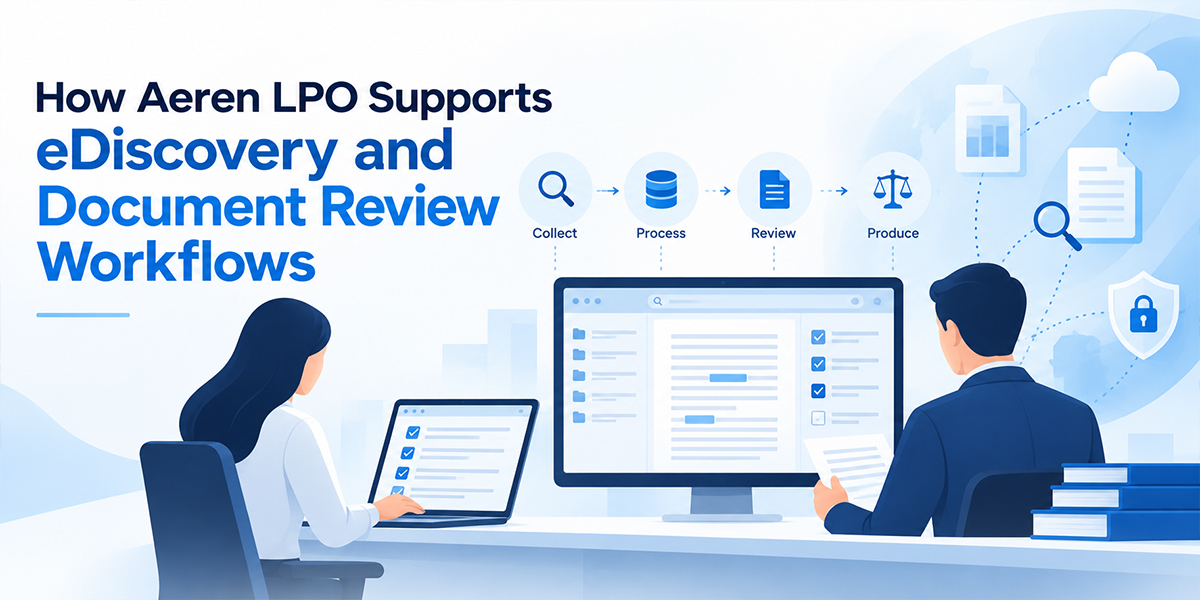
When a discovery project places pressure on a firm’s internal team, additional legal process support can help manage the workload without immediately expanding permanent headcount.
Aeren LPO provides eDiscovery and managed document review support for law firms and legal departments. Its role is to support legal workflows and review operations that complement a firm’s existing technology environment, rather than to act as an IaaS provider.
Depending on the matter and agreed scope, support may include document review, technology-assisted review workflows, quality checks, review coordination, and additional capacity for demanding projects.
For example, a firm may already have suitable cloud infrastructure and eDiscovery software but lack enough reviewers to work through a growing document population before a deadline. In that situation, additional review capacity may be more useful than changing the underlying technology.
The appropriate arrangement depends on document volumes, review instructions, confidentiality requirements, platform compatibility, and quality-control expectations. Clear responsibilities and reporting procedures should be established before work begins.
Law firms can explore Aeren LPO’s eDiscovery services and managed document review services. Firms that need additional review capacity can discuss their document volumes, deadlines, and workflow requirements with Aeren LPO.
Talk to Aeren LPO about your document volume, timeline, review workflow, and quality-control requirements.