



Document review rarely stays as predictable as it looks at the start of a matter.
A litigation team may begin with a defined set of custodians and a manageable review population. Then another collection arrives. New custodians are identified. The scope of an investigation expands. Privilege issues require closer attention. Yet the discovery deadline remains where it was.
Adding reviewers can increase capacity, but headcount alone does not create an effective review operation. Large-scale review also requires clear protocols, reviewer training, supervision, escalation procedures, quality control, and reliable visibility into progress.
Managed document review services bring these elements together within a coordinated review process. For law firms and legal teams handling demanding litigation, investigations, and regulatory matters, the model provides a way to expand review capacity while maintaining greater control over how the work is performed.
What Is Managed Document Review?
Managed document review is a structured approach to reviewing potentially relevant electronically stored information (ESI) and other documents during litigation, investigations, regulatory matters, and related legal proceedings.
Unlike a model focused primarily on supplying additional reviewers, managed review combines the review team with the processes needed to direct and supervise the work.
Depending on the scope of the engagement, managed document review may include reviewer selection, project management, review protocol development, reviewer training, first-level review, privilege review, quality control, issue escalation, progress reporting, and production support.
The purpose is not simply to put more reviewers on a matter. It is to establish a coordinated review operation in which reviewers work from the same instructions, questions are handled consistently, progress is monitored, and quality checks occur throughout the project.
That distinction becomes increasingly important as the number of reviewers, documents, custodians, and review issues grows.
When Do Law Firms Need Managed Document Review Support?
Not every matter requires a fully managed review team. There are, however, circumstances where managing review entirely with internal resources can place considerable pressure on litigation and eDiscovery teams.
Large Litigation Matters: Large litigation matters can involve substantial document populations across multiple custodians, data sources, issues, and time periods.
As review teams grow, coordination becomes more difficult. Reviewers need consistent instructions; assignments must be managed; questions need escalation paths; and review decisions must remain aligned across the team.
Legal document review services can provide additional review capacity, along with the operational structure required to manage it.
Regulatory Investigations: Regulatory matters can require legal teams to identify relevant information within substantial datasets while meeting demanding timelines and shifting priorities.
A structured review process helps establish clear coding protocols, escalation procedures, quality-control measures, and reporting throughout the engagement.
Internal Investigations: Internal investigations often involve sensitive information and rapidly developing facts.
Legal teams may need to quickly identify important communications or documents while maintaining confidentiality and ensuring consistent treatment of key issues.
A managed approach allows reviewers, project managers, and supervising counsel to work within a defined process as the investigation develops.
Tight Discovery Deadlines: Discovery deadlines do not necessarily change when the review population exceeds expectations.
Where the available review time is compressed, simply adding reviewers can create another management challenge. New team members must be trained, work needs to be allocated, and coding decisions must remain consistent.
Managed review provides a framework for expanding capacity without leaving the legal team to coordinate every operational detail.
Sudden Increases in Document Volume: The review population established at the beginning of a matter is not always the population that ultimately needs to be reviewed.
Additional custodians may be identified. New data sources may become relevant. Supplemental collections or productions may arrive.
A managed review structure can help legal teams adjust capacity and workflow as those requirements change.
Multilingual and Cross-Border Matters: Cross-border matters may involve documents in several languages, reviewers in different locations, and additional confidentiality or jurisdictional considerations.
These matters require more than finding reviewers with appropriate language skills. Review protocols, training, escalation, and quality-control processes also need to remain consistent across the wider team.
How the Managed Document Review Process Works
The precise workflow depends on the matter, technology, data population, review objectives, and counsel’s instructions. However, a well-managed eDiscovery document review generally moves through several connected stages.
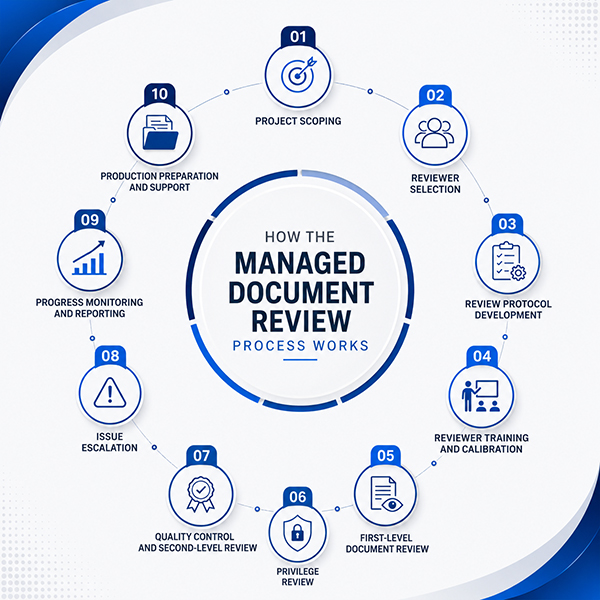
1. Project Scoping
Before review begins, the legal team and review provider establish the scope of the engagement.
This can include the expected document population, deadlines, relevant issues, privilege considerations, staffing requirements, technology environment, reporting expectations, and anticipated review stages.
Good scoping creates the operational foundation for the project while recognizing that requirements may change as the matter develops.
2. Reviewer Selection
Reviewers are selected according to the needs of the matter.
Relevant considerations may include legal experience, previous document review work, subject-matter familiarity, language requirements, platform experience, and availability.
For complex projects, different stages of the review may require different levels of reviewer experience.
3. Review Protocol Development
The review protocol translates counsel’s legal and factual requirements into practical instructions for reviewers.
It may address responsiveness, relevant issues, confidentiality, privilege, coding decisions, escalation procedures, and treatment of particular document categories.
A clear protocol helps reduce inconsistent interpretations once review begins.
4. Reviewer Training and Calibration
Reviewers need to understand more than the coding interface. They need context around the matter and the decisions they are expected to make.
Initial training typically covers the review protocol, key issues, coding requirements, examples, and escalation procedures.
Calibration can then be used to identify areas where reviewers are interpreting instructions differently. Those differences can be addressed before they affect a larger portion of the review population.
5. First-Level Document Review
During first-level document review, reviewers assess documents according to the agreed protocol.
Depending on the matter, this may involve decisions relating to responsiveness, relevance, issues, confidentiality, privilege indicators, or other coding requirements.
Project managers monitor progress and reviewer questions while ensuring that work continues to follow the agreed process.
6. Privilege Review
Where required, documents identified as potentially privileged may undergo additional review.
Privilege determinations can be particularly sensitive, so questions and borderline documents should follow defined escalation procedures rather than being resolved inconsistently across the review team.
7. Quality Control and Second-Level Review
Quality control should not begin only after the first-level review is complete.
Sampling, targeted checks, reviewer-specific analysis, and second-level document review can be used during the project to identify inconsistent coding or areas where the protocol requires clarification.
Findings can then be communicated back to reviewers, creating a feedback loop that improves consistency as the review continues.
8. Issue Escalation
Reviewers will encounter documents that do not fit neatly within the written protocol.
A defined escalation process allows those questions to reach project managers or supervising counsel without every reviewer developing an independent interpretation.
Significant decisions can then be communicated across the team where appropriate.
9. Progress Monitoring and Reporting
Review management also requires visibility.
Reporting can help legal teams understand how much of the population has been reviewed, how work is progressing against deadlines, where bottlenecks are emerging, and whether review priorities need to change.
10. Production Preparation and Support
Following review and quality control, responsive documents may require further checks and preparation before production.
The exact responsibilities at this stage depend on the scope agreed between the law firm, client, review provider, and other eDiscovery participants.
Managed Review vs. Reviewer Staffing: What Is the Difference?
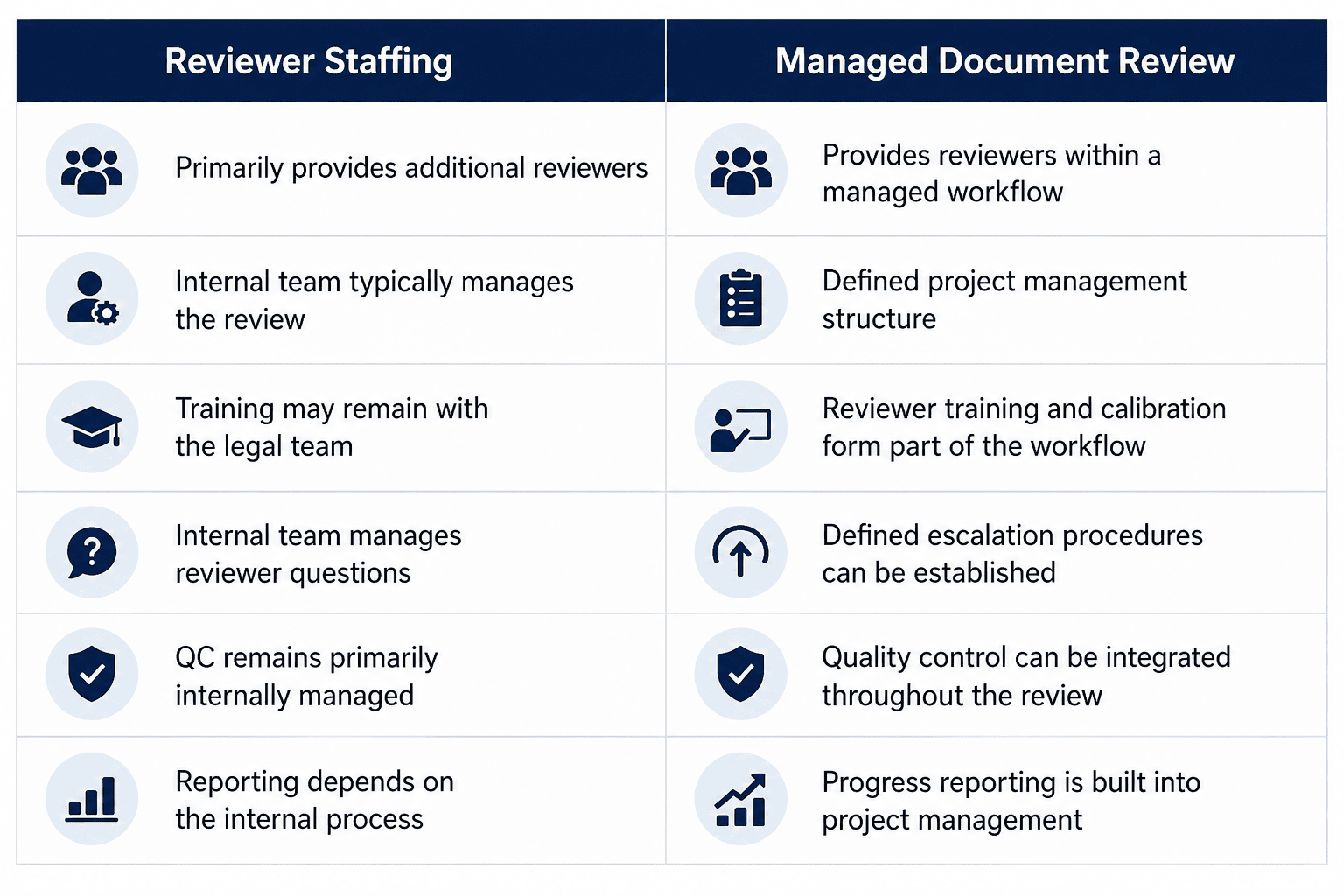
The difference is primarily one of operational responsibility.
Reviewer staffing gives a legal team access to additional people. The law firm or corporate legal team may continue to manage reviewer training, workflow allocation, supervision, questions, quality control, and reporting internally.
Managed review services combine reviewer capacity with a structured approach to managing the review itself.
Neither approach is inherently appropriate for every matter.
If a law firm already has the internal resources and infrastructure to manage a review, additional reviewer staffing may be sufficient.
If the challenge involves both capacity and the operational burden of coordinating the review, a managed model may be more appropriate.
How Managed Document Review Improves Review Speed
Review speed is not simply a matter of putting more people on a project.
Adding reviewers without sufficient coordination can create new problems. More reviewers mean more people to train, more coding decisions to monitor, more questions to resolve, and greater potential for inconsistency.
Managed review addresses throughput at the workflow level.
Clear coding protocols reduce avoidable uncertainty. Training and calibration help reviewers reach a shared understanding of the instructions. Defined escalation paths allow questions to be resolved without unnecessarily stopping work.
Project managers can also monitor progress against the review schedule, identify bottlenecks, adjust assignments, and flag issues before they materially affect the timeline.
For high-volume litigation document review, this coordination can be as important as the number of reviewers assigned to the matter.
The goal is not simply faster individual review. It is a review operation that continues moving efficiently as a whole.
How Quality and Consistency Are Maintained
Accuracy in document review depends heavily on consistency.
Two reviewers applying the same protocol should, as far as reasonably possible, interpret similar documents in a similar way. Achieving that requires more than a final quality check.
Effective document review quality control begins with the protocol itself.
Reviewers need clear coding guidance and examples. Initial calibration can expose differences in interpretation. Questions should follow an established escalation route so that important decisions can be resolved and communicated across the team.
Quality-control measures may then include targeted sampling, second-level review, checks focused on particular issues or reviewers, and analysis of coding patterns.
Where problems are identified, the response should not be limited to correcting individual documents. The underlying question should also be addressed with the review team where appropriate.
This creates an ongoing cycle:
review → check → identify inconsistencies → clarify → correct → monitor
Building QC into the review workflow allows issues to be identified while the project is still underway rather than discovering them near production.
How Managed Review Supports Changing Document Volumes
Scalability is one reason legal teams consider document review outsourcing , but effective scaling involves more than adding seats to a review platform.
Imagine a matter begins with ten custodians. During discovery, several additional custodians are identified, and new collections materially increase the review population.
More reviewers may be needed, but those reviewers must still be onboarded, trained on the protocol, calibrated, assigned appropriate work, supervised, and incorporated into existing communication and QC processes.
A managed structure makes those operational steps part of the scaling process.
The same principle applies in reverse.
As review volumes decline or particular workstreams are completed, capacity can be adjusted to reflect the remaining requirements.
For law firms, this creates a more flexible model for matters where document populations, priorities, and deadlines are difficult to predict at the outset.
How to Choose a Managed Document Review Provider
The number of reviewers a provider can supply is only one consideration. Legal teams should also understand how those reviewers will be managed once work begins.
Several questions can help evaluate the provider’s operating model.
Reviewer screening and training: How are reviewers selected? How will they be trained and calibrated before and during the project?
Quality-control methodology: What QC procedures are used? How are inconsistencies identified, escalated, corrected, and monitored?
Data-security practices: What controls are in place for accessing and handling confidential or sensitive information?
Reporting capabilities: What information will the legal team receive about review progress, productivity, issues, and potential risks to the timeline?
Technology-platform experience: Can the review team work effectively within the eDiscovery or review platform selected for the matter?
Ability to scale: How does the provider bring additional reviewers into an active project while maintaining training, supervision, and coding consistency?
Communication structure: Who will manage the engagement? How will reviewer questions reach supervising counsel? How are protocol changes communicated?
These questions help shift the evaluation from “How many reviewers are available?” to the more important question: “How will the review actually be managed?”
Why Legal Teams Work With Aeren LPO for Managed Document Review
Aeren LPO supports law firms and legal teams that need additional document-review capacity without sacrificing workflow, supervision, or quality.
Depending on the requirements of the engagement, support can be part of different stages of the review process, including first-level review, quality control, and second-level review activities, as well as broader litigation and eDiscovery workflows.
The emphasis is on fitting review support around the requirements of the matter rather than treating every project as a fixed staffing exercise.
For legal teams facing changing document populations or demanding review schedules, that means discussing the practical requirements upfront: scope, workflow, reviewer requirements, timeline, reporting expectations, escalation procedures, and quality-control needs.
More Review Capacity Should Not Mean Less Control
The question facing a law firm is rarely just how many documents need to be reviewed.
The harder questions are how the review will be organized, how reviewers will apply instructions consistently, how quality will be monitored, how progress will remain visible, and what happens when the scope changes.
That is the value of a managed model.
Managed document review services combine additional review capacity with the processes required to coordinate it—helping legal teams respond to changing matter requirements while retaining visibility into workflow and quality.
Need additional capacity for an upcoming document review?
Talk to Aeren LPO about your document volume, timeline, review workflow, and quality-control requirements.