


There is a version of this conversation that happens at least once in almost every patent dispute. A litigator pulls up the prosecution history, reads through the office action responses, and finds something they wish was not there. An argument that gave up more than it needed to. A claim amendment that narrowed things a bit too far. A statement to the examiner that the opposing counsel is now reading out loud in a brief.
This is not a rare occurrence. It is one of the more common ways that patent litigation vs prosecution play out against each other in practice. And it is the clearest illustration of why treating them as completely separate functions is a mistake.
This guide covers both in proper depth. Not textbook definitions but the actual mechanics, the real strategic considerations, and the things that matter when money and rights are on the line. The audience here is people who work in or around IP, so we are not starting from zero.
Patent prosecution is the process of getting a patent granted. That sounds straightforward but the work involved is anything but.
It starts before the application is even filed. A good patentability search tells you what prior art is out there, which shapes how the invention gets claimed. Then comes the application itself, and the part that actually matters is the claims. The specification describes the invention. The claims define what you own. Getting claim language right is genuinely hard. You want broad enough to be worth something, specific enough to get past the examiner, and worded in a way that does not accidentally limit your enforcement options later.
Once the application lands at the USPTO (or EPO, UKIPO, JPO, wherever you have filed), a patent examiner reviews it. They almost always come back with at least one office action, which is basically a formal list of objections. Prior art rejections, obviousness arguments, formality issues. Sometimes all three. The applicant responds, either by arguing the examiner is wrong, amending the claims, or some combination. This goes back and forth, sometimes for years.
What separates good prosecution from mediocre prosecution is not just getting the patent granted. It is how you get there. Every amendment, every argument, every statement made to the examiner becomes part of the prosecution history. That record does not disappear when the patent grants. It follows the patent, and it is one of the first things a litigator reads when the patent gets asserted years later.
Beyond the initial application, prosecution also covers continuation applications (filing additional applications off the same original disclosure to capture different claim scopes as a product evolves), divisional applications when the office decides you have tried to claim more than one invention, and responses to validity challenges like inter partes review (IPR) at the Patent Trial and Appeal Board. All of it falls under prosecution. None of it is passive work.
One more thing worth knowing: to prosecute patents before the USPTO, you need to be a registered patent practitioner. That means passing the patent bar exam and holding a qualifying technical degree, usually in engineering or science. This is not the same requirement as being a licensed attorney, and it matters when you are building or evaluating an IP team.
Patent litigation is what happens when the dispute stops being theoretical. Someone filed a lawsuit, or is about to. A cease-and-desist landed. An IPR petition showed up. Now you are in adversarial territory.
The most common context is a patent infringement case in US federal court, and if you have been through one, you know how expensive and slow they are. Cases regularly take three to five years. Costs per side in a case going to trial can run well into seven figures. The procedural complexity is real, and the technical subject matter makes everything harder.
The major stages of patent litigation in district court run roughly like this: pleadings, where infringement is alleged and defenses get raised. Then claim construction, which is often where cases are actually won or lost. The court holds a Markman hearing to determine what the patent claims mean. That construction then governs the rest of the case. After that comes discovery, which in a major patent case involves massive e-discovery exercises, expert depositions, and technical deep dives. Then expert discovery, summary judgment, and potentially trial.
On the defense side, the main levers are: challenging infringement directly (the accused product does not actually read on the claims), attacking the validity of the patent (it should never have been granted because of prior art, obviousness, or other grounds), and in some cases attacking enforceability based on conduct during prosecution. Each track requires its own analytical work, its own experts, and its own litigation strategy.
Since the America Invents Act in 2012, IPR at PTAB has become a parallel battlefield. Companies being sued for infringement routinely file IPR petitions to challenge the asserted patent’s validity before a panel of administrative patent judges. It is faster and cheaper than district court litigation, and the invalidation rates have historically been significant. Many patent disputes now play out on both fronts simultaneously.
Damages are worth understanding too. When infringement is found, the patent owner can recover a reasonable royalty, lost profits if they can establish them, or in cases of willful infringement, up to treble damages. In high-stakes cases, the damages numbers are why companies fight these cases so hard. A few hundred million dollars changes the calculus on settlement.
| Patent Litigation | Patent Prosecution | |
|---|---|---|
| What it is | The process of resolving a patent dispute in court or at PTAB / ITC | The process of obtaining a patent grant from a patent office |
| When it happens | After a patent exists and a dispute arises: infringement, invalidity challenge, licensing breakdown | Before the patent is granted (and sometimes post-grant via continuations, IPR responses) |
| Where it happens | US federal district courts, PTAB, International Trade Commission (ITC) | USPTO, EPO, UKIPO, JPO and other national patent offices |
| Who handles it | Patent litigators (no patent bar required, but technical depth and registered co-counsel often essential) | Registered patent agent or attorney (must pass the USPTO patent bar + hold a STEM degree) |
| Primary goal | Win the dispute: prove infringement, invalidate a patent, or reach a favorable settlement | Get the broadest, most defensible claims granted |
| Core work involved | Claim construction, prior art / invalidity analysis, claim charting, e-discovery, expert coordination, IPR petitions | Patentability searches, application drafting, claim writing, office action responses, continuation strategy |
| Key document | The prosecution history (file wrapper) and asserted claims | The patent application and claims |
| Pace | Deadline-driven and intense. District court cases often run 3-5 years but with hard court-imposed milestones | Deliberate and slow. USPTO examination averages 2-3 years |
| Mindset required | Adversarial, strategic, fast-moving. You are arguing a position under pressure with someone pushing back | Precise, technical, forward-looking. You are building something meant to last |
| What it produces | A resolution: judgment, injunction, damages award, or settlement | A granted patent: a legal property right |
| How they connect | Litigators rely on the prosecution history to interpret claim scope, build invalidity arguments, and anticipate the other side | Every argument and amendment made during prosecution becomes part of the prosecution history litigators will later scrutinize |
| Common risk if done poorly | Missing prior art, poor claim charts, misreading prosecution history. All of it can sink an otherwise strong legal position | Overly narrow claims, prosecution history estoppel problems, patents that are easy to design around or invalidate |
This is the part most guides skip, which is a mistake because it is where the real strategic value lives.
The doctrine of prosecution history estoppel creates a direct legal link between the two phases. If you narrowed a claim during prosecution to get past a prior art rejection, you generally cannot argue in litigation that the claim covers what you gave up. That narrowing sticks. Arguments made to the examiner become positions you are held to in court. This is not a rare edge case. It comes up in patent litigation constantly.
What this means for prosecutors: how you argue matters, not just what you argue. Giving up more than you need to in order to get a claim allowed can create problems that are genuinely hard to fix later. A well-written office action response limits the concessions, argues on the strongest grounds available, and does not create unnecessary admissions. This takes more work and sharper thinking. It is also worth significantly more to the patent owner in the long run.
What this means for litigators: the file wrapper is one of the first things you need to understand cold. The prosecution history tells you where the claim scope might be vulnerable, what arguments the patent owner made that you can use against them, and sometimes reveals whether you have a reissue or reexamination option if the prosecution has significant weaknesses. Litigators who do not understand prosecution history deeply tend to miss things that matter.
The companies that handle IP well run regular patent portfolio reviews that treat enforceability as a serious metric, not just granted status. They think about litigation scenarios when drafting applications. They make sure the prosecution and litigation sides of their IP work are actually talking to each other, not operating as separate silos. That integration is genuinely rare, and it produces better outcomes.
The prosecutor vs litigator distinction is about more than specialization. These are genuinely different professional profiles built around different kinds of thinking.
A patent prosecutor lives in a world of technical documents, claim language, and examiner correspondence. The work is deliberate and precise. Most have engineering or science backgrounds and understand the technology at a real level, not just conceptually. The best ones think about claim scope the way a chess player thinks about the board: multiple moves ahead, anticipating how a claim might be challenged or designed around or interpreted in a future dispute.
A patent litigator operates in an environment where someone is actively trying to beat them. Hard deadlines. Adversarial discovery. Judges who need complex technology explained simply. The skills that matter here are fast legal analysis, strategic thinking under pressure, strong written advocacy, and the ability to build a coherent narrative out of highly technical facts. Many patent litigators develop specific technology focuses over time because the learning curve on new technology in the middle of a case is steep.
In practice, large firms separate these into distinct groups that collaborate when needed. Smaller boutiques often have attorneys who do both, especially at lower complexity levels. But the deeper the litigation, the more you need people who do it all day. Running a serious IPR proceeding or a multi-district infringement case while also maintaining a full prosecution docket is genuinely difficult.
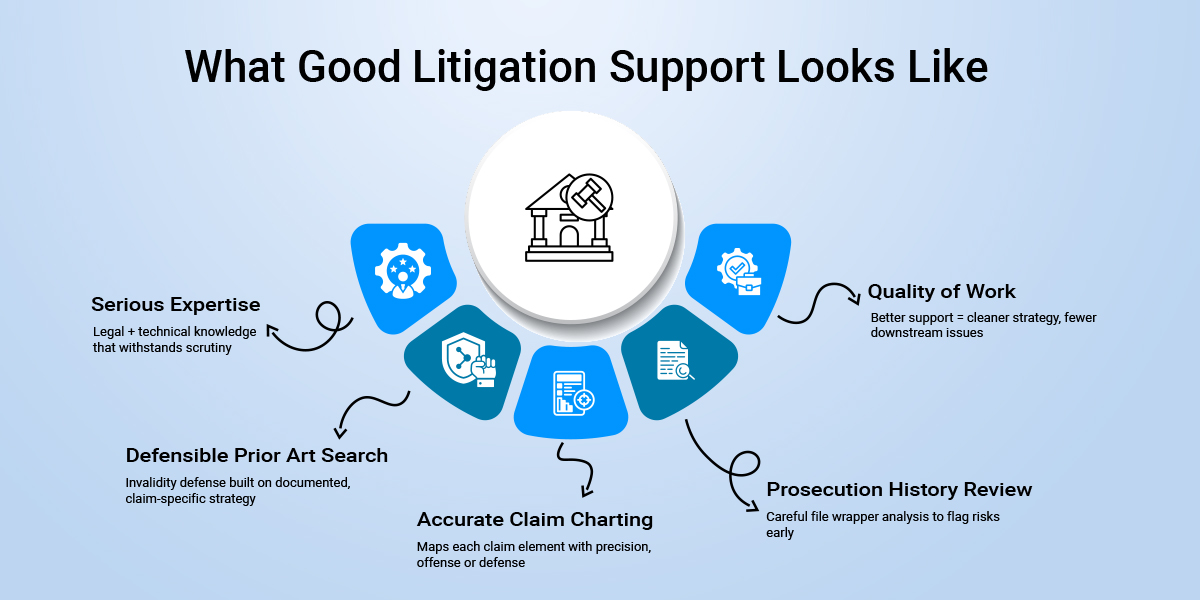
Given how expensive patent litigation is, the demand for serious analytical support has grown substantially. The work is not simple. It requires people who understand both the legal context and the technical subject matter, and who can produce work product that stands up to scrutiny.
Prior art searching for litigation is a different exercise than patentability searching. In litigation you are building an invalidity defense, which means the search needs to find art that specifically addresses the claim limitations being asserted. The search strategy has to be documented and defensible because it may end up in front of a judge or a PTAB panel. Cutting corners here creates problems downstream.
Claim charting is core to both offense and defense. An infringement claim chart maps each element of the asserted claims against the accused product or process. An invalidity chart maps each element against a prior art reference. Both require genuine technical understanding and careful attention to claim language. A chart that misreads a claim limitation or mischaracterizes a prior art reference is worse than useless because it can mislead counsel into a bad position.
Prosecution history review is preparation work that serious litigation teams do early. The file wrapper can run to hundreds of pages. Having someone go through it carefully, identify the key prosecution events, flag the risky statements or amendments, and summarize it accurately is genuinely valuable. It is also technical enough that not everyone can do it well.
The quality of patent litigation services directly affects the quality of the legal strategy being built on top of them. Good support is not just faster work, it is better work that catches issues early and gives counsel a cleaner picture of where they actually stand.
Startups filing patents right now are in the prosecution phase and should be thinking about it seriously. The claims you get granted today are what you will either enforce or try to enforce later. Whether you are doing that to protect market position, raise a round, or eventually license the technology, the quality of the prosecution work matters more than most founders realize until it is too late to fix.
The questions worth asking during prosecution, even if litigation feels distant: are these claims broad enough to cover what a well-resourced competitor would actually build? Does the specification support those claims clearly enough that an expert could explain them in court? Are you making arguments to the examiner that you might regret in five years? None of these questions add much to the prosecution cost. All of them matter if the patent ever gets asserted.
Law firms managing active patent portfolios for clients face a different version of the problem. The operational challenge is maintaining quality across both prosecution and litigation functions while managing associate bandwidth and client cost expectations. That is where structured support, whether internal or through a trusted external partner, makes a real difference. Not as a cost-cutting measure but as a capacity and quality strategy.
Aeren LPO provides research and drafting support for patent litigation teams at law firms and IP departments across the US, UK, and Europe. The work covers prior art searches, invalidity analysis, claim charting, prosecution history review and summarization, and technical drafting support for IPR and district court matters. The team has technical backgrounds across software, electronics, mechanical engineering, and life sciences.
If your litigation practice needs reliable support on the research and drafting side, reach out.

We use cookies and similar technologies for analytics and personalization. You can accept, reject, or customize your cookie settings at any time.