


A new litigation matter rarely arrives with clear answers. Instead, it brings thousands of emails, collaboration messages, cloud files, and a growing list of questions. Which data matters? How much will review cost? Is the case strong enough to litigate, or should settlement be considered early? Before legal teams can answer any of these questions, they first need a clear understanding of the evidence.
This is strong because it focuses on the reader’s pain points. It naturally leads into Early Case Assessment, and it avoids sounding like a fictional scenario.
What’s changed in the last few years is what’s technically possible during that window. Work that once ate up two or three weeks of paralegal and associate time can now happen in days — sometimes less. That shift matters because it changes when a legal team can make an informed decision, not just how they eventually make one.
What Is Early Case Assessment (ECA)?
What is early case assessment in eDiscovery, exactly? Put simply, it’s how legal teams get an early handle on a matter’s facts, evidence, cost, and risk before diving into full document review. Think of it as triage — someone needs a rough map of what’s actually in the data before committing to reading all of it. Specifically, ECA is meant to answer:
- What does the available evidence actually show?
- How large and complicated is the underlying data set?
- What will it realistically cost to carry this matter through review and production?
- Does it make more sense to litigate, negotiate, or settle?
- Where is the exposure—privileged material, sensitive data, damaging communications?
In practice, ECA sits at the front of the eDiscovery lifecycle, right after data preservation and collection but before formal review and production. It shapes litigation strategy before that conversation formally starts — informing what outside counsel proposes and whether the matter proceeds to full review at all. Get ECA right, and both sides work from the same evidence-based starting point instead of competing assumptions. Get it wrong, and a team can spend six figures on review before realizing the case should have settled in month one.
Why Traditional Early Case Assessment Is No Longer Enough
Twenty years ago, eDiscovery Early Case Assessment mostly meant digging through email archives and shared drives. That world is gone.
One employee alone can leave a trail of discoverable data spread across email, Teams chats, Slack channels, SharePoint folders, a personal cloud drive, and a work phone. Teams and Slack conversations behave nothing like email — they’re fragmented across channels, written in shorthand, and often meaningless without the surrounding thread. A message that says “yeah, go ahead” tells you nothing without the messages before and after it. Mobile data adds its own headache, with texts and app-based chats living outside the systems legal teams are used to collecting from.
Volume compounds all of it. A mid-sized dispute involving a few hundred thousand documents isn’t unusual once you count attachments, duplicate copies, and calendar invites that technically qualify as electronically stored information (ESI). Reviewing that by hand takes time and money the case timeline rarely has, and courts don’t extend deadlines just because the data set turned out unwieldy.
Keyword search, the backbone of traditional ECA, wasn’t built for this. Search a common term, and you drown in false positives; search too narrowly, and you miss documents discussing the same issue in different words — “layoff” versus “restructuring”. Teams relying solely on keywords often review far more than necessary while still missing material a smarter system would catch. That gap is what AI-powered Early Case Assessment was built to close and why the practice looks so different today than it did five years ago.
How AI Is Transforming Early Case Assessment
The value AI brings to early case assessment boils down to speed, not judgment. It doesn’t replace legal thinking — it shortens the gap between opening a new matter and having a working sense of what’s actually in it.
AI-Powered Data Culling: Before substantive review starts, AI scans the data set and strips out material with no bearing on the matter — system notifications, spam, personal content, files unrelated to the custodians or issues at hand. On a large matter, this alone can cut the review population dramatically before formal review begins.
Intelligent Document Classification: Once the noise is gone, AI tags and sorts what’s left by topic, custodian, document type, and predicted relevance. Metadata that would take a paralegal hours to compile by hand gets organised automatically, so reviewers spend limited hours on what could actually move the case.
Email Threading: One exchange can spawn a dozen near-identical copies as it’s forwarded and CC’d across a list. Threading technology consolidates related messages into a single readable conversation, so a reviewer reads it once instead of piecing it together from fragments.
Predictive Coding: Predictive coding, or technology-assisted review (TAR), is one of the most established forms of AI document review in eDiscovery — supervised machine learning applied directly to relevance calls. A senior attorney marks a sample set as relevant or not relevant, and the system extends that pattern across the remaining population, ranking documents by predicted relevance. Its output typically goes through several validation rounds before anyone relies on it for production decisions.
Generative AI Summaries: Generative AI can produce plain-language summaries of long documents or an entire custodian’s collection — a fast way to get oriented. But generative models can sound confident while quietly missing something in dense or ambiguous material, so any AI-generated summary feeding into strategy needs a human checking it against the source documents first.
Risk Identification: AI can also be trained to flag likely privileged communications, regulatory exposure, personally identifiable information, or language that reads like a “hot document.” This doesn’t replace a lawyer’s privilege review — it makes sure the highest-risk material gets human eyes early, instead of surfacing for the first time during production.
Benefits of AI-Powered Early Case Assessment
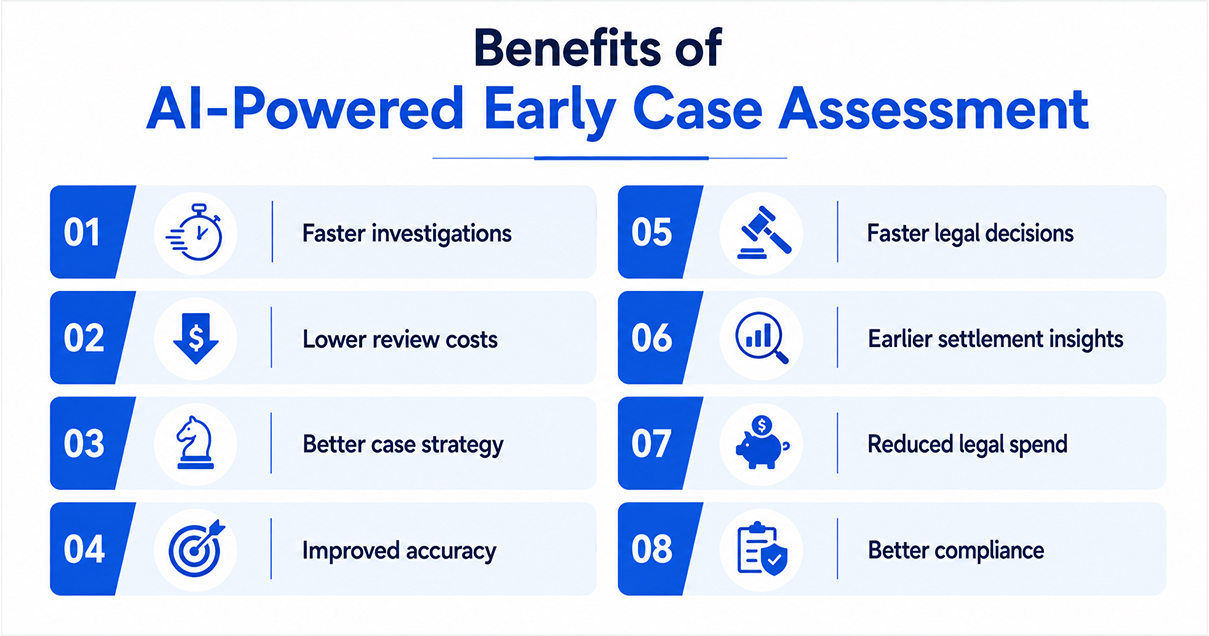
- Faster investigations: Legal teams can form an initial read on a matter in days rather than weeks.
- Lower review costs: Culling and near-duplicate detection reduce billable review hours directly.
- Better case strategy: Understanding the evidence early sharpens litigation risk assessment and lets counsel decide whether to fight, negotiate, or settle.
- Improved accuracy: Validated predictive coding models don’t lose consistency the way tired reviewers do at hour ten.
- Faster legal decisions: A clearer early picture means budget conversations happen with real evidence behind them.
- Earlier settlement insights: Knowing where the exposure sits gives leverage to resolve a matter before both sides spend heavily on discovery.
- Reduced legal spend: Efficiency gained during ECA compounds through every later stage.
- Better compliance: Faster identification of regulatory exposure gives more runway to respond.
AI-Powered Early Case Assessment Workflow
- Data preservation – Legal holds go out, and relevant sources are identified and locked down.
- Collection – Data is gathered from every relevant source using forensically sound methods.
- Processing – Collected data is normalized, deduplicated, and indexed.
- AI analysis – Culling, classification, threading, near-duplicate detection, and risk flagging run across the data set.
- Risk assessment – Legal teams review AI-flagged material, with a human making the final call on every flag.
- Review prioritization – The remaining population is ranked so reviewers work through the highest-value documents first.
- Litigation strategy – Everything gathered informs decisions on budget, scope, and case direction.
Each step depends on the one before it — rushed collection produces a shaky foundation for AI analysis, and analysis built on a shaky foundation shouldn’t drive a strategy call.
Key Challenges Organizations Face
Data privacy is a real concern in matters involving personal data or information subject to regulations like GDPR, so AI tools need to operate inside a framework that respects data minimization and tight access controls.
AI hallucinations — confident-sounding but inaccurate output — remain a documented limitation of current models, which is why generative summaries need human verification rather than blind trust.
Privilege review stays a hard problem for AI alone. Privilege depends on the relationship between parties and the purpose of a communication, not just keywords like “attorney.” AI can flag likely-privileged material efficiently, but the final call still belongs to qualified counsel.
Regulatory compliance shifts by jurisdiction and industry, and general-purpose AI tools won’t automatically account for sector-specific rules. Human validation has to stay part of the process throughout — AI output is a starting point for legal judgment, not a replacement for it.
Cross-border data raises its own legal complexity when AI processing happens in a different jurisdiction than the data originated in, and AI governance — documented policies on how tools get validated and defended if challenged — is becoming table stakes as courts scrutinize AI-assisted methodologies more closely.
Best Practices for Successful Early Case Assessment
These Early Case Assessment best practices separate teams that keep review costs under control from teams that don’t:
- Define litigation objectives. Know what questions ECA needs to answer instead of running a one-size-fits-all process.
- Preserve data early. Err toward over-preservation; narrowing scope later is easier than recovering data nobody held onto.
- Combine AI with legal expertise. Pair AI’s speed with reviewers who understand the matter’s nuances.
- Validate AI outputs. Spot-check rankings, summaries, and risk flags against real source documents.
- Establish defensible workflows. Record how AI tools were used and who signed off on decisions.
- Choose scalable Early Case Assessment software. Performance should hold at 500,000 documents, not just in a 10,000-document pilot.
- Monitor review quality. Sampling and validation should run throughout review, not just as a final audit.
Why Law Firms and Corporate Legal Teams Are Investing in AI-Powered ECA
The logic isn’t complicated. Legal departments face constant pressure to control outside counsel spending, and document review is consistently among the largest cost centers in litigation. As AI legal technology matures, early case assessment in legal matters is shifting from a nice-to-have into a standard part of scoping any matter. Any tool that shrinks review volume pays for itself quickly — translating into reduced legal costs and faster investigations. Firms weighing how to modernize their own eDiscovery workflows can find a closer look at what that shift involves in Aeren LPO’s guide to AI in eDiscovery for law firms
There’s a competitive angle too. Teams that deliver a risk assessment in days instead of weeks are better positioned to advise clients quickly and negotiate from actual knowledge rather than guesswork — better risk visibility that shows up directly in client service. Nobody enjoys learning six months into litigation that the fact pattern was weaker than assumed.
None of this replaces skilled legal professionals. It shifts where their time goes — away from sorting duplicate emails and toward the analysis that actually requires legal training.
How Aeren LPO Supports AI-Powered Early Case Assessment
Running AI-assisted ECA well takes more than licensing the right software — it takes trained reviewers, quality-assurance protocols, and a workflow built to hold up under scrutiny. That’s where a dedicated eDiscovery and legal process outsourcing partner earns its place.
Aeren LPO supports legal teams across the eDiscovery lifecycle — from eDiscovery support and litigation support through AI-assisted workflows and managed document review. Its experienced legal professionals work alongside AI tools rather than around them: validating predictive coding output, reviewing flagged privilege concerns, and applying the judgment no algorithm can fully replace.
With scalable review teams, global legal expertise, and the cost advantages of offshore delivery, Aeren LPO helps legal teams move through ECA with faster turnaround, while quality assurance stays built into every stage rather than bolted on at the end.
Conclusion
Early Case Assessment has always mattered, but the stakes have changed. Data volumes that would have seemed unmanageable a decade ago are now routine, and legal teams still relying on manual, keyword-driven ECA are working at a genuine disadvantage — slower, more expensive, and more prone to missing what’s buried in the noise.
AI doesn’t remove the need for legal expertise. It compresses the distance between “we have a new matter” and “we understand what we’re dealing with”, giving legal teams a real head start on strategy, budget, and risk management. Paired with experienced reviewers and a defensible workflow, AI-powered ECA gives legal teams a faster, more accurate starting point for every matter that comes through the door.
Ready to see how AI-assisted early case assessment could work for your next matter? Connect with Aeren LPO’s eDiscovery team to talk through your data, timeline, and litigation goals.