



Big law firms spent years as the ones doing the disrupting. Now the tables have turned. A wave of small, fast, tech-first shops has walked into the market, and they are pulling work that once belonged only to the big names. These are the AI-native law firms, and they were built around software from the very first day, not bolted on years later.
So here is the honest question. What can a large firm actually take from all this? Not the buzz. The real, usable stuff.
That is what this piece is about. We will look at how AI for law firms is reshaping the money side of legal work, where the old model starts to crack, and what senior partners can borrow without breaking what already works. This is written for people who already know the industry, so we will skip the basics and get to the parts that matter.
The short version is this. AI-native law firms are not winning because they hold some secret. They win because they threw out a handful of assumptions that Big Law firms still treat as sacred. Let us unpack that, one piece at a time.
What Is an AI-Native Law Firm?
A law firm with an AI-first approach places technology at its very heart, not on its margins. These technological solutions are not purchased in order to make them fit in with existing processes; rather, they influence how the firm hires people and charges for its services.
This distinction is quite significant. In a typical firm, the tool would be acquired, and then employees would be expected to integrate it into their processes. However, in an AI-first firm, the process works the other way round: the process is designed first, taking into account the capabilities of the software, and then the human element is introduced to fill in the gaps.
This shows up in legal AI systems that draft first versions of contracts, sort through thousands of documents in minutes, and flag risk before a human even opens the file. The lawyer still leads every matter. But a lot of the heavy lifting is done before they start.
The staffing looks different too. Fewer junior associates spending long nights on review. More people who mix legal training with a real comfort for data and tools. That blend is a big part of the AI in legal industry shift we are seeing across the US, the UK, and wider Europe right now.
And the pricing follows the workflow. When a task takes one hour instead of ten, the billable hour stops making much sense. So many of these firms charge flat fees or monthly retainers instead. Clients tend to love it, because they know the cost up front and there are no ugly surprises at the end of the month.
This is not a thought experiment. Real firms are already running this way. In the US, Crosby reviews contracts like NDAs and MSAs in under an hour, with lawyers checking the work and a flat per-document price in place of the billable hour. In the UK, Garfield Law became the first fully AI-native firm cleared by the Solicitors Regulation Authority, and it handles small claims and debt recovery online. Paralex, also in the US, takes a similar route for small businesses, pairing AI with an attorney in the loop to cut the cost of routine legal help. Different markets, same core idea.
One more thing sets them apart. These firms measure everything. They track how long tasks take, where errors creep in, and which tools earn their keep. That habit of measuring is quiet, but it is a huge edge.
It is worth being clear on what these firms are not. They are not chatbots pretending to give legal advice. They are not trying to replace lawyers. The best AI-native law firms use real lawyers, often very senior ones, and simply give them better tools to work with. The people at the top of these firms tend to come from the same top schools and the same big firms as everyone else. They just chose to build a different kind of shop. That point matters, because it kills the lazy idea that this is only a story about cheap tech and junior staff. It is a story about smarter design.
Challenges Facing Traditional Big Law Firms
Let us be fair to Big Law firms here. They are not slow because the people are dull. They are slow because the model itself rewards the old ways.
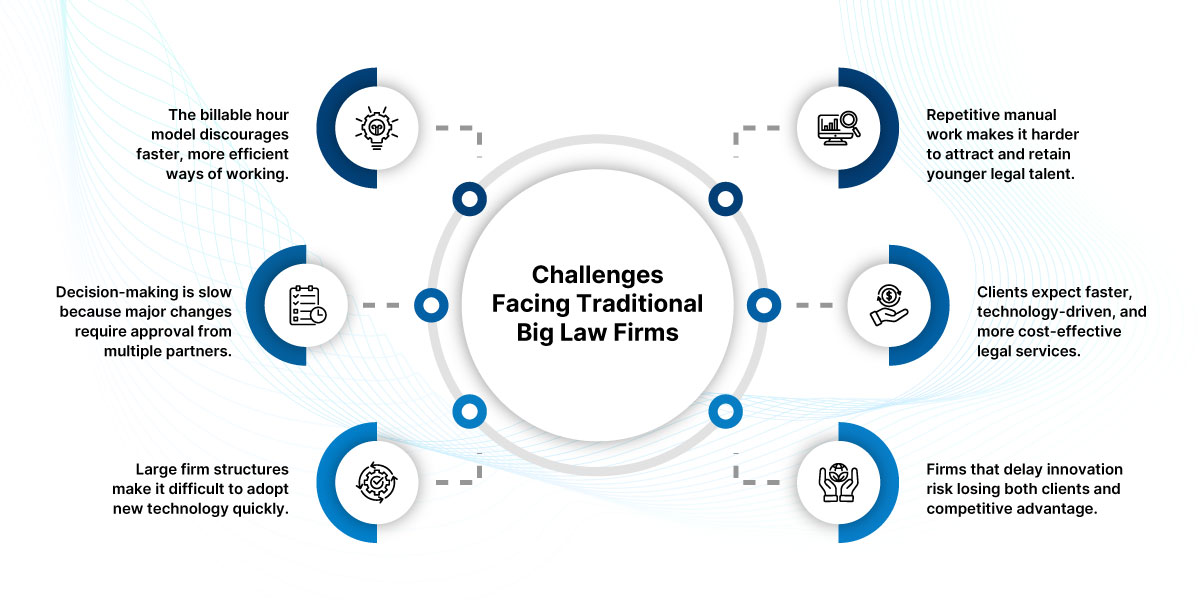
Start with the billable hour. It ties revenue to time spent. So there is a quiet reason not to make work faster. Cut the hours and you cut the income. That tension sits right at the heart of most large firms, and it makes real law firm innovation hard to push through. Nobody wants to be the partner who shrinks the bill.
Then there is the partnership setup. Big decisions need buy-in from many partners, each with their own book of business and their own worries. New legal technology often means a short-term cost and a lot of change now, while the payoff shows up much later. That is a tough sell in a room full of people focused on this year’s profit share.
Scale is another trap. A firm with two thousand lawyers cannot turn on a dime. Training, systems, and old habits all drag on the pace. What a fifty-person shop rolls out in a single month can take a giant firm two full years.
There is also the talent side, and it is bigger than most partners admit. Younger lawyers want to do sharper, more interesting work. They did not go to law school to spend nights on document review a machine could handle in seconds. When firms cling to those old tasks, they lose good people to places that offer better days.
Client expectations add to the squeeze. General counsel at large companies are under their own pressure to cut legal spend. They read the same headlines about AI for law firms that everyone else does. So they walk into every pitch asking why a task still costs what it did five years ago. A firm that cannot give a good answer starts to look slow, even when the legal work is first rate.
None of this means Big Law firms are doomed. Far from it. It means the pressure is real, and pretending otherwise helps no one. The firms that name the problem out loud are the ones that start to fix it.
Key Lessons Big Law Firms Can Learn from AI-Native Firms
Here is where it gets useful. These lessons are not about copying a startup wholesale. They are about picking the smart parts and leaving the rest.
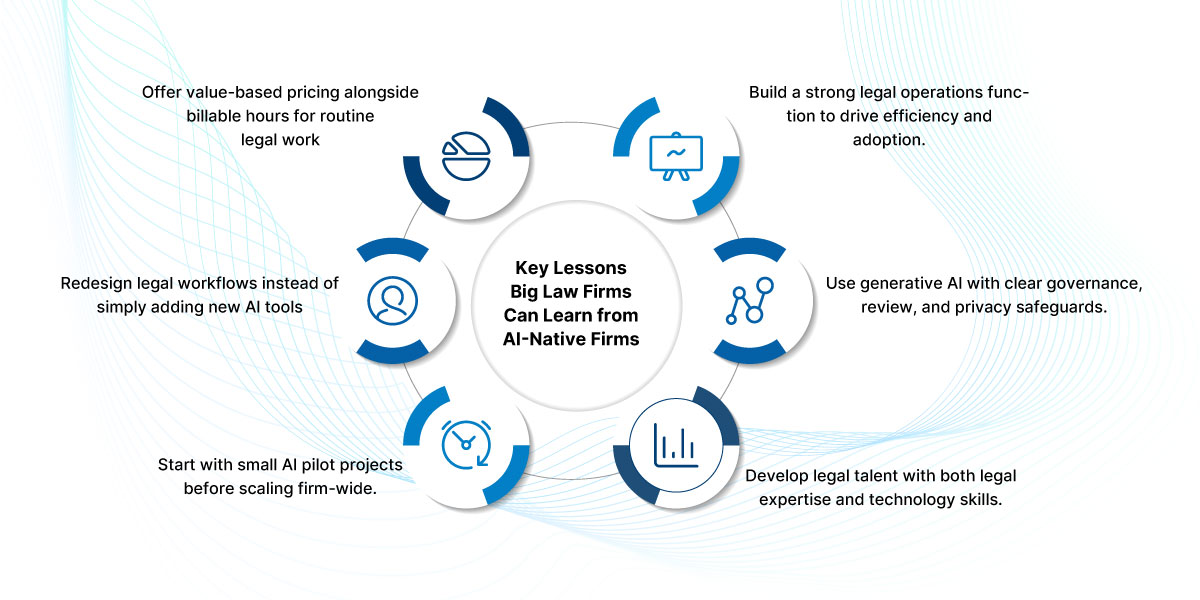
Rethink pricing before the tools force your hand. AI-native firms priced by value from the start. Big firms do not need to drop the billable hour overnight. But they can add flat-fee options for repeatable work, like standard contracts or routine filings. Clients are already asking for it, so this is a door that is open, not one you have to break down.
Redesign the work, not just the tools. Buying software and pointing lawyers at it rarely moves the needle. The gains come when you rebuild the process around the tool. This is the core of good AI legal workflows: map the task, find the slow parts, and let the software handle them so people can focus on judgment. Skip this step and you just have expensive shelfware.
Treat legal ops as a real function. Strong legal operations teams sit between the lawyers and the tech. They measure what works, cut waste, and keep projects on track. AI-native firms live and die by this group. Big Law firms often treat it as an afterthought, and it shows in the results.
Start small and prove it. You do not need a firm-wide overhaul on day one. Pick one practice group. Run a clean pilot. Show the numbers. Then scale what works and drop what does not. This lowers the risk and gives skeptical partners something solid to look at, not just a pitch deck full of promises.
Use generative tools with clear rules. Generative AI for law firms can draft, summarize, and research at real speed. But it needs guardrails. The firms doing this well set clear rules on review, privacy, and when a human must sign off. Speed with no checks is just a lawsuit waiting to happen.
Build talent that speaks both languages. The lawyers who thrive in these firms can read a contract and read a dashboard. You do not need everyone to code. But you do need a core group who understand both the law and the tools well enough to bridge the two. Train for it. Hire for it. Reward it. This is one of the quietest but most durable forms of law firm innovation, and it pays off for years.
The pattern across all of these is simple. AI for law firms works best when it is treated as a change in how the work happens, not just a new gadget on the shelf. The tool is the easy part. The process and the people are where the value hides.
Where Legal Process Outsourcing (LPO) Fits In
Here is a piece many firms miss. You do not have to build all of this in house. That is often the slowest and most expensive path.
Legal process outsourcing lets a firm hand off high-volume, repeatable tasks to a partner who already has the people, the process, and the tools ready to go. Think document review, contract abstraction, due diligence, and research support. A good LPO partner brings AI legal workflows that are already tested and running, so the firm skips the painful build-and-debug phase.
This is a smart middle path. A large firm gets the speed and cost benefits of AI for law firms without hiring a whole tech team or betting the budget on tools that may not fit. The LPO handles the scale and the tooling. The firm’s own lawyers focus on strategy, client trust, and the calls that need real experience.
It also helps with the money question in a neat way. Outsourcing turns a big fixed cost into a flexible one. You pay for what you use. For work that spikes and dips, like a large discovery project or a merger review, that flexibility is worth a great deal. You are not paying for idle staff between big matters.
For firms in the US, the UK, and across Europe, this model also eases the pressure of finding rare talent. The people who blend deep legal skill with real tech fluency are hard to hire and even harder to keep. An LPO partner has already built that bench, so you borrow the strength instead of spending two years building it yourself.
There is a speed angle too. When a big matter lands with a tight deadline, an LPO partner can scale up a review team in days, not weeks. The tools and trained people are already in place. For a firm trying to win and hold demanding clients, that quick response can be the difference between keeping the work and losing it to a rival who moved faster. In practice, this is how many firms first taste the benefits of legal AI without any risk to their own systems.
Risks of Adopting AI Without a Strategy
Now the flip side, because it is real. Rushing in is a genuine danger, and the cost of getting it wrong is not small.
The first risk is data. Legal technology that touches client files must be locked down tight. Feed sensitive data into the wrong tool and you may hand it to a third party without meaning to. A data breach in a law firm is not just embarrassing. It carries a heavy legal and financial impact: regulator fines, client lawsuits, lost trust, and years of slow cleanup. Under rules like GDPR in Europe and similar laws in the US and the UK, the penalties can climb into the millions fast.
There is a second layer here that firms often ignore. Many fail at the response stage, not just the prevention stage. A slow or messy breach response can turn one bad day into a full crisis. If your AI tools quietly spread client data across systems no one is tracking, you cannot respond fast, and that gap is exactly where the damage grows. So any move into AI for law firms has to start with a clear data map and a real plan for the day something goes wrong. Hope is not a plan.
The next risk is accuracy. Generative tools can make things up, and they do it with total confidence. In law, a made-up case citation is not a small slip. Courts in the US and the UK have already sanctioned lawyers for filing AI-written briefs stuffed with fake cases. So human review stays firmly in the loop. Always.
The third risk is culture. Drop tools on a team with no training and no buy-in, and people will quietly ignore them. The tech gathers dust. The money is gone. Real law firm innovation needs people to come along for the ride, not just software to show up one Monday.
The fix for all three is the same, and it is not complicated. Have a strategy first. Know what problem you are solving. Set the rules. Train the people. Then bring in the tools. Firms that skip this order tend to spend a lot and gain very little.
It also helps to pick one owner. When everyone is responsible for the AI push, no one really is. Name a partner or a legal operations lead who owns the plan, the budget, and the results. That single point of ownership keeps the effort honest and stops good ideas from dying in committee.
The Future of Legal Services
So where does all of this head? A few things already look clear.
The line between a law firm and a tech firm will keep blurring. The future of law firms likely looks like a blend: sharp legal minds backed by strong tools and tight legal operations. The firms that thrive will not be the biggest ones. They will be the ones that adapt the fastest and waste the least.
Clients will keep pushing for value, and that push only grows. They have seen what AI-native law firms can do on speed and cost. Once a client tastes flat fees and fast turnaround, going back to surprise bills feels wrong. There is no putting that back in the box.
Regulation will shape the pace, especially in Europe. New rules around AI and data are already landing, and more are coming. Smart firms will not wait to be told what to do. They will build clean, well-documented AI legal workflows now, so that when the rules firm up, they are ready instead of scrambling. Getting ahead of the rules is cheaper than getting caught behind them.
The role of the lawyer changes, but it does not shrink. Machines take the grunt work. People handle judgment, strategy, and trust. If anything, the human parts get more valuable, because those are the parts a tool simply cannot fake.
And the mix of build, buy, and outsource will keep shifting. Some firms will build their own tools. Some will lean on legal process outsourcing. Most will do a bit of both, and adjust the balance as they learn. The AI in legal industry story is not one single path. It is many, and the winners will be the ones who pick the mix that actually fits them.
Conclusion
Big Law firms are not going away. But the rise of AI-native law firms is a clear signal that cannot be ignored. The old way of trading hours for money is under real strain, and clients have already noticed.
The good news is that the lessons here are not scary. Rethink pricing. Redesign the work, not just the tools. Take legal operations seriously. Start small and prove it. Use generative AI for law firms with firm rules. And lean on the right partners, through legal process outsourcing, so you do not have to build every single piece yourself.
None of this asks a firm to bet the whole business on a trend. It asks them to move with intent instead of fear. The firms that treat AI for law firms as a real shift in how work gets done, not a passing fad, will be the ones still standing strong a decade from now.
At Aeren LPO, we help firms make that move without the guesswork. If you want to bring the speed and cost benefits of AI-native law firms to your practice while keeping your data safe and your clients happy, that is exactly the kind of work we do best. Start with one workflow, prove the value, and grow from there.