


Most organizations find out how good their breach response actually is when they’re already inside one. Not during the tabletop exercise. Not during the annual compliance review. During the real thing, when the forensics team is still working, legal is getting pulled in six directions, and someone in the room is asking when notifications need to go out.
That question, when do notifications go out, is where a lot of incident responses start to visibly fall apart. The technical investigation is still open. Data scope is unconfirmed. Jurisdictional requirements haven’t been fully mapped. But the regulatory clock is already running.
Many organizations evaluate cybersecurity incident response based on how quickly an attack is contained. In reality, containment is only part of the story. A more meaningful measure is how efficiently and accurately the organization meets its legal and regulatory obligations once the incident has occurred, particularly when it comes to notifying affected parties. That’s what regulators examine, what plaintiffs’ attorneys scrutinize, and what customers, employees, and stakeholders remember.
This blog is designed for legal, compliance, and operations leaders who are already familiar with the fundamentals. We’ll focus on one of the most challenging aspects of cybersecurity incident response: managing post-incident notifications. We’ll explore why notification requirements are difficult to execute under tight deadlines, the risks associated with delays or errors, and how the right operational support can help organizations respond more effectively.
Cybersecurity Incident Response Is No Longer Just an IT Function
This is still a common misconception, and it causes real problems. When a breach happens, the instinct is to hand it to the security team and let them work. But within hours, the scope of the response has already moved well beyond IT.
Legal counsel needs to assess exposure. Compliance teams need to check cyber incident reporting obligations across multiple jurisdictions. PR has questions. Executives want a timeline. Insurers need to be looped in. And somewhere in that chaos, someone needs to start building the foundation for notifications before the regulatory clock runs out.
Cybersecurity incident response is now a cross-functional discipline. The organizations that handle it well have established that fact before a breach ever happens. They’ve mapped responsibilities, built workflows, and designated clear ownership over notification processes. The ones that haven’t tend to find out what that costs the hard way.
The legal and compliance component of incident response is growing more complex every year. Between GDPR’s 72-hour notification window, US state-level breach notification laws, SEC disclosure rules for publicly traded companies, and sector-specific requirements like HIPAA, the regulatory surface area is enormous. Meeting all of it simultaneously, while also managing the technical response, is not something most internal teams can do at speed without outside support.
Why Post-Incident Notifications Have Become a High-Risk Pressure Point
Post-incident notifications sit at the intersection of legal obligation, stakeholder trust, and reputational risk. They’re not just administrative tasks. They are, in many cases, the moment where the organization’s response becomes visible to the outside world.
The stakes around post-breach legal response workflow management are high for a few specific reasons.
First, the regulatory landscape is no longer forgiving. Authorities in the US, UK, and EU have all signaled that notification delays will be scrutinized. The FTC, the ICO, and the EDPB have each taken enforcement action where notification timelines were inadequate. GDPR fines for notification failures alone have reached into the millions. This is not a gray area anymore.
Second, notifications are legally binding communications. What gets said, how it’s framed, and who it goes to all carry legal weight. An imprecise or incomplete notification can expose the organization to additional liability. Over-disclosure can cause different problems. Getting the language right under time pressure is genuinely difficult.
Third, affected parties, whether customers, employees, or business partners, have expectations. How quickly and transparently an organization communicates after a breach shapes how those relationships hold up in the aftermath. Slow, poorly worded notifications tend to make a bad situation worse.
The Real Business Consequences of Delayed Post-Incident Notifications
Delayed notifications aren’t just a regulatory problem. They create a cascade of secondary consequences that compound over time.
Regulatory penalties are the most obvious. But there’s also the question of cyber incident response notification requirements around timeliness. Under GDPR, supervisory authorities expect notification within 72 hours of becoming aware of a breach, not 72 hours after the breach occurred. That distinction matters, and many organizations misread it under pressure.
Beyond fines, there’s civil exposure. Class action litigation following data breaches often targets the notification timeline specifically. Plaintiffs’ attorneys look for evidence that organizations knew about a breach and delayed informing affected individuals. Every day of delay that can’t be justified becomes a liability.
There’s also the operational drag. When notifications are late or inconsistent, regulators ask more questions. That means more time spent on regulatory correspondence, more document review, more legal hours. A faster, cleaner notification often shortens the entire post-incident engagement with authorities.
And then there’s the trust dimension. Research consistently shows that customers are more forgiving of a breach when the response is transparent and fast. Delayed notifications tend to leak into the press before they reach the affected parties, which is about the worst version of the story an organization can be part of.
What Makes Rapid Notification So Difficult in Cybersecurity Incident Response?
Speed in cybersecurity incident response is not just a matter of will. There are real structural barriers that slow notification processes down, even when teams are working urgently.
The first is data volume. Identifying who was actually affected by a breach requires reviewing large volumes of data, often unstructured, often stored across multiple systems. The review process needs to come first because notifying people who were not actually impacted can introduce a different set of operational and reputational risks.
The second is jurisdictional complexity. A mid-sized organization with customers across the US, UK, and EU is operating under several overlapping notification frameworks simultaneously. Each has different definitions of what constitutes personal data, different thresholds for when notification is required, and different timelines. Mapping exposure to the right framework takes legal expertise and time.
The third is internal coordination. The security team is running the technical investigation. Legal is assessing exposure. Communications is drafting language. Compliance is checking requirements. Executives want updates. All of this needs to happen in parallel, and someone needs to be orchestrating it, while also doing their own piece of it.
The fourth is document review. Before notifications can be finalized, the rapid breach notification process often depends on reviewing contracts, data processing agreements, vendor relationships, and prior communications to understand exactly what was held, what was exposed, and what obligations exist. That’s a significant legal operations task that doesn’t disappear just because the clock is running.
The Notification Timeline Problem: Why the First 24–72 Hours Matter Most
The 72-hour window under GDPR has become a kind of benchmark for how seriously organizations take notification. But it’s worth understanding what actually needs to happen inside that window for the notification to be complete, accurate, and legally defensible.
Within the first few hours, the organization needs to confirm that a breach has occurred and assess its initial scope. This is the technical investigation phase, and it’s still happening while everything else starts moving.
By the 12-to-24-hour mark, legal needs to be fully engaged. The initial scope assessment needs to feed into a jurisdictional analysis. Which regulators need to be notified? Under what framework? What are the specific requirements for content and format?
Between 24 and 72 hours, the actual notification work accelerates. Drafting, review, approval, and transmission of regulatory notifications. Parallel work on individual notifications where required. Coordination with insurers and outside counsel. Internal briefings for leadership.
That is an enormous amount of work compressed into a very short window. Organizations that don’t have the capacity to execute on all of it simultaneously will miss timelines. It’s not a failure of intent. It’s a capacity problem.
What Information Legal and Response Teams Need Before Notifications Can Go Out
Post-incident communication in cybersecurity requires legal teams to work with information that is still being assembled by technical teams. That tension is one of the core operational challenges in breach response.
Before notifications can be issued, teams typically need to know:
What data was affected, which means file types, categories of personal information, and the approximate volume. Whether the data included special categories under GDPR or protected health information under HIPAA. Who the data belonged to, meaning customers, employees, third parties, or a combination. Whether the data was accessed, exfiltrated, or simply exposed, since each carries different notification implications. What contractual obligations exist with the affected parties or their processors. Which jurisdictions are in scope for regulatory notification.
Much of this comes out of document review. Contracts, data maps, vendor agreements, and processing records all need to be pulled and analyzed quickly. That’s legal operations work, and it doesn’t scale well when it’s entirely in-house.
Where Legal Operations and Review Support Become Essential After a Cyber Incident
This is the point where the support model matters. Most in-house legal teams don’t have the capacity to handle the volume and speed of review that a significant breach demands. Outside counsel can provide strategic oversight, but high-volume document review is not where they add the most value per hour.
Data breach response support services that sit between in-house legal and outside counsel, specifically legal process outsourcing, fill this gap directly. They can handle the volume-intensive components of breach response: reviewing large document sets to identify affected individuals, pulling relevant contracts and data agreements, supporting the preparation of notification letters, and managing the logistics of bulk notification workflows.
The value isn’t just in cost. It’s in speed. When a dedicated team is focused on the review and preparation work, internal legal and compliance resources can concentrate on the decisions only they can make: regulatory strategy, communication tone, executive briefings, and managing outside counsel.
Post-incident communication in cybersecurity that is accurate and on time depends on the underlying operational work being done well and quickly. That’s where LPO support changes the math.
Best Practices for Building a Faster Post-Incident Notification Workflow
The organizations that handle breach notifications well almost always have a few things in common.
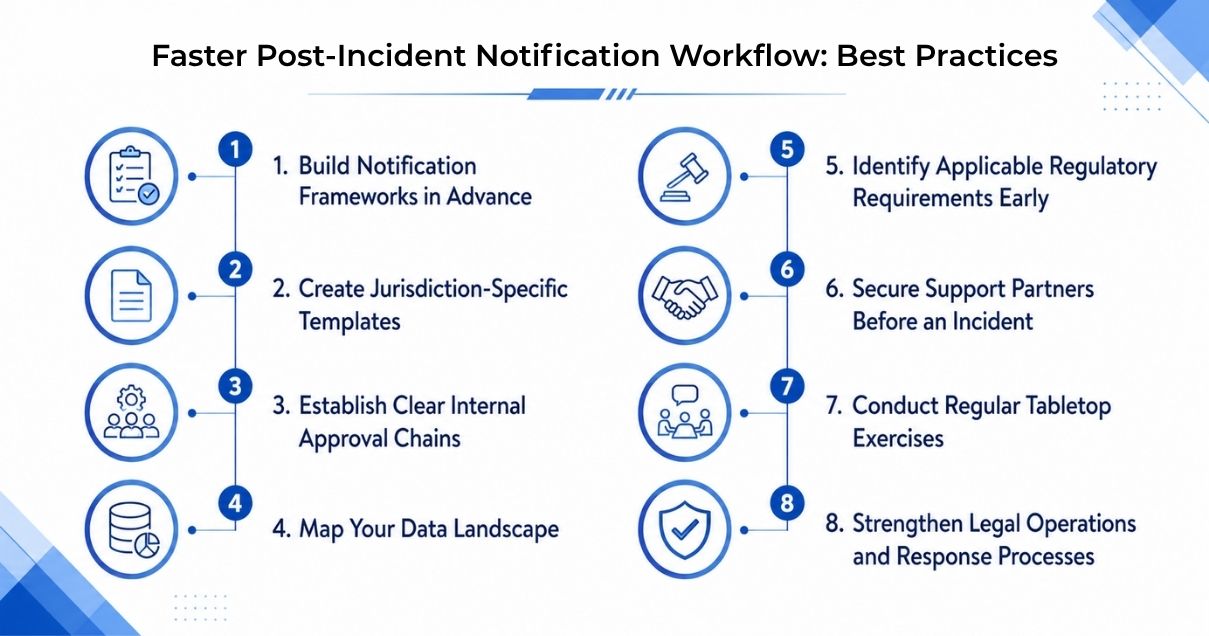
They’ve built notification frameworks before they need them. That means jurisdiction-specific notification templates, pre-approved regulatory communication structures, and a clear internal approval chain that doesn’t create bottlenecks under pressure.
They’ve mapped their data landscape. Knowing where personal data lives, what categories exist, and which regulatory frameworks apply before a breach happens compresses the analysis time significantly after one does.
They’ve established support relationships in advance. Whether that’s outside counsel, a forensics firm, or an LPO partner, the vendors who will support breach response should be contracted and briefed before the incident. Onboarding a new vendor during an active breach adds days you don’t have.
They’ve practiced. Tabletop exercises that simulate the notification timeline, not just the technical response, reveal gaps in capacity and coordination that won’t show up any other way.
And they’ve invested in the legal operations layer. The document review, the cyber incident reporting obligations analysis, the notification letter preparation: these are not glamorous tasks, but they are the tasks that determine whether notifications actually go out on time.
How Aeren LPO Supports Cybersecurity Incident Response and Post-Breach Notification Workflows
Aeren LPO works with law firms and in-house legal teams to support the operational demands of cybersecurity incident response, specifically the document-intensive and time-critical components that strain internal capacity during an active breach.
Our support includes large-volume document and data review to identify affected individuals and data categories, contract and agreement review to map exposure and obligations, drafting support for notification letters and regulatory communications, and workflow management for bulk notification logistics.
We operate across US, UK, and EU-based engagements, which means we’re familiar with the different frameworks that apply across those jurisdictions. Our teams work under strict confidentiality protocols and are set up to scale quickly when a matter requires it.
The goal is straightforward: give legal and compliance teams the operational bandwidth they need to move faster and more accurately at the moment when speed and accuracy are most consequential.
Rapid Notification Is Ultimately a Governance Issue, Not Just a Cybersecurity Issue
It’s easy to frame post-incident notifications as a technical or legal problem. But at the board level, it’s a governance question. What is the organization’s actual capacity to fulfill its obligations when a breach occurs? Has leadership made the investments, in people, process, and vendor relationships, that would allow a rapid, accurate, legally sound response?
Regulators are increasingly asking that question. The ICO, the SEC, and state attorneys general have all signaled that incident response capability is something they evaluate in enforcement decisions, not just the breach itself. An organization that can demonstrate it had a serious, well-resourced notification process, even if it hit some friction, is in a materially different position than one that clearly had no process at all.
Governance means owning the answer to that question before an incident forces the issue.
Conclusion
The technical side of breach response gets the most attention, but cybersecurity incident response lives or dies on the operational and legal side of the process. Post-incident notifications are the most visible, most regulated, and most scrutinized part of that process. They’re also the part most likely to be under-resourced when speed is most required.
Organizations that build notification capacity into their response infrastructure, rather than scrambling to create it under pressure, handle breaches fundamentally differently. The regulatory outcomes are better. The litigation exposure is lower. The stakeholder trust holds up.
If your legal or compliance team is reassessing its breach response capabilities, the notification workflow is a smart place to start. That’s where the gaps tend to show, and where the right support makes the most measurable difference.
Need support with your post-incident notification workflow? Find out how Aeren LPO can help your team move faster when it matters most.