


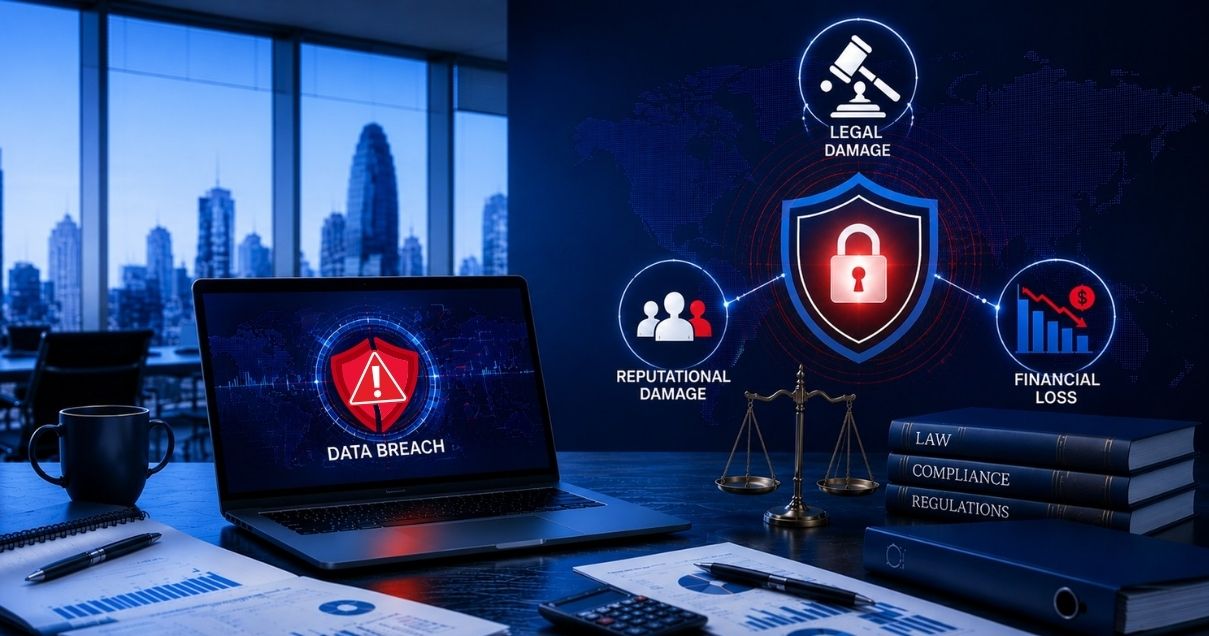
Companies rarely collapse because they got hacked. They collapse because of what happened after the hack, when the response fell apart in front of regulators, clients, and the press. Data breach response failures are the actual danger here, and they cost more than the breach itself ever does. Watch any company’s stock slide, its customers quietly leave, and its legal bills climb after an incident, and you’re not watching a breach play out. You’re watching a botched response play out in slow motion.
Regulators in the US, UK, and across Europe have gotten less patient with this. Notification windows are tighter. Fine ceilings are higher. Some frameworks now hold individual executives personally accountable for security failures, not just the company. A slow or disorganized response can take a contained IT incident and turn it into something that drags on for years. The data breach legal and financial impact of a weak response, separate from the breach itself, is what decides whether an organization recovers in months or spends the next several years in litigation.
So let’s walk through what actually goes wrong, why it gets expensive so fast, and what a response that holds up under scrutiny actually looks like.
What Counts as a Data Breach Response Failure?
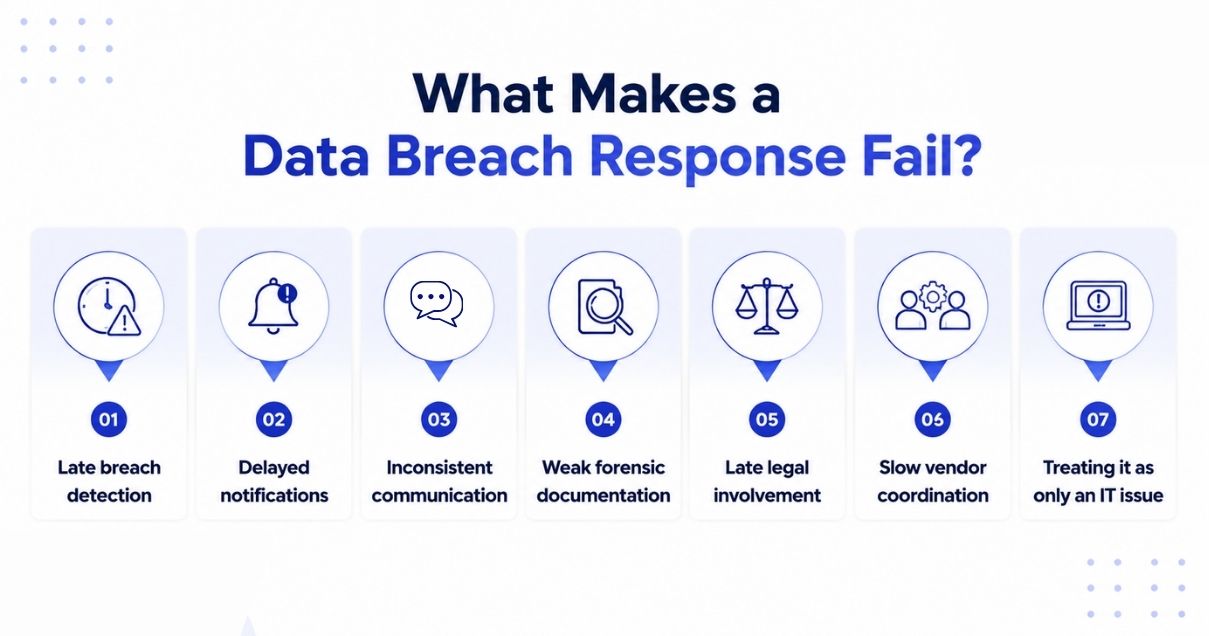
Getting breached isn’t the failure. The failure is what happens in the 72 hours after, and in the months that follow.
There are a few trends that recur within events related to the law, health care, and the financial services industry. One trend is that detection occurs weeks to months after the initial intrusion takes place, giving the hacker ample time to roam free. Notification tends to arrive late, or vague, sometimes only after a journalist or a dark web researcher forces the issue into the open.In many cases, it is not clear in advance who will speak to the regulatory body, who to the media, and who to the customers, which results in having three different departments communicating three different versions of what is going on. The forensic investigation is often hasty, and the chain of custody is careless. Vendors and insurers get looped in too late, even though they often carry their own data breach notification compliance obligations tied directly to your incident. And in a lot of cases, the whole thing gets treated as an IT problem from start to finish, with legal and compliance brought in only after the early decisions are already locked in.
None of this is exotic. It’s ordinary, predictable, and avoidable, which is exactly why it’s so costly when it happens anyway. The organizations that get burned worst usually aren’t the ones with the weakest security. They’re the ones whose data breach response failures happened in full view of clients, regulators, and reporters, with no plan for managing what people saw.
Legal Damage: How Response Failures Increase Liability
A detail that catches a lot of legal and compliance teams off guard: regulators don’t just look at whether you got breached. They look hard at how you behaved afterward.
In the US, state attorneys general and agencies like the FTC and HHS scrutinize whether notification deadlines under state breach laws or HIPAA were actually met. In the UK, the ICO expects notification within 72 hours of becoming aware of a breach under UK GDPR. The same 72-hour clock runs across the EU under GDPR, and NIS2 has layered on additional accountability that can reach individual executives for cybersecurity negligence, not just the corporate entity.
Miss that window and you’ve created a breach response legal risk that stands on its own, apart from whatever caused the breach in the first place. Regulators frequently treat a late or incomplete notification as its own violation. So a company can end up facing penalties not for the breach, but for how it handled telling people about it.
Litigation follows a similar logic. Plaintiff’s attorneys reviewing a case look for the gaps. Did the company know earlier than it admitted? Did the early public statement understate the scope, only for the real numbers to come out later? Did the company claim data was encrypted when it wasn’t? Every inconsistency between what got said publicly and what actually happened becomes evidence, and it’s discoverable. This is where the data breach legal and financial impact really compounds, because inconsistent statements don’t just erode trust. They hand the other side a timeline to build their case around.
A well-documented, disciplined response works against all of this. Regulators and courts read it as good faith, and that alone can meaningfully cut penalties and settlement figures.
Financial Damage: The Hidden Costs of a Poor Breach Response
Forensic investigation, system restoration, credit monitoring for affected individuals: that’s the visible part of the bill, and it’s usually the smaller part. The real cost shows up later, and it traces back almost every time to how the response was run.
Regulatory fines are the obvious one. GDPR fines can climb as high as 4% of global annual turnover for the most serious violations, and US state-level penalties per affected individual add up quickly once you’re dealing with a large dataset. Legal defense and settlements tend to run higher too, since plaintiffs love pointing to specific, documented failures in disclosure timing or communication accuracy, and juries respond to that kind of evidence. Cyber insurance can get complicated fast: insurers examine the response process closely, and if the team deviated from the incident response plan filed with the policy, or missed a contractual notification deadline owed to the insurer itself, coverage can shrink or disappear. Client and contract churn is another one people underestimate. B2B clients in legal, healthcare, and financial sectors often have contractual rights to terminate or renegotiate after a vendor breach, particularly one handled badly. And remediation under pressure, after the initial response has already burned through goodwill and time, almost always costs more than doing it properly from the start.
This is the piece of the data breach legal and financial impact conversation that gets the least attention, even though it deserves the most. The breach itself is a fixed cost. The response is a variable one, and a poor response multiplies it in ways that are hard to walk back once regulators, insurers, and courts are all watching the same sequence of events unfold.
Reputational Damage: Why Poor Response Can Hurt More Than the Initial Breach
Clients and patients tend to forgive a breach. Almost everyone understands, at this point, that no system is unhackable. What they don’t forgive is silence, spin, or finding out from a news article before hearing it from you directly.
A law firm’s clients trust it with privileged material. A healthcare provider’s patients trust it with health data. A financial firm’s clients trust it with money and identity. Once that trust cracks, patching the systems doesn’t repair it, and that’s where reputational damage after a cyberattack turns into a problem entirely separate from the technical incident itself.
The pattern usually plays out in stages. The first disclosure sets the tone, and a clear, accurate, timely statement buys more goodwill than most companies expect, even when the underlying news is genuinely bad. Then come the updates, because forensics almost always turn up new facts as the investigation continues, and how those revisions get communicated matters nearly as much as the original statement did. Finally, stakeholders start looking for proof that the organization actually fixed the underlying problem rather than just apologizing for it publicly and moving on.
Skip any one of those stages and the damage builds on itself. Coverage stays in the news cycle longer. Renewal conversations with existing clients get harder. New business slows, because prospective clients Google the firm’s name before they ever look at case results, and the breach coverage is what shows up first.
Real-World Example
Two recent incidents make the point clearly, and they show how the response mechanics play out differently even when both companies are large, sophisticated, and well-resourced.
Example: What the 2026 Novo Nordisk Incident Shows About Breach Response Risk
In June 2026, Danish pharmaceutical company Novo Nordisk confirmed unauthorized access to a limited number of its internal IT systems. A cyber extortion group calling itself FulcrumSec claimed it had been inside the network for more than two months before Novo Nordisk caught it, and said it had pulled over a terabyte of data, including clinical trial information, source code, and material tied to internal AI models.
The scale is notable, but what’s more instructive is how the response actually unfolded. Novo Nordisk activated its incident response protocol, brought in outside forensic experts, and notified data protection authorities. It also did something a lot of companies skip under pressure: it separated its disclosure by category instead of sending one generic notice. Pseudonymized clinical trial data, which carries lower individual re-identification risk, got treated differently from exposed healthcare provider contact details, which carry a much more immediate phishing risk. Each group received a tailored letter explaining what that meant for them specifically.
That distinction matters a great deal for data breach notification compliance. GDPR and the newer NIS2 framework expect notification that’s accurate about scope, not just fast. A vague, overly broad notice can do just as much damage as a late one, because it either creates unnecessary panic or leaves people without the specific information they actually need to protect themselves. The two-plus-month dwell time, as claimed by the attackers, is still a serious detection failure worth examining closely. But the disclosure process itself, segmented, specific, coordinated with regulators, is close to a working template for what a sound notification response looks like even when the underlying breach is severe.
Example: Tata Electronics Cyber Breach and the Legal Risk of Supply-Chain Data Exposure
Around the same period, Tata Electronics, a major supplier to Apple, confirmed a separate incident after a group calling itself World Leaks posted more than 200,000 files, roughly 630 gigabytes of data, on a dark web leak site. The material reportedly included Apple supplier documents, component schematics, and manufacturing data tied to products that hadn’t been released yet, along with files allegedly connected to other technology clients.When CLM is working, the effects are practical and measurable.
This case shows a different side of breach response legal risk, the supply-chain angle. Tata Electronics wasn’t only responsible for protecting its own information. It was holding proprietary data that belonged to its clients, and once that data surfaced publicly, the reputational and contractual fallout reached well past Tata’s own walls. Apple’s internal security team reportedly got directly involved in assessing the damage, and analysts have pointed out that the incident may shape how comfortable large clients feel about concentrating sensitive manufacturing data with a single supplier going forward.
The lesson translates directly to legal process outsourcing, accounting, and professional services firms that hold client data under strict confidentiality terms. When your organization is a vendor to larger clients, a breach on your end isn’t just your problem. It becomes your client’s disclosure obligation too, and a slow or unclear response on your side creates exposure for everyone downstream. That’s exactly why incident response for healthcare and pharma breaches, and for any regulated or contractually sensitive sector, needs to account for third-party notification duties from the very start, not as something bolted on after the forensic report is finished.
Why Organizations Need a Structured Cyber Incident Response Review Process
Most organizations already have an incident response plan sitting in a folder somewhere. The problem is that plans written once, filed away, and never tested tend to fall apart the moment they’re actually needed. A cyber incident response review works differently. It stress-tests the plan against real scenarios before an actual breach forces the gaps into the open in front of clients and regulators.
A serious review usually looks at a few things. Can the team realistically meet a 72-hour notification window under GDPR and comparable frameworks, given how detection and escalation currently work internally? Are legal, IT, compliance, and communications actually aligned on who approves external statements, or does that get sorted out for the first time during the crisis? Has anyone mapped which contracts and jurisdictions create separate notification duties when a vendor or client gets caught up in the incident? Is the forensic and legal documentation process built to hold up under litigation or regulatory inquiry, not just internal review? And after each tabletop exercise or real incident, does the organization genuinely update its process, or does the same gap quietly resurface next time?
Firms that build this kind of review into a regular compliance calendar consistently show a smaller data breach legal and financial impact when a real incident hits, mostly because the muscle memory already exists. Nobody is improvising a legal hold process or drafting a notification letter for the first time while the clock is running.
Bringing in an experienced outside partner helps here too. An external review brings a fresh, skeptical eye to a plan that internal teams have often stopped questioning after the tenth read-through. It also gives legal and compliance leadership something concrete to point to with regulators and clients: proof that breach response legal risk was taken seriously before an incident, not just addressed after one.
Conclusion
The breach itself rarely tells the whole story. What actually determines whether an organization recovers in months or spends years fighting litigation, regulatory scrutiny, and client attrition comes down to the response. Data breach response failures, slow detection, vague notification, disconnected teams, weak documentation, are what turn a contained security incident into a legal and financial mess with a long tail.
None of this requires guesswork. The regulatory timelines are published. The notification requirements are written down. The organizations that handle breaches well simply took the time to build and test their process before they needed it, rather than discovering the gaps live.
Think about it this way. Two companies can face the exact same technical breach, the same entry point, the same amount of stolen data, even the same attacker, and still walk away with completely different outcomes. One ends up with a fine, a lawsuit, and a wave of client departures. The other gets a regulatory inquiry that closes quietly and a client base that stays, because the communication was clear from day one. That gap rarely comes down to the hackers. It comes down to whether the data breach legal and financial impact was handled by a team that had rehearsed this moment already, or one that was improvising it for the first time while the clock kept running.
If your incident response plan hasn’t been tested against today’s regulatory landscape across the US, UK, and Europe, that’s the gap worth closing first, before the next incident closes it for you.