



A contract gets signed, filed somewhere, and then largely forgotten until something goes wrong. That’s not a harsh judgment. It’s just the reality for a large number of Australian businesses, from mid-sized commercial firms to enterprise-level organizations managing hundreds of active agreements at once. And when something does go wrong, whether it’s a missed renewal, a disputed clause, or a compliance gap that nobody flagged, the trail leads back to the same place: no real system for Contract Lifecycle Management Australia.
CLM isn’t a new concept. But the way Australian businesses are approaching it is changing, and fast. Here’s what’s actually happening on the ground, why it matters, and how organizations are getting ahead of it.
Understanding Contract Lifecycle Management (CLM)
Contract Lifecycle Management is essentially about handling a contract from start to finish. It covers drafting and negotiating, then signing off. Once active, it keeps being managed until it’s renewed or terminated. So, it includes all stages of a contract’s life, really.
The reason it gets complicated is that most businesses aren’t managing one contract. They’re managing dozens, hundreds, sometimes thousands, spread across departments, entities, and jurisdictions. Some of those contracts are with local vendors. Others involve overseas parties operating under different legal frameworks. In Australia specifically, you also have the overlay of the Australian Consumer Law, the Privacy Act, industry-specific regulations in construction, financial services, healthcare, and so on.
When there’s no coherent process, a few things happen predictably. Contract visibility drops. Nobody has a clear picture of what the organization is committed to. Renewal dates slip past unnoticed. Obligations go untracked. And contract compliance turns into something people only think about when there’s already a problem.
The businesses that manage this well treat CLM as a core operational function, not a legal admin task. That distinction matters more than most people realize.
The Contract Lifecycle Management Process Explained
The CLM process has a defined shape, even if it looks different from one organization to the next. These are the stages that matter.
Authoring and drafting. Drafting contracts is where you set the quality of the final agreement. To do it right, use approved templates and clear, consistent language. Also, consider potential issues early on, before showing it to the other side. Otherwise, you’ll end up spending triple the time fixing easily avoidable problems during negotiations.
Negotiation and review. Contract review is where time disappears if there’s no structure around it. Version control breaks down. Redlines go back and forth over email. Three people are looking at different documents simultaneously. Proper contract negotiation at this stage isn’t just about getting favorable terms. It’s about getting to a final, agreed version efficiently, with a clear record of what changed and why.
Approval and execution. Before a contract goes to signature, it needs internal sign-off. Contract execution gets delayed when approval workflows are unclear, when the right people are hard to reach, or when nobody’s sure who actually has authority to sign. These delays are common and very avoidable.
Storage and obligation tracking. Once the contract is signed, it needs to be somewhere findable, tagged with key dates and obligations, and assigned to someone who will actually monitor it. This is where most organizations quietly fall short.
Compliance and performance monitoring. Are the obligations being met? Are there milestone dates coming up? Is contract compliance being actively tracked, or is it sitting in a spreadsheet that someone checks occasionally? The gap between having a process and running a process shows up here.
Renewal or exit. Contract renewal decisions made deliberately, with proper lead time, tend to produce better outcomes than renewals that happen because nobody got around to reviewing the contract before the auto-renewal kicked in. The same goes for terminations.
Why Contract Lifecycle Management Is Becoming a Priority for Australian Businesses
A few years ago, CLM was largely a large-enterprise concern. Now it’s a conversation happening in organizations of all sizes, and a few things are driving that.
Regulation is one. The compliance landscape for Australian businesses has gotten meaningfully more complex. Modern Slavery Act obligations, updates to the Australian Privacy Principles, the evolving framework around financial services and consumer protections. These aren’t abstract concerns. They show up in contracts, and they require regulatory compliance monitoring that can’t be done manually at any real scale.
Contract governance is another. There’s been a real shift in how boards and leadership teams think about the organization’s contract portfolio. What are we committed to? Where’s the exposure? Who approved this? These are governance questions, not just legal ones, and organizations are being held to a higher standard of answering them.
There’s also a practical cost driver. The legal disputes, the missed renewals, the vendor agreements that ran past their useful life because nobody flagged them, these have a price tag. Enough organizations have felt that price tag clearly enough that the investment in better CLM processes has become much easier to justify.
Common Contract Management Challenges Faced by Australian Organizations
This is where theory meets the actual work. The challenges below are real, consistent, and worth being direct about.
No Real Contract Visibility
Ask most legal or procurement teams where all their active contracts are. You’ll get a range of answers. Shared drives. Outlook folders. Someone’s desktop. A document management system that half the team uses. Contract visibility at an organizational level requires more than just having contracts stored somewhere. It requires consistent metadata, a central repository, and the discipline to maintain it.
For Australian businesses with multiple entities or offshore counterparties, this is harder. The same contract may touch several jurisdictions and be managed by different teams. Without a unified view, nobody actually knows the full picture.
Contract Risk Management That's Only Done at Signing
Contract risk management should be continuous. In practice, it’s often treated as a one-time activity at the drafting or negotiation stage. Terms get agreed, the contract gets signed, and then the risk assessment largely stops.
What that misses: obligations can become risky if circumstances change. Indemnity clauses that seemed reasonable when signed can look very different after a counterparty’s financial situation shifts. Performance commitments that weren’t being met may have gone unnoticed for months. By the time the issue surfaces, there’s often limited recourse precisely because nobody was monitoring.
Contract Administration That Relies on Individuals
Contract administration, the daily management of active agreements, tends to be person-dependent in most organizations. Someone in procurement knows the renewal dates. Someone in legal keeps track of the variation log. When those people leave, change roles, or go on leave, that knowledge goes with them.
This creates fragility. It also creates inefficiency, because work that could be systematized gets done through individual effort and informal knowledge instead. The legal team handles things that don’t require legal judgment because no proper administrative process exists.
Volume That Manual Processes Can't Handle
Many Australian businesses started managing contracts with a spreadsheet and a shared folder. That worked when the contract volume was low. It stops working as the business grows, not because the tools are wrong, but because the approach doesn’t scale.
The manual effort required to track every obligation, every renewal date, every approval across a large contract portfolio grows faster than the headcount available to manage it. And as volume increases, so does the rate of errors.
Renewals That Nobody Catches in Time
Auto-renewals on contracts that should have been renegotiated occur all the time. Companies often miss renewals altogether, causing contract gaps. Plus, vendor agreements sometimes roll over at old rates that are too high now. These issues are very common and easily avoidable though. The key is being proactive, which manual systems usually don’t do well consistently.
Key Benefits of Effective Contract Lifecycle Management
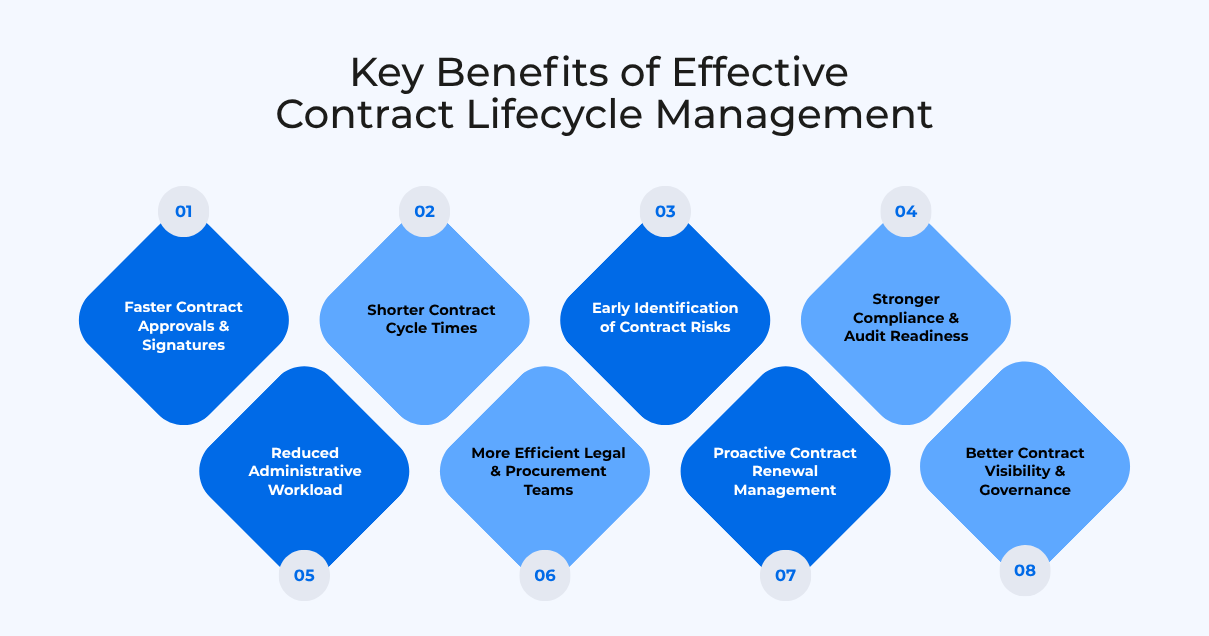
When CLM is working, the effects are practical and measurable.
Contracts move faster. Cleaner contract drafting, structured review, and defined approval paths cut cycle times significantly. In competitive situations, getting to signature faster can be the difference between winning and losing a deal.
Risk becomes visible earlier. Proper contract risk management means issues get flagged before they become disputes. That changes the economics of contract management considerably.
Compliance holds up under scrutiny. Standardized language, documented approvals, and ongoing monitoring mean contract compliance isn’t something you scramble to demonstrate after the fact. It’s built into the process.
The administration load drops. When contract administration is systematized rather than person-dependent, legal and procurement teams spend less time on routine tasks and more time on work that actually requires their expertise.
Renewals become decisions, not surprises. With proper tracking and lead time, contract renewal conversations happen deliberately. Organizations can renegotiate, exit, or extend from a position of knowledge rather than time pressure.
And across all of it, contract governance becomes something that leadership can actually rely on, because there’s a real picture of what the organization holds, what it’s committed to, and who’s accountable.
How Aeren LPO Supports Contract Lifecycle Management for Australian Businesses
Not every organization can build a full CLM function internally. Capacity, cost, and time are real constraints. Some businesses need high-volume contract review services without the overhead of an expanded legal team. Others need help building the foundations of a CLM process from scratch or cleaning up a contract portfolio that’s grown without much structure.
That’s the work Aeren LPO does. As a provider of Contract Management Services Australia, Aeren supports businesses and law firms with the practical end of contract management: reviewing and redlining commercial agreements, building and standardizing templates, supporting negotiations, tracking obligations, and managing ongoing contract administration tasks that would otherwise sit on already-stretched internal teams.
Legal process outsourcing works particularly well for the work that is important but doesn’t need to sit in-house. Routine contract review, clause library development, legacy contract analysis, renewal tracking. Aeren handles this at scale, consistently, without the overhead of full-time headcount.
For Australian businesses looking at CLM solutions Australia from a technology angle, Aeren also brings process expertise to the table. Software alone doesn’t fix a broken process. Getting the right combination of tooling and workflow design is where a lot of CLM implementations stall, and having experienced support on the process side makes a real difference.
Conclusion
Contract Lifecycle Management Australia has moved from a best practice to a baseline expectation for businesses that want to manage risk, maintain compliance, and operate efficiently. The challenges are real: visibility gaps, weak contract risk management, manual processes that don’t scale, and renewal management that happens by accident rather than design.
Getting CLM right means having the full process covered, from contract drafting and contract negotiation through to contract execution, ongoing contract compliance monitoring, and disciplined contract renewal decisions. It means building contract governance that gives leadership real answers about the organization’s exposure. And for many businesses, it means pairing internal capability with the right external support.
Aeren LPO works with Australian businesses and law firms to make that support practical and scalable. Whether the need is high-volume contract review services, ongoing contract administration, or building out a more structured CLM approach, the team is set up to help.
If contract management is creating friction in your business right now, that’s worth addressing sooner rather than later.