



Australian law firms are under more pressure than ever before. Billable hours are being scrutinized. Clients want faster results at lower costs. Regulatory demands are climbing. And the talent pool? It is tight, expensive, and unpredictable.
This is not a future problem. It is happening right now, and firms that are still relying on traditional staffing models and in-house-only workflows are starting to feel the squeeze. The good news is that legal process outsourcing, Australia included, has become a real, practical solution that mid-size and large firms are quietly adopting to stay competitive. Not as a cost-cutting gimmick, but as a genuine operational strategy.
So let us get into the specifics. What is actually driving these challenges, and how does legal process outsourcing address them in a way that makes sense for Australian practices?
Rising Operational Costs: The Numbers Don't Lie
Now, if you happen to be a businessman in either Sydney, Melbourne, or Brisbane, you can testify firsthand about how tough overhead is. There has been quite an increase in the pay packages for senior associates over the last few years. The cost of renting office space in the CBD hasn’t reduced. When all these expenses add up, they really do stack up.
The traditional response is to raise billing rates. But clients, especially large corporates and institutional clients, are pushing back harder on fee increases. They have in-house legal teams now. They compare rates. They negotiate.
The firms that are finding room to breathe are the ones that have started to reduce legal operational costs without reducing quality. That is where offshore legal support comes in. By outsourcing specific, well-defined tasks to trained legal professionals offshore, firms are able to cut the cost of those functions by a significant margin while keeping their local teams focused on high-value, client-facing work.
This is not about replacing lawyers. It is about using legal staffing solutions that Australian firms actually need: flexible, scalable, and not tied to local salary benchmarks. The tasks that benefit most from this model include document review, legal research, contract drafting support, and contract review services that would otherwise sit in a queue waiting for a senior associate to have a spare hour.
Managing Large Volumes of Legal Documents Is a Workflow Problem
Let us talk about something that does not get enough attention: the sheer volume of documents that modern litigation and transactional work generates.
A single commercial dispute can involve tens of thousands of emails, contracts, internal records, and third-party communications. eDiscovery Australia is no longer just a niche concern for big-ticket litigation. Even mid-size matters regularly involve document populations that are too large to manually review without burning through a massive amount of time and budget.
The workflow problem here is real. When document review gets stacked up against drafting, client calls, court appearances, and everything else, something has to give. Usually, it is turnaround time, and that creates risk.
Litigation support Australia practices have evolved to handle exactly this. Specialized teams working on document review services can process large volumes quickly, applying consistent review criteria, tagging documents accurately, and delivering organized outputs that your local team can actually use. They are not guessing at relevance. They follow your protocols, your privilege frameworks, and your review criteria.
The same logic applies to contract review services. Whether you are handling a due diligence exercise for a transaction or need a bulk review of supplier agreements, having a dedicated team built for that specific task is far more efficient than pulling your associates off other work to handle it.
What makes this work is not just cost. It is capacity. You can scale the team up or down based on the matter. You are not hiring a full-time employee for a six-week project. That kind of flexibility is genuinely valuable when litigation workloads are unpredictable, which they always are.
Cybersecurity and Compliance: The Risk Nobody Wants to Own
This is where a lot of firms hesitate when outsourcing comes up. And honestly, that hesitation is reasonable. Legal compliance in Australia is strict. The Privacy Act, the Australian Privacy Principles, and sector-specific regulations all create real obligations around how client data is handled. A breach is not just embarrassing. It is potentially career-ending and firm-ending.
But here is the catch: legal outsourcing has evolved dramatically when it comes to data security. The notion that outsourcing your legal process overseas is always dangerous is a stereotype from the past. Nowadays, respected service providers work in highly secure enterprise environments equipped with such standards as ISO 27001 certification, end-to-end encryption, access control, and audit trails.
Secure legal outsourcing means asking the right questions before you sign anything: How is data transferred? Who has access and under what conditions? What happens in the event of a breach? Are staff vetted and trained on legal confidentiality standards? A provider that cannot answer these clearly is not worth engaging. One that can, and can back it up with certifications and documented protocols, is actually a more defensible choice than a junior employee working from a laptop on public Wi-Fi.
The compliance picture also extends beyond data security. Law firms operating across jurisdictions, or serving clients in regulated industries, need consistent legal compliance Australia standards applied to their outsourced work. The right LPO partner understands this and builds those standards into their processes, not just their marketing materials.
How Legal Process Outsourcing Helps Australian Law Firms Grow
Let us bring this together. The case for legal process outsourcing, Australian law firms specifically, is not just about solving problems. It is about creating capacity for growth.
Here is what changes when firms get this right:
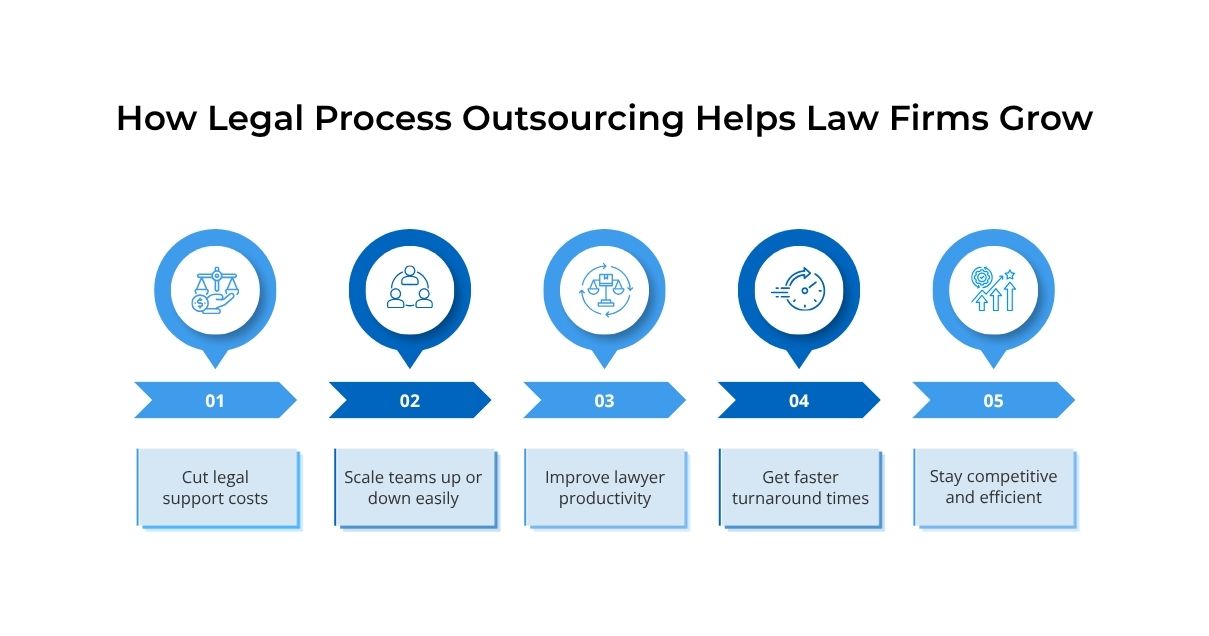
Cost savings that are real and measurable. Firms report consistent reductions in the cost of document review, research, and drafting support when they move these functions to a well-run LPO model. The savings can be redirected into business development, technology investment, or simply better margins.
Scalability that matches your actual workload. Litigation is lumpy. Transaction work comes in waves. Offshore legal support allows you to scale your capacity up when matters are heavy and pull it back when they are not. You are not carrying fixed headcount through slow periods.
Improved efficiency across the board. When your senior lawyers are not spending hours on document review or routine research, they get that time back. That means faster client responses, more matters handled concurrently, and better utilization of your highest-billing people.
Faster turnaround on time-sensitive work. Time zone differences, used well, actually become an advantage. Work sent end-of-business in Sydney can come back reviewed and processed before your team arrives in the morning. Litigation support Australia engagements structured this way have meaningfully compressed timelines for firms working to tight court deadlines.
None of this is theoretical. Australian firms are already doing this. The adoption curve has accelerated since 2020, and the firms that engaged with LPO early now have operational models that are genuinely more resilient and more competitive than those still doing everything in-house.
The Future of Legal Outsourcing in Australia
The future of legal outsourcing in the Australian market is not a question of whether it grows. It is a question of how firms use it strategically.
A few trends are worth watching. First, the scope of what can be outsourced is expanding. It started with document review and legal research. It now includes contract lifecycle management, regulatory compliance monitoring, legal drafting, and parts of the litigation workflow that require genuine legal judgment, not just processing. As LPO providers build deeper expertise, the range of viable engagements grows.
Second, legal operations Australia as a discipline is maturing. More firms are appointing legal operations professionals who think about process design, technology integration, and resource allocation as core functions, not afterthoughts. These people are natural champions for LPO because they understand that the goal is not just reducing cost but building better systems.
Third, client expectations are not going back. Corporate clients who have experienced the efficiency and cost profile of firms using LPO well are now expecting it. They are asking how their outside counsel is managing costs and what processes are in place to handle large document exercises efficiently. Australian law firms that cannot give a credible answer to those questions are at a competitive disadvantage.
The firms that will lead in this environment are the ones that treat LPO as a structural part of how they deliver legal services, not a temporary workaround for a busy period.
Conclusion
The challenges facing Australian law firms right now are real and they are structural. Rising costs, increasing litigation volumes, compliance demands, and talent constraints are not going away. They require a different approach to how legal work is resourced and delivered.
Legal outsourcing services done properly, through a provider that understands the standards Australian firms must meet, offers a genuine answer to most of these pressures. It is not a compromise on quality. It is a decision to deploy your best people on your highest-value work, and let specialized teams handle the rest with the same level of care and precision your clients expect.
Legal process outsourcing, Australian law firms that have adopted it are more scalable, more cost-competitive, and better positioned for the workload demands ahead. The question is not whether it works. The evidence is in.
We at Aeren LPO work alongside law firms from all over the United States, the United Kingdom, and Europe to provide you with exceptional legal services that meet the current needs of the market.