


Contracts don’t age well when they’re ignored. A renewal clause nobody caught, a liability cap that’s been sitting there untouched for three years, a termination notice requirement that nobody remembered until it was already too late. These aren’t hypothetical problems. They happen in real legal teams, at real companies, every single week.
Contract abstraction is the practice that stops this from happening. And while it’s been a part of law firm workflows for a long time, the way organizations are using it now looks very different from what it looked like even five years ago.
This blog explains what contract abstraction actually means, how it works in practice, and why getting it right matters more than most people give it credit for.
At its core, contract abstraction is the process of reading through a legal agreement and pulling out the information that actually matters, then recording it in a structured, accessible format.
That format might be a spreadsheet. It might be a field inside a contract lifecycle management (CLM) platform. It might be a standardized one-page summary that sits alongside the original document. The format is less important than the output: a clean, reliable record of what the contract says, without having to re-read the whole thing every time someone needs to check something.
Legal abstracting as a discipline goes back decades. Law firms used to do this by hand for large transactions, having paralegals work through stacks of agreements and note the key provisions. That practice hasn’t gone away. What has changed is the volume of contracts organizations are now dealing with, and the tools available to handle that volume.
First, there’s one thing that needs to be said about abstraction, it’s not the same as a summary. A summary tends to be loose and not fully detailed. On the other hand, an abstract should be detailed and well-formatted in such a way that anyone will be able to make use of it without having to refer back to the original document.
Here’s the honest answer. Most organizations, even well-run ones, do not have a clear picture of what’s inside their full contract portfolio at any given moment. They know where the files are stored. They can pull up an individual agreement when they need to. But ask them to quickly identify every contract with an auto-renewal coming up in the next 60 days, or every agreement that restricts assignment in an M&A context, and the process falls apart.
That gap is expensive. Missed renewal windows, auto-renewals nobody wanted, penalties triggered by overlooked obligations, liability exposure from clauses that were never properly flagged. The cost of not having abstracted contract data tends to show up quietly at first, and then all at once when something goes wrong.
Contract abstraction services exist to close that gap. When contracts are properly abstracted, the information inside them becomes searchable, reportable, and actually usable by the people who need it, not just by the lawyers who drafted the agreements.
For in-house legal teams in the US and UK, the driver is usually operational efficiency and risk management. For law firms, it’s about handling due diligence reviews, large-scale portfolio analysis, or client contract audits at a speed that wouldn’t be possible if someone had to read every document in full.
The contract abstraction process is more involved than it looks from the outside. Here’s what it actually takes to do it properly.
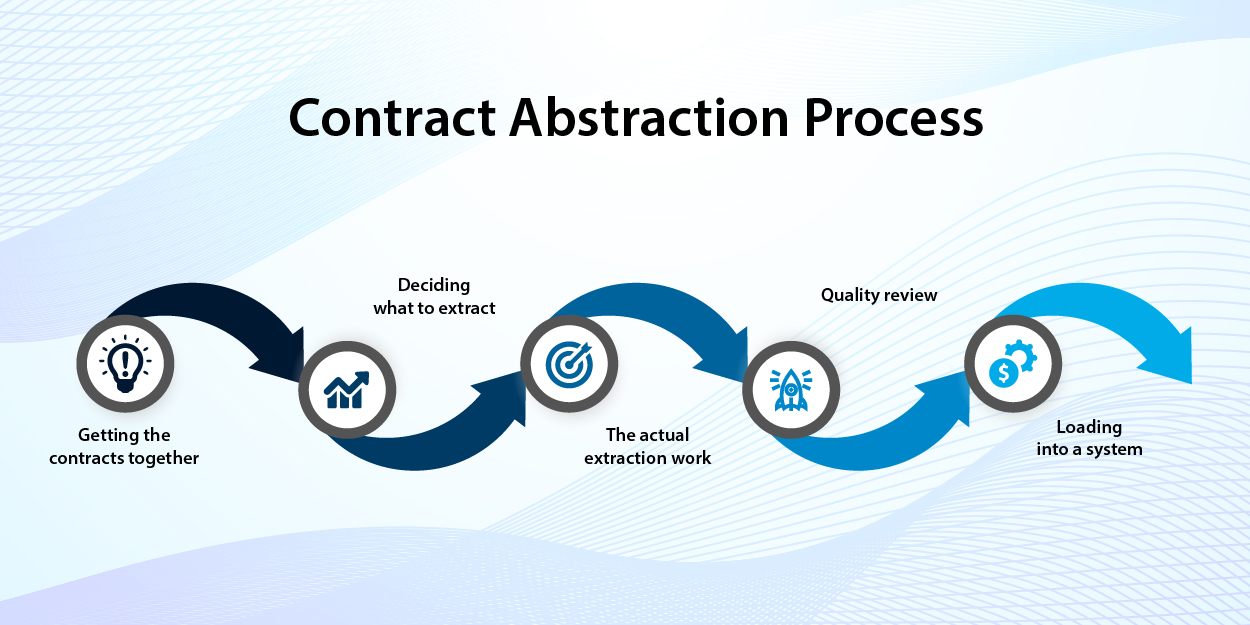
Getting the contracts together
Before anything else, you need to know what you’re working with. This sounds straightforward, but contract collections are almost always messier than expected. Agreements are scattered across shared drives, email threads, DocuSign accounts, and sometimes filing cabinets. The first step is gathering everything and sorting it by type, counterparty, business unit, or whatever classification makes sense for the purpose of the exercise.
Deciding what to extract
This step is where most organizations underinvest. The fields you pull from a contract should reflect why you’re doing the abstraction in the first place. An M&A due diligence review will prioritize change of control provisions, assignment restrictions, and indemnification caps. An ongoing contract management program will care more about payment terms, renewal dates, and service level commitments.
Building a proper abstraction template before you start is not optional. Without one, you end up with inconsistent outputs that are hard to compare and harder to report on.
The actual extraction work
A trained reviewer goes through each contract and records the relevant data points against the template. This is where accuracy is everything. A wrong date, a missed exclusion, an incorrectly recorded notice period. Any of these can have real downstream consequences. The work requires legal knowledge, not just reading ability.
Some of the important clauses which usually make their way into any agreement include information related to the parties and signatories, effective dates and expiry dates, methods of automatic renewals, details regarding payment, terminations, liabilities, warranties, intellectual property rights, and choice of law and jurisdiction.
Quality review
No responsible abstraction program skips this step. Someone other than the original reviewer checks the extracted data against the source document. In LPO engagements, this is typically a second reviewer with legal training. The error rate on unreviewed abstraction work, even good work, is higher than most people expect.
Loading into a system
The finished abstracts go into whatever system the client is using, whether that’s a CLM platform, a structured database, or a shared spreadsheet. This is the point at which the abstracted data actually starts doing something useful.
The specific fields vary by contract type and purpose, but a professional abstract will almost always cover the following:
For real estate contracts, you’d also capture subletting rights, option to purchase provisions, and rent escalation clauses. For employment agreements, covenant not to compete terms and notice periods become critical. The template gets built around what matters for that specific contract population.
The time-saving argument for contract abstraction is well understood. Faster due diligence, quicker answers to business questions, less time spent hunting through PDFs. That’s all true and worth having.
But the less-discussed benefits are often where the real value sits.
When contracts are abstracted into a consistent, searchable format, patterns become visible that were impossible to see before. You start noticing that a particular clause type shows up in 40% of your supplier agreements, or that your liability caps vary wildly across contracts that should have been standardized years ago. That kind of portfolio-level insight is only possible when the data is out of the documents and in a form you can actually analyze.
The negotiating position improvement is also underrated. Teams that know what terms they’ve agreed to in the past negotiate better. They know where they’ve pushed back successfully, where they’ve given ground, and what their baseline exposure looks like across the portfolio.
And for organizations preparing for an acquisition, a regulatory audit, or even just an internal contract review, having abstracted data ready to go changes the experience entirely. Instead of a scramble, it becomes a straightforward reporting exercise.
The software market for contract abstraction tools has grown substantially. Most of what’s available now falls into one of two categories: purpose-built AI extraction tools and CLM platforms with abstraction built in.
On the AI extraction side, Leah, formerly known as Kira Systems, has been widely used in law firms for M&A work. It’s strong on identifying defined terms and specific clause types, and it allows users to build custom provision models for things it doesn’t recognize out of the box.
Luminance takes a similar approach but leans more heavily on anomaly detection, flagging clauses that look unusual compared to the broader document set.
On the CLM side, platforms like Evisort, Icertis, and Ironclad include abstraction as part of a broader contract management workflow.
ContractPodAi, now acquired by Litera, has picked up significant adoption in UK and European markets, partly because of its workflow automation capabilities.
The honest assessment: these tools are impressive at scale, and they’ve gotten genuinely better in the last two or three years. But they still make mistakes, particularly with unusual clause structures, heavily negotiated bespoke terms, or contracts that don’t follow standard formats. Every serious abstraction program still has human reviewers in the loop. The tools handle volume. The reviewers handle judgment.
This comparison gets framed as a competition more often than it should be. For most organizations doing abstraction at any meaningful scale, it’s not a choice between the two.
Manual abstraction by trained legal professionals is slower and costs more. It is also more accurate when contracts are complex, ambiguous, or outside standard templates. A good paralegal or legal analyst will notice when something doesn’t read right, when a clause is unusual for its type, or when two provisions in the same agreement seem to conflict. AI tools, for all their improvement, still miss these things regularly.
AI-based abstraction is faster and cheaper for high-volume, standardized work. Run a few thousand NDAs or supplier agreements through a well-configured AI tool with clear extraction fields, and you’ll get good results at a fraction of the cost and time of doing it manually.
The hybrid model is where legal contract abstraction services from an experienced LPO tend to sit. AI handles the first pass and the routine work. Trained legal reviewers handle validation, quality control, and anything that requires actual judgment about what a provision means. That combination is what makes large-scale abstraction both fast and reliable.
Contract lifecycle management covers the full arc of a contract’s life, from drafting and negotiation through execution, performance monitoring, renewal decisions, and eventual termination or expiry. Abstraction sits inside that lifecycle, but it’s foundational to the whole thing working properly.
A CLM system without abstracted data is basically a better filing cabinet. You can find contracts faster, but you still can’t answer questions across the portfolio without opening documents one by one. Once abstraction is in place, the CLM becomes an actual management tool. You can report on upcoming renewals, track obligation fulfillment, monitor limitation of liability exposure across all your agreements, and generate the kind of data that actually helps with decisions.
This is why organizations that invest in CLM platforms often find that the platform doesn’t deliver its full value until the abstraction work is done. The software provides the structure. The abstracted data is what makes that structure useful.
One practical note for teams that are earlier in this journey: you don’t need a CLM platform to start abstracting contracts. A well-built spreadsheet with consistent fields gets you most of the benefit for a fraction of the investment. As the volume grows or the use cases get more complex, you migrate the data into a proper system. But waiting for the platform before starting the abstraction is a mistake that delays the value by months or years.
The volume of contracts most organizations are managing today is not going to get smaller. And the expectation that legal teams can provide fast, accurate answers about what’s in those contracts is only increasing.
Contract abstraction is how that expectation gets met. It’s not a technology solution or a one-time project. It’s an ongoing operational capability that, when built properly, makes every other part of contract management work better.
At Aeren LPO, this is work we do every day for clients across the US, UK, and Europe. The contract abstraction process we follow combines trained legal reviewers with smart use of technology, and the output is abstracted data that legal and business teams can actually rely on.
If your contract portfolio has grown faster than your ability to manage it, that’s the conversation worth having.
It depends on complexity. A standard NDA might take 40 to 60 minutes. A heavily negotiated 60-page agreement takes considerably longer. For large portfolios, an LPO with parallel reviewers will move much faster than an in-house team working through the same backlog alone. Get an estimate based on your actual contract mix, not a flat per-document average.
Contract review happens before you sign. It's about evaluating risk and negotiating terms. Contract abstraction happens after execution. It's about recording what the signed contract says so that information stays accessible over time. One helps you decide whether to sign. The other helps you manage what you've already signed.
For simple, high-volume contracts, AI tools have gotten genuinely capable. But they still miss context, misread unusual clause structures, and occasionally pull data from the wrong part of a document. If an error has real consequences, you want a human checking that output. Use AI for scale, reviewers for judgment.
No. A well-structured spreadsheet gets you most of the practical value when you're starting out. CLM platforms add automation and reporting as the program scales, but the value comes from having the data, not from the platform. Start the abstraction now and sort out the system later.

We use cookies and similar technologies for analytics and personalization. You can accept, reject, or customize your cookie settings at any time.