



Open the news on any given week and there’s a decent chance a company is dealing with a breach, a ransomware lockout, or a vendor compromise that’s dragged client data down with it. Nobody’s surprised by these stories anymore. What separates the businesses that recover quickly from the ones that spend a year cleaning up the mess isn’t fancier firewalls. It usually comes down to one thing: a cyber incident response plan that brought legal thinking into the room from hour one, not week three.
Most guides on this topic stop at the technical layer. They’ll walk you through isolating a compromised server or running a forensic scan, which is useful, but it’s only half the story. The harder questions show up once that scan starts confirming what you suspected, and those questions are legal as much as they’re technical.
For businesses operating in Australia, there’s a lot riding on getting this right. There’s the cost of stopping the attack itself, the cost of notifying the people affected and the regulators watching, and then the slower, quieter cost of clients deciding whether they still trust you. A proper cyber incident response approach has to cover all of that, and it needs people in the room who understand the law just as well as they understand the network.
Here’s what that looks like in practice.
What Is Cyber Incident Response?
Cyber incident response is the process an organisation follows when something goes wrong on the security side, detecting it, containing it, and getting back to normal afterward. Simple enough on paper. The problem is what happens when there’s no real process at all. People start unplugging machines that shouldn’t be touched yet, wiping logs they think look suspicious (which forensics teams will later need), and firing off internal emails that read like confessions before anyone actually knows what’s going on.
That’s exactly what incident response planning is meant to prevent. A decent plan spells out who’s responsible for what, the order things should happen in, and who needs to be told and when. It covers everything from one compromised email inbox to a company wide ransomware encryption event, and it doesn’t assume the worst case is the only case worth planning for.
Security breach management also isn’t something IT handles on its own while everyone else waits for an update. Legal, comms, HR, and often outside specialists all have a role, and they need to be working from the same script. Truthfully, getting attacked isn’t the differentiator anymore, almost every business eventually does. What separates the ones that come out fine is whether they already knew what the first sixty minutes were supposed to look like.
Common Cyber Threats Facing Australian Businesses
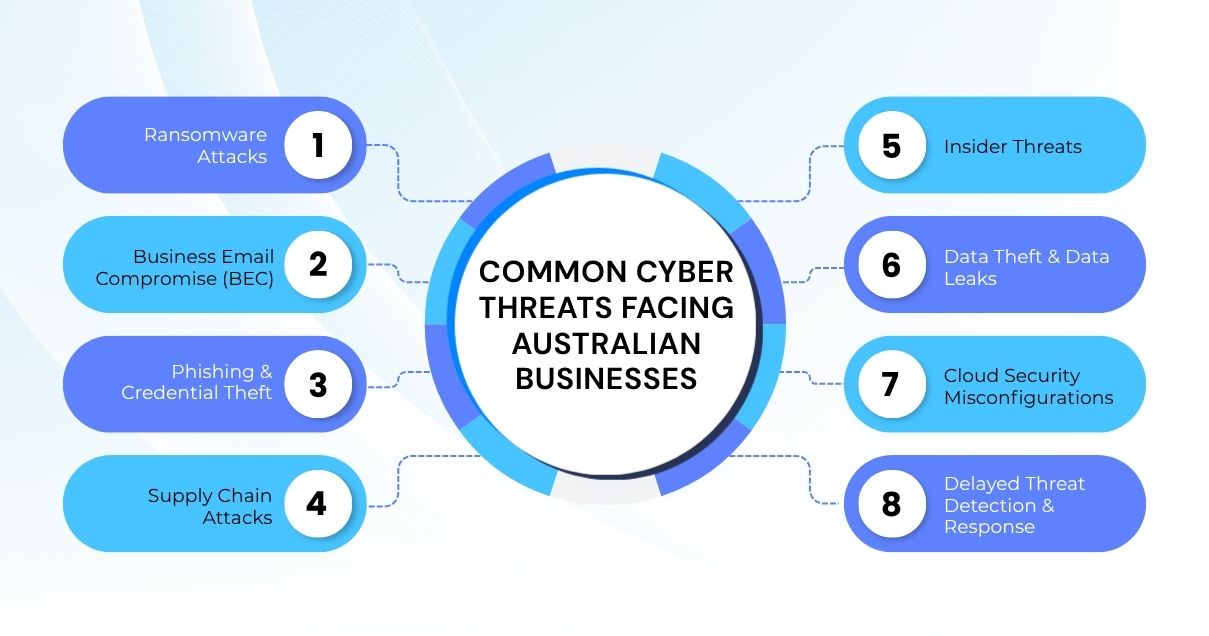
The threat landscape for Australian organisations has changed quite a bit, and a few patterns keep coming up.
Ransomware is still the headline grabber, for good reason. Attackers get in, encrypt everything they can reach, and demand payment to unlock it. The newer twist, and the more painful one, is that they often steal data first and threaten to leak it whether or not the ransom gets paid. That combination is brutal because it removes the option of just restoring from backup and moving on.
Business email compromise tends to fly under the radar but causes just as much damage. Someone gets access to a legitimate inbox, usually through a convincing phishing email, and quietly redirects invoice payments or pulls sensitive files. It works because it exploits trust, and trust is hard to monitor.
Then there’s the supply chain problem. A business can have its own security locked down tight and still get caught up in an incident because a vendor or service provider it depends on was the actual target. Often the affected company has no idea anything happened until the vendor announces it, sometimes weeks after the fact.
And insider risk rounds things out, whether it’s deliberate or just someone clicking a link they shouldn’t have, leaving a cloud bucket open to the public, or walking out the door with files they weren’t supposed to take. The damage from this can rival anything an outside attacker manages.
Different scenarios, different responses, but one thing is constant across all of them. The moment detection happens, the clock is running, and what gets done in those first hours sets the tone for everything after.
The Legal Implications of a Data Breach in Australia
This is the part that catches businesses off guard most often, because the legal clock and the technical clock don’t move at the same speed.
Under the Australian Privacy Act, organisations covered by the Notifiable Data Breaches scheme have to act once they become aware that a breach is likely to cause serious harm. That means notifying the Office of the Australian Information Commissioner and the people affected, within a set window once the assessment wraps up.
The assessment itself is where things get complicated. You genuinely can’t notify properly until you know what was taken, how many people it touches, and what kind of data was involved. A leaked spreadsheet of email addresses is a very different conversation than one containing health records or government ID numbers, and the notification thresholds reflect that difference.
Data breach notification isn’t just a single canned email sent out to everyone on a list. It has to be accurate, written in plain language people can actually understand, and it has to tell them what to do next to protect themselves. Get the messaging wrong, whether that’s saying too little or putting out conflicting versions across different channels, and the legal exposure from that mistake can outlast the original breach by a long way.
Contracts add another layer most people forget about. A lot of Australian businesses work with international clients, particularly across the US, UK, and Europe, and those contracts often have their own breach notification clauses that are tighter and faster than what Australian law requires. If your response plan is built purely around Australian deadlines, you might technically comply with the Privacy Act while still being in breach of a client agreement, which is its own separate legal headache.
And this is where cyber security compliance starts overlapping with other frameworks entirely. If your data touches EU residents, GDPR can apply no matter where your infrastructure sits. If you serve US healthcare or financial clients, there are sector specific rules layered on top of everything else. Figuring out which rules apply, and in what order they kick in, is genuinely a legal exercise, not a technical one.
Key Stages of an Effective Cyber Incident Response Plan
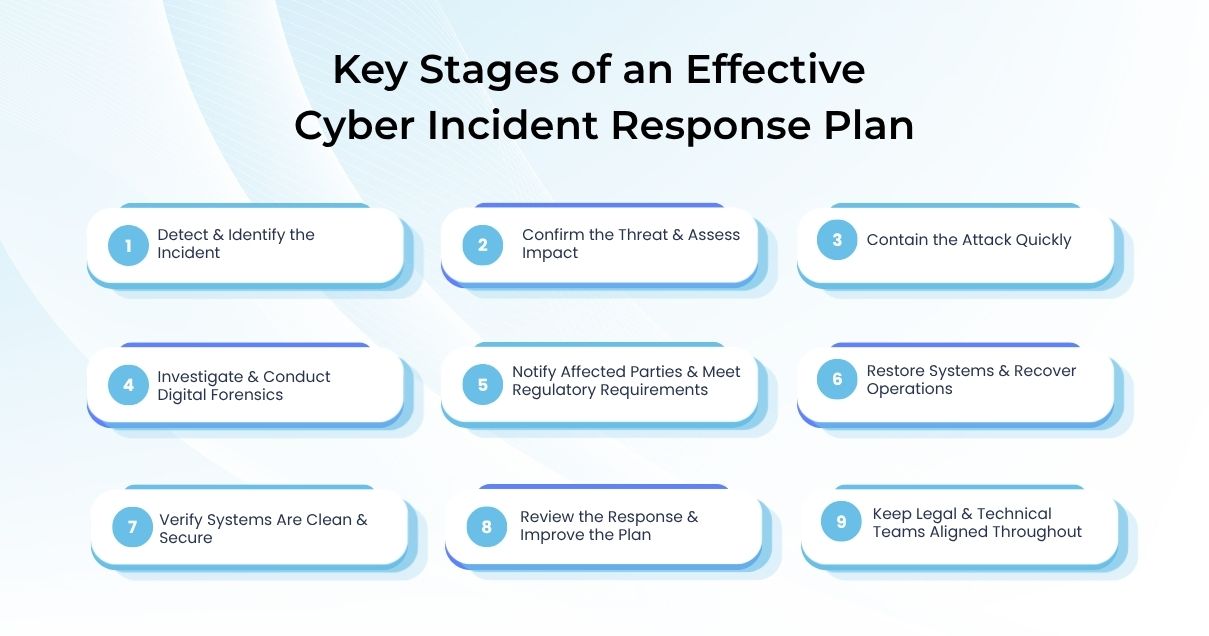
A working incident response plan tends to move through a handful of stages, though in reality several of them overlap and happen at the same time.
It starts with detection and identification. Something trips an alert, whether that’s odd login patterns, a ransom note suddenly appearing on screens, or a partner flagging strange traffic coming from your network. At this stage you’re mostly trying to confirm something real has happened and get a rough sense of how big it is.
Containment comes next, and it has to happen fast. The goal is isolating whatever’s been compromised so the problem doesn’t spread, while being careful not to destroy evidence that forensic teams and lawyers will need later. This is also where a lot of businesses go wrong, usually by acting before anyone’s coordinated who’s doing what.
Investigation and digital forensics is where the real picture forms. How did the attacker get in, what did they touch, are they still inside? Everything downstream depends on this, including the legal call on whether notification thresholds have actually been crossed.
Once there’s enough clarity, notification and regulatory reporting kick in. Legal teams typically lead here, drafting the notifications, dealing with regulators, and coordinating messaging to affected individuals and partners.
Recovery is the long stretch most people underestimate. Systems need restoring, everything needs verifying as clean, and backups often need checking for contamination before anyone trusts them again. This phase routinely takes longer than expected.
Finally, review and improvement. What worked, what didn’t, what needs to change before the next time, because there usually is a next time. Skip this step and you’re setting yourself up to repeat the same mistakes.
Treating these as a strict checklist, one after another, misses the point. Legal and technical work need to run side by side from the very start.
How Legal Teams Support Cyber Incident Response
Legal involvement in cyber incident response doesn’t start once the dust has settled and someone needs a notification letter drafted. It starts as soon as an incident is even suspected, and it shapes almost every decision after that.
One of the earliest moves is establishing privilege over the investigation. In plain terms, that means setting up how forensic findings get documented and shared so that the more sensitive parts of the analysis, including anything that doesn’t look great about how the breach happened in the first place, are protected if litigation or regulatory action follows later.
Legal risk management during a live breach is also a moving target. An incident that looks small and contained on day one can balloon by day three once the forensics team digs deeper. Legal teams have to keep reassessing, and adjust notification timelines, contractual obligations, and public messaging as the picture changes.
Compliance management runs underneath all of this. It means checking notification duties against every jurisdiction that’s relevant, going back through client and vendor contracts for breach related clauses, and making sure nobody in customer service is accidentally making promises in an email that create new legal commitments.
Incident documentation is one of those things businesses don’t think about until they’re mid breach and suddenly need it. Every decision, every timestamp, every escalation has to be recorded properly. That record becomes critical if regulators come asking questions, if affected individuals raise claims, or if an insurer wants proof before paying out on a cyber policy.
Security breach response also involves a surprising amount of contract review, often under serious time pressure. Insurance policies, vendor agreements, client contracts, employment agreements, all of it potentially matters, and someone has to be reading the fine print while everyone else is focused on getting the lights back on.
The Role of Legal Process Outsourcing in Cyber Incident Response
Here’s the issue most businesses run into. A real cyber incident response generates a huge amount of legal work, most of it document heavy and urgent, exactly when internal legal teams are already stretched thin handling everything else the breach has triggered.
That’s where legal process outsourcing earns its place. Cyber incident response services delivered through an LPO model give businesses access to legal professionals who can absorb that volume work without pulling internal staff off strategic decisions or scrambling to hire expensive contractors on short notice.
Picture what a mid sized breach actually produces on the legal side. Dozens, sometimes hundreds, of contracts that need checking for notification clauses. Notification letters that need drafting and adapting for different jurisdictions. Documentation that needs compiling for regulators and insurers in the exact format they expect. Outgoing communications that need a legal read before they go anywhere near a client. None of this is exciting work, but all of it has to happen fast and it has to be right.
Outsourced support also brings something internal teams often lack, which is repetition. Teams that work across multiple breach responses build up a working knowledge of what regulators actually want to see, what insurers ask for first, and where things tend to fall apart. That kind of pattern recognition is hard to build internally when, ideally, your own team isn’t dealing with breaches often enough to develop it on the job.
How Aeren LPO Supports Australian Organizations During Cyber Incidents
Aeren LPO works alongside law firms and the businesses they represent across Australia, the UK, the US, and Europe, stepping in with the legal document and process support that becomes urgent the moment a cyber incident response kicks off.
In practice, that looks like fast contract review across a client’s vendor and customer base to flag notification obligations, often turned around in hours rather than days. It means drafting and reviewing notification letters so they’re accurate, legally sound, and consistent no matter who’s receiving them. It also means handling regulatory reporting by organising and formatting documentation the way regulators actually want to receive it.
There’s a quieter side to this too. Reviewing employment contracts when an insider is involved. Checking data processing agreements when a third party vendor is part of the picture. Running privacy compliance checks across multiple jurisdictions when one breach touches clients in several countries with different rules.
Speed matters enormously in the first days of a breach, but it’s not the whole story. What really helps is having a team that’s seen the legal patterns in cyber incidents enough times to know what questions are coming before anyone’s had to ask them.
Cyber Incident Response Best Practices for Australian Businesses
A few things tend to separate businesses that handle breaches well from the ones that don’t.
Build the plan before you need it, and actually test it. A plan sitting in a shared drive that nobody’s opened isn’t much better than having no plan. Run a tabletop exercise at least once a year with everyone who’d actually be involved, legal counsel included, and walk through a scenario that feels real.
Bring legal in from the start. Not after IT has already made calls about evidence handling, shutting down systems, or sending communications that can’t be walked back.
Map your notification obligations across every jurisdiction your business touches, not just Australia. If you’ve got clients in the EU, UK, or US, work out what applies now, while there’s no pressure, instead of scrambling to figure it out mid breach.
Keep your incident documentation habits sharp even when nothing major is happening. Smaller incidents and near misses are good practice for the discipline you’ll need when something bigger hits.
Build relationships with outside legal and forensic support before you need them. Negotiating engagement terms with a new vendor in the middle of a breach is not a good time.
And treat cyber security incident management as something the whole business owns, not just IT. The businesses that bounce back fastest are usually the ones where leadership, legal, IT, and comms have already practiced working through this together, before it ever became real.
Conclusion
Cyber incidents aren’t slowing down, and for Australian businesses with clients overseas, the legal landscape around them just keeps getting more layered. A solid cyber incident response plan treats legal preparation as just as important as the technical side, because the choices made in the first few hours often decide how the whole thing plays out legally, financially, and reputationally.
Done properly, data breach response doesn’t look dramatic from the outside. It looks like clear communication, accurate notifications, documentation that holds up under scrutiny, and a recovery that doesn’t spiral into a second crisis. None of that happens by accident. It takes preparation, the right legal support, and people who’ve been through this before.
If your organisation wants to tighten up how it handles cyber security incident management, especially the legal and documentation side, Aeren LPO’s cyber incident response services are built exactly for this. Get in touch and let’s talk through how legal process support can slot into your existing response plan, ideally before you ever need it.