



A litigation team may receive thousands of emails, attachments, spreadsheets, contracts, correspondence, and other records during discovery. Locating potentially relevant documents is only one part of the work. The team also needs a consistent way to identify what each document contains, who is involved, whether it is responsive, whether privilege concerns exist, and how it relates to the issues in the matter.
Litigation coding provides that structure. It involves capturing or assigning defined information and classifications to documents so they can be organized, searched, filtered, reviewed, and analyzed within a litigation or eDiscovery database.
The process can range from recording straightforward bibliographic information to making judgment-based decisions under a detailed review protocol.
What Is Litigation Coding?
Litigation coding is the process of capturing or assigning structured information to documents involved in litigation, investigations, or discovery.
The coding fields used depend on the matter and its review protocol. They may record a document’s date, author, sender, recipient, document type, title, or subject. Other fields may reflect review decisions such as responsiveness, privilege, confidentiality, or association with a particular case issue.
This structured information makes it easier for litigation teams to work with large document collections. Instead of treating every document as an isolated file, attorneys can search and filter the collection using consistent classifications.
EDRM materials, for example, describe review platforms as allowing teams to tag or code documents for categories such as responsiveness and privilege and to establish coding schemes appropriate to the review.
Where Does Litigation Coding Fit Within the EDRM?
Litigation coding should not be treated as a separate formal stage of the Electronic Discovery Reference Model simply because coding occurs during eDiscovery.
The EDRM describes an eDiscovery process that moves information through activities including identification, collection, processing, review, analysis, and production. Coding commonly takes place within review and analysis workflows, although its precise role depends on the matter, technology, and review design.
For example, reviewers examining potentially responsive ESI may simultaneously assign responsiveness, privilege, confidentiality, or issue tags. Reviewers can then use the resulting information for further review, analysis, searches, quality control, or production preparation.
Who Performs Litigation Coding?
Who performs coding depends on the type of decision involved. Attorneys, contract attorneys, paralegals, litigation support professionals, trained document reviewers, and appropriately supervised legal process outsourcing teams may all participate.
Straightforward bibliographic coding may require less legal judgment than determining whether a communication is privileged or whether a document relates to a narrowly defined legal issue. Responsibility, supervision, and escalation procedures should therefore reflect the nature of the coding being performed.
Why Litigation Coding Matters in U.S. Litigation
Consistent litigation document coding can make a large review population more manageable. Legal teams can use coded information to isolate potentially responsive material, identify documents requiring privilege review, group records around case issues, and locate evidence for closer attorney analysis.
Coding also operates within a broader discovery framework.
Federal Rule of Civil Procedure 26 addresses the scope and limits of discovery, including relevance and proportionality. Rule 34 governs requests to produce documents and electronically stored information and addresses matters such as the form and organization of production. Rule 37 covers failures to make disclosures or cooperate in discovery and, under Rule 37(e), circumstances involving ESI that should have been preserved but was lost.
None of these rules makes litigation coding itself mandatory. Nor does accurate coding, standing alone, establish FRCP compliance or make a discovery process legally defensible. Coding is better understood as an operational tool that can support an organized review process within the broader legal, procedural, preservation, supervision, and production obligations applicable to a matter.
Types of Litigation Coding
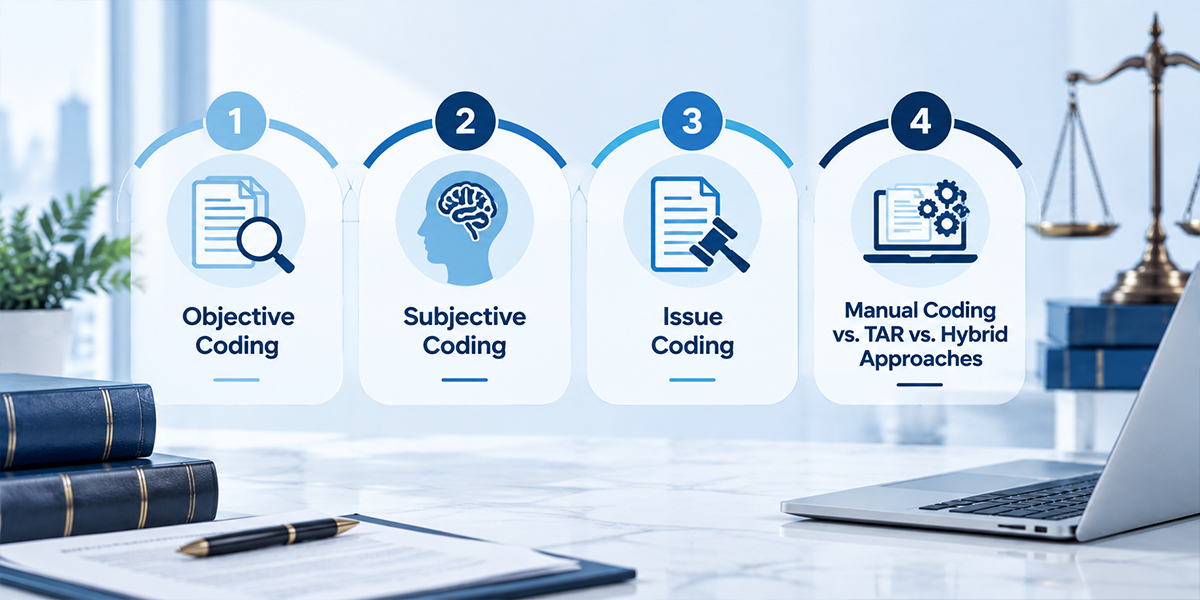
Objective Coding
Objective coding captures information that can generally be identified directly from a document rather than through substantive interpretation.
Typical fields might include the document date, document type, author, sender, recipient, title, or subject. Depending on the project, you may also capture beginning and ending identifiers or other bibliographic information.
Required fields vary by document population and the purpose of the review. EDRM guidance notes that bibliographic coding traditionally captures objective information such as dates, authors, recipients, and titles to facilitate document search and retrieval.
Subjective Coding
Subjective coding requires a reviewer to interpret a document against instructions established for the matter.
Protocol changes also require disciplined distribution. If supervising counsel changes an instruction, each capsule needs to receive and understand the same update.
Because reasonable reviewers may interpret the same document differently, subjective coding benefits from detailed protocols, training, examples, calibration, supervision, and clear procedures for escalating uncertain decisions.
Issue Coding
Issue coding connects documents with legal, factual, transactional, or investigative issues relevant to a particular matter.
In a commercial dispute, for example, the legal team might establish separate issue codes for communications about contractual performance, specific transactions, representations, or other questions.
These classifications should be designed around the matter rather than treated as universal categories. An effective issue-coding structure reflects the legal team’s objectives and should evolve through controlled protocol updates when necessary.
Manual Coding vs. TAR vs. Hybrid Approaches
Manual coding and technology-assisted review (TAR) are related but distinct concepts.
With manual coding, human reviewers examine documents and apply agreed classifications. TAR uses technology to help prioritize or classify documents based on review decisions, analytics, and other signals. Predictive coding and continuous active learning may form part of such workflows.
A hybrid approach combines human review with appropriate technology. Analytics might help prioritize documents or identify patterns, while reviewers make decisions requiring contextual or legal judgment.
Litigation coding and predictive coding should therefore not be used interchangeably. Technology can support the review process, but it still requires validation, quality controls, and professional oversight.
Litigation Coding vs. Document Review: What's the Difference?
Document review is the broader examination of documents to determine matters such as responsiveness, privilege, confidentiality, and relevance to particular issues. Coding is the structured recording of information or decisions about those documents.
The distinction is useful, but the activities frequently happen at the same time.
A reviewer might read an email to determine whether it responds to a discovery request and then record that decision in the review platform. Examining the email is part of document review; recording the responsiveness designation is a coding activity.
This overlap is why coding protocols are often integral to the wider document review workflow.
Common Litigation Coding Challenges for Law Firms
Large document populations can place significant demands on reviewer coordination. As more reviewers participate, maintaining consistent interpretations of coding instructions becomes increasingly important.
Inconsistency matters most in subjective coding. One reviewer may interpret an issue tag more broadly than another, or reviewers may encounter documents that were not anticipated when the original protocol was written. Written instructions, examples, calibration sessions, issue logs, feedback, and defined escalation channels can help address these differences.
Deadline pressure introduces another operational consideration. Discovery schedules may require reviewing large document volumes within fixed periods, making staffing and workflow planning important.
Quality control must also account for different types of error. Problems may include incorrect fields, inconsistent issue classifications, missed privilege indicators, or decisions that don’t follow the current coding protocol. No QC process guarantees perfect accuracy, but systematic checks can identify patterns that warrant correction, retraining, or further review.
When Does Outsourcing Litigation Coding Make Sense?
External support may be worth evaluating when document volumes exceed available internal capacity, workloads fluctuate considerably, a matter needs a dedicated review team, or attorneys need to preserve more of their time for substantive legal analysis.
Document review offshoring and broader legal process offshoring can also provide access to additional review resources without requiring the firm to build permanent internal capacity for a temporary matter.
The practical value depends on the provider, however. Outsourcing does not automatically mean faster review, lower costs, or better accuracy. Those outcomes depend on factors such as workflow design, reviewer experience, supervision, technology, communication, quality controls, and matter complexity.
How Quality Control Supports Consistent Litigation Coding
Quality control is most useful when it runs throughout the review rather than as a final inspection after coding is complete.
A controlled workflow may begin with written coding protocols and reviewer training, followed by calibration exercises using sample documents. Once review begins, project leaders can use QC sampling, consistency checks, issue logs, reviewer feedback, and additional review where appropriate to identify differences in interpretation.
Privilege and other sensitive decisions may require specific escalation paths or second-level review. Changes to the protocol should also be communicated clearly so reviewers are working from the same instructions.
EDRM guidance emphasizes the importance of supervision and procedures for managing reviewers, while its review-platform guidance specifically identifies tools for detecting inconsistent coding as an important consideration.
How to Choose the Right Litigation Coding Partner
A law firm evaluating litigation coding services in the USA should look beyond the number of reviewers a provider can supply.
Relevant questions include the provider’s experience with litigation document coding, how it selects and trains reviewers, and how it implements matter-specific protocols. Firms should also understand how calibration and QC are handled, how difficult documents are escalated, how reviewer consistency is monitored, and what reporting is available.
Technology and information security deserve separate attention. The firm should establish how data will be accessed, stored, transmitted, and protected and determine whether the provider can work within the firm’s existing eDiscovery environment.
Commercial arrangements should define responsibilities, changing volume requirements, service expectations, and any agreed service levels. Rather than assuming a standard SLA will suit every engagement, these requirements should reflect the specific matter.
How Aeren LPO Approaches Document Review Workflows
Aeren LPO’s current services include managed document review and eDiscovery support. Its published managed-review framework describes AI-powered prioritization, TAR workflows, dual-layer quality control, reviewer calibration, second-level validation for sensitive material, reporting, audit trails, and support for major eDiscovery platforms.
These capabilities can support coding-related work within a managed document review engagement. They provide a framework for combining review protocols, human review, technology, QC, and reporting, rather than treating coding as simple data entry.
Aeren also states that its information-security framework includes ISO 27001:2022 certification, SOC 2 Type II attested controls, ISO 9001:2015 certification, and role-based access controls. Firms evaluating offshore review should still assess those controls against their own matter requirements, client obligations, and contractual standards.
The Future of Litigation Coding: AI + Human Review
Technology can reduce some of the repetitive work associated with large document populations. Search, clustering, prioritization, classification, TAR, and other analytics can help teams identify patterns and direct reviewer attention toward potentially important material. EDRM materials likewise describe analytics and search technologies as tools used across review and discovery workflows.
The appropriate balance between technology and human review depends on the matter.
Ambiguous documents, privilege questions, nuanced issue classifications, protocol exceptions, and strategic decisions may require contextual legal judgment. Human involvement also remains important in validating workflows, resolving escalations, and assessing QC results.
The practical direction is therefore not simply manual review versus AI. Litigation teams increasingly have a range of tools available and can decide where technology is useful, where human judgment is necessary, and how the two should interact within a controlled workflow.
Conclusion
Litigation coding turns an otherwise difficult-to-navigate document population into structured information that legal teams can search, filter, review, and analyze more effectively.
Its usefulness depends on more than entering information into database fields. Clear protocols, reviewer training, consistent interpretation, supervision, escalation, and ongoing quality control all affect the reliability of the coded information.
For law firms considering outside support, the more useful question is not simply how many documents a provider can process. The firm should understand how the coding and review workflow will be managed, how difficult decisions will be handled, and what controls are in place to maintain consistency throughout the matter.
Need Additional Support for Your Document Review?
Talk to Aeren LPO about your document volumes, coding requirements, review protocols, quality-control expectations, timelines, and existing eDiscovery workflow.