



Document review has always been the part of litigation nobody talks about at conferences. It is unglamorous, brutally expensive, and on large matters, it can quietly consume more budget than the actual legal strategy. Firms in the US, UK, and Europe have known this for years. What has changed is that there is now a real, proven way to fix it, and the firms moving fastest on AI in eDiscovery are the ones their clients are staying with.
This blog is not a general introduction to AI. If you are reading this, you probably already know the broad strokes. What we want to get into is the practical reality:the reality of artificial intelligence-assisted AI document review as employed by law firms, what it is really like when it works effectively, when it makes an actual difference, and the distinction between the good, the bad, and the ugly of artificial intelligence technology.
Understanding AI in eDiscovery
The term AI-powered eDiscovery gets used loosely, so it helps to be specific. At its core, it refers to machine learning models and natural language processing being applied to electronically stored information (ESI) during the discovery phase of litigation or investigation. The AI learns from attorney coding decisions, identifies patterns across a document set, and starts making predictions about which documents are likely to be relevant, privileged, or important.
The early versions of this, called Technology-Assisted Review (TAR) or predictive coding, date back to the early 2010s. Courts in the US and UK began accepting TAR as a defensible review methodology around 2012, and since then the technology has moved considerably further. Today’s eDiscovery services use advanced technologies like concept grouping, duplicate identification, email conversation mapping, sentiment analysis, and OCR for scanned files all working together within a single review workflow.
The biggest shift compared to older systems is the speed and accuracy of modern AI-driven platforms. Current legal technology solutions can process massive volumes of documents, organize them intelligently, and highlight the most relevant files for legal review in a much shorter timeframe, often within just a few hours.
One thing worth noting for firms handling cross-border matters: these platforms handle multilingual review as a standard feature. German financial records, French regulatory correspondence, Dutch corporate filings, all processable in the same workflow without separate reviewer teams in each country. For European matters, that alone changes how a review gets staffed and budgeted.
The broader category of AI legal services now extends well beyond review classification. Drafting privilege logs, building document chronologies, flagging contradictions between witness accounts and documentary records, generating summaries of key custodian communications, these are all capabilities that modern platforms offer. The scope of what AI handles in a review is considerably wider than it was even three years ago.
Traditional Challenges in Legal Document Review
It is perhaps best to be straightforward when discussing the costs of manual document review because they tend to get understated in a genteel company.
A group of ten contract lawyers working regular hours can go through roughly between 20,000 and 50,000 documents in one week for a straightforward case. If we scale this up to a complicated securities fraud case, an antitrust case, which may have well over a million documents, months of review work will precede production. Those reviewers are billing anywhere from $50 to $150 per hour in US and UK markets. On large matters, the review budget alone can run well past seven figures.
That cost problem is real, but the consistency problem might actually be worse. Human reviewers are subjective, and their subjectivity changes over time. The call a coder makes about a code when they start work at 9 a.m. is not going to be the same call they make after working for five hours straight at 2 p.m., and it will most likely not even be the same call that someone next to them will make. In the case of having a team of 30 or 40 coders work on a project, it leads to the existence of 30 to 40 documents coded differently. That is a privilege waiver risk, a sanctions risk, and a production integrity problem rolled into one.
The legal document review challenges that firms face have also gotten structurally harder as the data landscape has changed. Electronic discovery services that were designed for email and Word documents are now having to handle Slack channels, Teams messages, Zoom transcripts, cloud storage records, and social media. The volume has exploded and the formats have multiplied. Litigation support services built on headcount simply cannot scale to meet that at a cost clients will accept.
There is also a quality problem that often gets overlooked. On a linear review, documents seen later in the process tend to get less attention, because reviewer fatigue is real and timelines compress as deadlines approach. The materials buried deep in a large dataset are statistically less likely to be reviewed carefully than the ones at the top of the queue. That is a structural flaw in any purely manual process, and it does not go away by hiring more people.
Benefits of AI-Driven eDiscovery Services
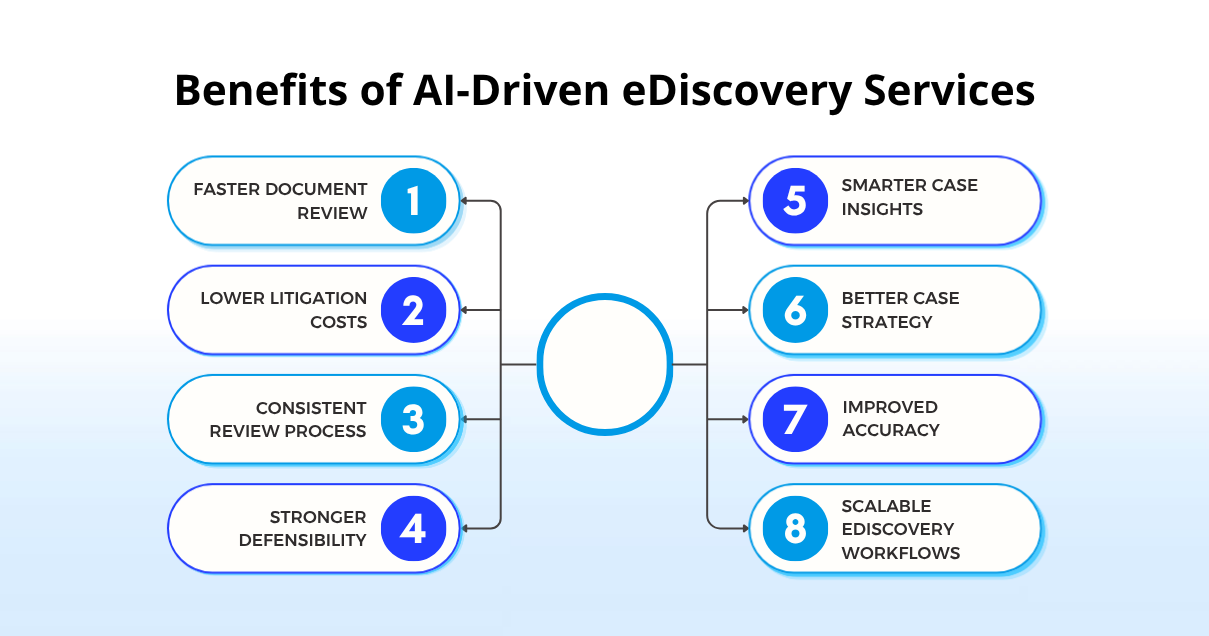
The benefits of AI in eDiscovery are well documented at this point, so rather than list them abstractly, it is more useful to look at how they play out in real review scenarios.
On speed, the shift is significant enough that it changes case strategy, not just operations. When faster legal document review cuts first-pass review from three months to three weeks, attorneys can do early case assessment with actual data rather than educated guesses. Settlement conversations happen from a position of real information. Depositions are prepared with a complete picture of the documentary record. That is not just an efficiency gain. It changes what is legally possible at each stage of the case.
On cost, cost-effective litigation support through AI typically delivers cost reductions somewhere between 40% and 70% compared to a traditional linear review of the same dataset. The reason is that AI-assisted workflows dramatically reduce the number of documents that need human eyes. Instead of reviewing 800,000 documents, a team might review 150,000 prioritized ones with statistical validation confirming the remainder is low-value. Clients, especially in-house teams managing legal spend carefully, notice that difference fast.
On consistency, AI-powered legal workflows apply the same logic uniformly across every document in the set. The system does not get tired, does not interpret instructions differently depending on the time of day, and does not introduce reviewer drift over a six-week review. That consistency is also what makes the process defensible. Courts want to understand how review decisions were made, and AI platforms generate audit trails, quality metrics, and validation reports that support a rigorous methodology defense far more cleanly than a human review process can.
The insight dimension is one that experienced litigators particularly appreciate. AI does not just sort documents into buckets. It maps relationships between custodians, surfaces anomalies in communication patterns, flags documents where stated facts contradict each other, and identifies clusters of related content that point to key issues in the case. That kind of structural intelligence across a million-document set is genuinely not achievable through manual review, regardless of how experienced the reviewers are.
AI Use Cases in Litigation and Compliance
AI in eDiscovery is not a single-use tool. It is being applied across different practice areas with different objectives, and the use cases have become more sophisticated as the technology has matured.
Litigation Support Services
In active litigation, the primary value of litigation review services is early case intelligence. AI surfaces the most relevant documents first, which means attorneys can make informed strategic decisions weeks earlier than they could on a linear timeline. AI-assisted case preparation now routinely includes automated timeline construction, custodian network mapping, and contradiction detection across large document sets. Attorneys going into depositions with that level of preparation are working from a materially stronger position.
For high-stakes commercial litigation, antitrust matters, and securities fraud cases, the data volumes are typically large enough that AI is not really optional. A significant antitrust matter might involve communication records from dozens of custodians over several years, across multiple formats and jurisdictions. Approaching that with traditional electronic discovery services and a manual review team creates cost, timeline, and accuracy problems that are genuinely difficult to justify to clients or courts.
Regulatory and Compliance Reviews
Regulatory compliance review is an area that deserves more attention than it usually gets in discussions of eDiscovery AI.Entities undergoing investigations by the FCA, entities under audit by the CMS, or organizations undergoing review by the DOJ face voluminous document collections that cannot be handled effectively without the use of AI. AI compliance systems can now process real-time communications surveillance, automatic identification of possible violations, and creation of document collections with appropriate tagging for regulatory purposes.
Internal investigation services benefit similarly. When a company needs to investigate potential misconduct, speed and confidentiality both matter. AI enables a thorough, well-documented review to happen quickly, without the visibility and cost that comes with standing up a large external review team.
Cyber incident response review has become one of the more pressing applications. Under GDPR, companies typically have 72 hours to assess a breach and notify. Under various US state laws, the window is 30 days. AI that can classify and analyze breach-related documents in hours rather than weeks is not a convenience in that context. It is operationally and legally necessary.
AI vs Traditional Manual Review
The AI vs manual document review debate has largely been settled in practice, even if some firms are still working through it internally.
Traditional linear review requires headcount that scales proportionally with document volume. There is a ceiling on how fast it can go, defined by how many qualified reviewers you can assemble and how many hours they can work. Automated legal review does not have that ceiling. Processing speed is a function of compute, not headcount, and it scales in ways that human teams cannot.
The traditional legal review process is also not particularly good at learning. If you discover midway through a review that a particular document type needs different coding, you have to go back and recode. An AI model adapts as it receives corrected examples and updates its predictions accordingly. The system gets more accurate as the review progresses, which is the opposite of what happens with a fatigued human team operating under deadline pressure.
Where human judgment remains indispensable is at the level of legal strategy and nuanced interpretation. The decision about whether a particular document changes the theory of the case, or whether a communication crosses a privilege line in a genuinely ambiguous way, that belongs with a senior attorney. The AI’s role is to make sure that attorney is spending their time on those decisions rather than on the 800,000 documents that are straightforwardly irrelevant.
The firms getting the most value from AI document review for law firms treat it as a collaboration, not a replacement. The AI handles scale. The attorneys handle judgment. That division, done properly, produces better outcomes than either could deliver independently.
Why Law Firms Choose Aeren LPO for eDiscovery
There are plenty of software vendors offering eDiscovery platforms. What outsourced eDiscovery services from a specialist like Aeren LPO bring to the table is different from buying a software license and figuring it out yourself.
Aeren LPO litigation support combines AI-powered technology with experienced legal professionals who understand how litigation actually works, not just how the software functions. A platform without that human layer is a tool without a user. What firms across the US, UK, and Europe need is a partner who can configure the technology correctly for their specific matter, manage the review workflow, catch quality control issues before they become production problems, and communicate in the language of litigation rather than in the language of software sales.
As a legal process outsourcing company with experience across complex matters, Aeren LPO works on everything from large commercial disputes to regulatory investigations and internal reviews. The team understands what defensible review looks like across different jurisdictions, whether that is GDPR considerations on a European matter, privilege doctrine under English law, or proportionality standards in US federal discovery. AI-driven legal solutions built on that contextual knowledge are considerably more effective than the same technology deployed without it.
The practical benefit for law firms is that their internal teams stay focused on strategy. Document volume management, review platform configuration, quality control, and production logistics are handled by a team that does this at scale every day. Less overhead, better outcomes, and a review process that holds up under scrutiny.
The Future of AI in eDiscovery
The future of AI in the legal industry is worth thinking about carefully, because the pace of change is faster than most legal technology cycles have historically been.
Generative AI in law firms is already moving from pilot programs into operational workflows. Large language models are being used within eDiscovery platforms to draft privilege log entries, generate document summaries, answer natural language questions about a document set, and produce chronologies of key events across millions of records. Tasks that used to take paralegal teams days are being completed in minutes with attorney oversight.
AI legal automation trends are moving toward end-to-end workflows where collection, processing, review, and production are managed with minimal manual intervention at each stage. The role of human review is shifting from primary processing to quality control and strategic interpretation. That is a significant change for legal teams and the litigation support services that serve them.
Next-generation eDiscovery tools are also handling data types that were historically difficult to process: voice recordings, video, handwritten notes, and communications from newer platforms. The idea of a discovery document set being limited to text files is already outdated. Firms handling matters involving audio evidence or video communications need tools built for that reality, and those tools exist now.
Predictive analytics for litigation strategy, using AI to assess likely outcomes based on judge history, opposing counsel patterns, and factual profiles, is an adjacent development some firms are already using. The boundary between AI in eDiscovery and broader legal analytics is blurring, and the firms building capability now will be better positioned as those tools mature further.
Conclusion
The conversation around AI-powered document review has moved well past whether it works. It works, courts have accepted it, clients expect it, and the cost and speed advantages over traditional review are substantial and well-documented across thousands of matters
What matters now is execution. AI in litigation support delivers on its promise when the technology is implemented correctly, the review workflow is properly managed, and the people running the process understand both the legal and technical dimensions. Done badly, it is just an expensive platform with a complicated interface. Done well, it changes what is possible on a matter.
Aeren LPO eDiscovery solutions are built on that understanding. The goal is not to sell a platform. It is to manage a review process that law firms and in-house teams can actually rely on, one that is fast, defensible, and built around the real demands of litigation.
The legal technology transformation in eDiscovery is not a future event. It is already the standard for firms operating at a level where matters are complex, data is large, and clients expect both quality and cost discipline. The question for any firm still running traditional review workflows is a simple one: how much longer does it make sense to stay there?
FAQ’s
AI in eDiscovery uses machine learning models trained on attorney coding decisions to predict the relevance, privilege status, or importance of documents across a large dataset. The process typically starts with a seed set of documents that attorneys code manually. The AI learns from those decisions, applies predictions across the full document population, and surfaces the highest-priority materials for review. Statistical sampling validates the model accuracy before production. The result is a review that covers the full dataset but concentrates attorney time on the documents that actually matter.
Yes. Courts in the US, UK, and across Europe have accepted TAR and predictive coding as defensible review methodologies for over a decade. Several US federal courts and the English High Court have issued guidance confirming that AI-assisted review, when properly validated and documented, meets discovery obligations. In some jurisdictions, courts now actively encourage its use on proportionality grounds for large matters.
On large matters, cost reductions of 40% to 70% compared to traditional linear review are consistent with published case studies and industry data. The savings come from reducing the volume of documents requiring human review. Instead of a team reviewing every document in a set of one million, the AI identifies the 150,000 to 200,000 that are likely relevant, and statistical validation confirms the remainder can be set aside. The human review budget is applied to a fraction of the original dataset.
Yes, and this is one of the more practically valuable features for European matters. Modern AI eDiscovery platforms support multilingual processing across dozens of languages, including mixed-language document sets. German, French, Dutch, Spanish, Italian, and many others can be processed, classified, and reviewed within the same workflow, without separate reviewer pools for each language.
Any matter with large volumes of electronically stored information benefits, but the return is highest on complex commercial litigation, regulatory investigations, antitrust matters, securities fraud cases, internal investigations, and cyber incident response. These are matters where data volumes are large, timelines are tight, and the cost of linear review would otherwise be very difficult to justify.
Aeren LPO provides end-to-end management, not just platform access. That includes configuring the AI model for the specific matter and review protocol, managing the review workflow, running quality control checkpoints, and handling production logistics. The team is experienced across US, UK, and European matters and understands the legal and procedural requirements in each jurisdiction. Law firms get a fully managed process, not a software tool to figure out independently.