


There’s a reason some law firms consistently outperform others in complex litigation, and it’s rarely about who has more partners or a fancier office. It comes down to preparation. Specifically, how deep their research goes before a single argument is made in court.
Litigation research can be defined as the act of collecting, analyzing, and applying legal information in order to formulate or defend a particular case. This may include case analysis, judicial opinion review, analysis of legal precedent, and other activities such as review of court documents and statutory analysis relative to the particular case at hand. Unlike the general legal research carried out by law firms, litigation research aims at providing attorneys with all that they require in making their arguments.
For firms in the US, UK, and Europe, this has become harder, not easier. Caseloads are more complex, timelines are tighter, and the volume of relevant material in any major dispute can be overwhelming. Add in how quickly legal analytics and AI tools are changing the research process, and it’s clear why firms that treat research as an afterthought tend to lose to firms that don’t.
This is a look at how litigation research actually works, where it makes the biggest difference, and what firms should be thinking about when it comes to getting it right.
What Is Litigation Research?
Most attorneys would say they know what litigation research is. But there’s a difference between knowing the definition and understanding the full scope of what it involves.
Fundamentally speaking, statutory analysis amounts to researching case law, selecting pertinent cases, and analyzing the evolution of judicial interpretation of a statute or legal principle over time. That said, this is far from the full extent of statutory analysis. For one thing, you’ll be identifying which circuits disagree on an important question of law, any controlling case law that could be used by the other party, any indications gleaned from the litigation records of comparable cases about how your opposition might try to make their case, and whether the legislative history surrounding the enactment of the statute can be used as evidence for your cause or against it.
The distinction between this and general legal research matters. General research might help a first-year associate understand a concept. Litigation research is built for a specific fight. It has a client, a set of facts, a jurisdiction, and a deadline. Everything it produces has to be usable.
There’s also a component that doesn’t get talked about enough: researching the people involved. Who’s the judge? What has she ruled in similar matters? How does she typically respond to expert testimony? What’s opposing counsel’s track record in cases like this? Firms that skip this part are leaving real information on the table.
Why Litigation Research is Important for Law Firms
Here’s the honest version: bad research doesn’t always show up immediately. An attorney can walk into a hearing with a flawed legal theory and not realize it until the judge starts asking questions the brief didn’t anticipate. By then, the damage is done.
The risk isn’t just losing a motion. In complex commercial litigation, one missed precedent or a misread statute can collapse an entire legal strategy. And when that happens in a matter worth tens of millions of dollars, the fallout goes well beyond the case itself.
Litigation support services exist partly because of this risk. Firms that use structured research support, whether in-house or outsourced, consistently catch things that a busy associate under deadline pressure might miss. The Thomson Reuters 2023 State of the Legal Market report noted that firms investing in stronger research infrastructure saw better outcomes in complex matters, not just faster preparation times. Better outcomes, because the arguments were built on sounder ground.
For US firms especially, the jurisdictional complexity makes this worse. Federal versus state, circuit splits, evolving case law in areas like data privacy and securities regulation, these aren’t minor complications. They’re the kind of thing that requires someone who’s specifically paying attention, not someone who’s juggling three other deadlines.
The Key Components of Litigation Research
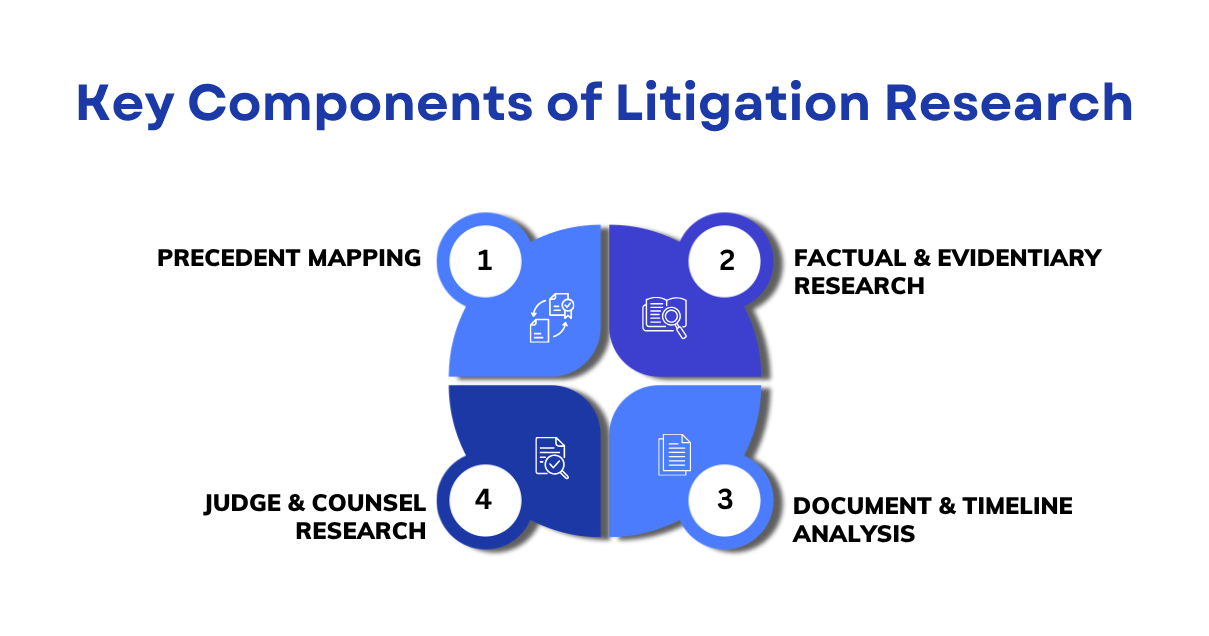
Litigation research is not one task. It’s a set of tasks that build on each other, and firms that treat it as a single step usually end up with gaps.
Precedent mapping is where most people start. You’re tracking how courts at every level have ruled on the issue in front of you. In appellate work, understanding the landscape of legal precedents across circuits often determines how the brief is structured. If there’s a circuit split, you need to know it before the other side brings it up.
Factual and evidentiary research is a separate discipline. A financial fraud case might require a researcher who understands accounting standards well enough to identify where the numbers don’t add up. A patent matter needs someone who can translate technical claims into legally relevant language. This isn’t something you can rush, and it’s not something every attorney has the bandwidth to do well alongside everything else.
Document and timeline analysis sits at the intersection of research and case management. Complex cases come with thousands of documents. Building a coherent factual timeline, identifying inconsistencies, and flagging documents that support or undermine key claims is painstaking work. eDiscovery platforms have made this more manageable, but they don’t replace the analytical judgment required to make sense of what you find.
And then there’s judge and counsel research, which experienced litigators treat seriously. A judge’s prior rulings on evidentiary questions, her approach to summary judgment, how she’s handled similar expert testimony shape how you write your briefs and frame your arguments. The same goes for opposing counsel. Firms that know how the other side tends to argue are in a better position to anticipate it.
How AI is Transforming Litigation Research
AI in litigation research has moved well past the hype stage. Firms are using it, and the ones using it well are getting a genuine edge.
Legal research software powered by artificial intelligence, such as Westlaw Precision, Lexis+ AI, and Casetext’s CoCounsel, allows users to conduct concept-based searches instead of keyword-based searches. This may seem like an insignificant feature until you have been working on an issue for several hours, only to find that the case you need cannot be found because of the use of the wrong keywords. Concept searches yield more relevant cases at a much higher recall rate than conventional searches.
Legal analytics platforms like Lex Machina and Docket Alarm have added a different dimension. Now firms can pull data on how a specific judge has ruled in similar matters, what the average time to resolution looks like in a given district, and how often certain types of motions succeed. That’s litigation analytics in practice, and it changes how firms approach everything from pre-filing strategy to settlement decisions.
What AI doesn’t do is replace judgment. It’s faster at retrieval and pattern recognition than any human researcher. But applying what it finds, deciding what’s actually relevant to this client, this set of facts, this argument, still requires a lawyer. The firms getting the most out of these tools are using them to do more and better research, not to skip the research altogether.
Benefits of Outsourced Litigation Research Services
Running a full in-house research team makes sense for the largest firms with consistent, high-volume caseloads. For most others, it’s an expensive way to manage a function that fluctuates with case volume.
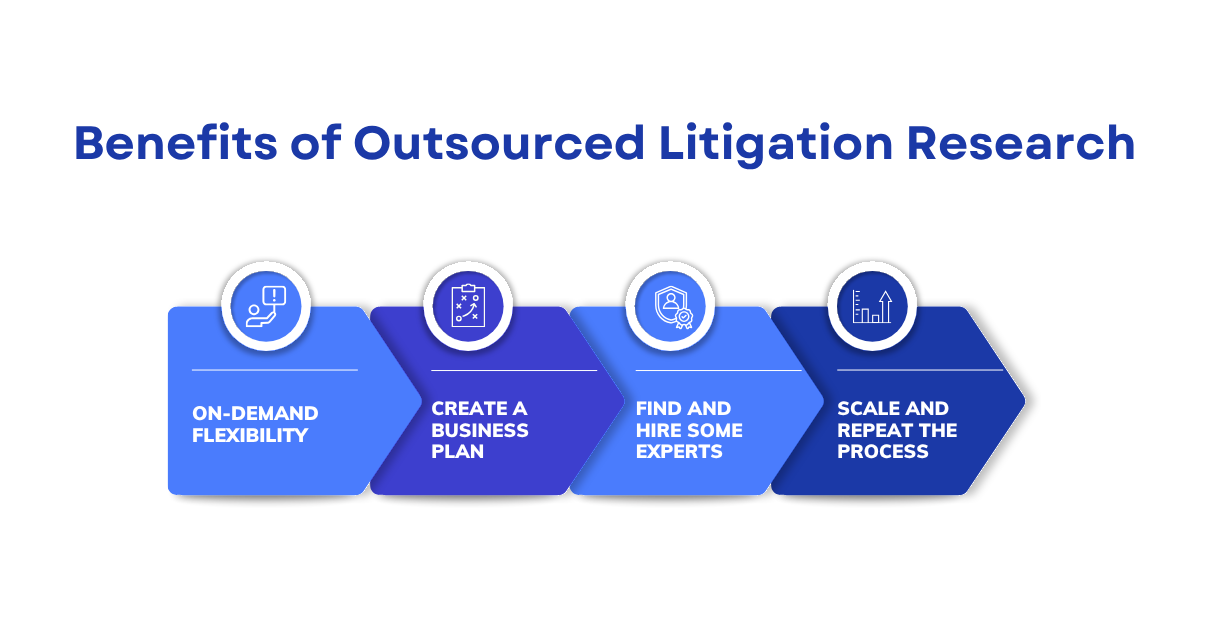
Outsourced litigation research gives firms access to experienced researchers on demand, without the overhead of full-time hires. When a complex commercial matter comes in, you scale up. When it settles, you’re not carrying unnecessary cost. That flexibility matters, especially for mid-size and boutique firms that compete with larger rivals on specific case types.
The other thing outsourcing gets you is specialization. A good litigation research company doesn’t just have generalists. It has researchers who’ve spent years working on patent disputes, securities litigation, or regulatory enforcement matters. That depth of experience shows up in the quality of the work, and it shows up in court.
The turnaround time argument is real, too. A dedicated litigation support provider isn’t juggling client calls, billing requirements, and business development on top of research. When a motion deadline is approaching, that focus matters. Many firms find that outsourced research memos come back faster and require less back-and-forth than work produced internally under the same pressure.
Cost efficiency is the obvious benefit, but it’s worth being specific. Engaging a litigation research partner on a per-matter basis converts what would otherwise be a fixed overhead cost into a variable one tied directly to revenue. For smaller firms, that’s a meaningful shift in how resources are managed.
Step-by-Step Litigation Research Process
The difference between good litigation research and mediocre litigation research is usually the process. Here’s how it should work.
It starts with a clear brief. What’s the legal question? What jurisdiction are we in? What facts is the research meant to support, and what’s the deadline? Research without a clear objective tends to drift, and drift costs time.
From there, researchers identify the right sources. Primary materials, statutes, regulations, and judicial opinions get pulled first. Secondary sources, treatises, law review articles, practice guides come in to provide context, especially in emerging areas of law where case law is still developing.
Then comes the actual search and retrieval phase. Good researchers don’t just run one search. They test multiple terms, check across databases, and verify that they’re not missing a controlling case because they searched in one jurisdiction and not another. This is where digital legal research platforms save real time, but the strategy behind the search still matters.
Analysis is where the work becomes genuinely useful. Raw results have to be evaluated. Which cases actually apply? Which precedents are distinguishable? Where does the case law create problems for the argument, and how do you address those problems rather than ignore them? A research memo that surfaces every case but doesn’t analyze which ones matter isn’t much help.
The output, whether it’s a full memo, an annotated case list, or draft brief sections, gets reviewed before delivery. And because law doesn’t stand still, good research teams build in a final check for recent decisions before anything is filed.
Common Challenges in Litigation Research
Volume is the most common problem. A major commercial dispute can generate hundreds of thousands of documents and relevant cases across multiple jurisdictions. Without a clear research plan and the right tools, it’s easy to either miss something important or get buried in material that isn’t actually useful.
Jurisdiction is another one. Multi-jurisdictional matters require careful analysis of which law applies and where, and that question isn’t always as simple as it looks. Conflict of laws analysis adds a layer of complexity that some research teams underestimate.
The pace of change in certain areas of law creates its own pressure. Data privacy, employment law, securities regulation, and anything touching on digital assets or AI have all seen significant developments in recent years. Research that was solid six months ago might need to be revisited before it’s used in a brief. Building update checks into the research process isn’t optional in these practice areas.
Quality control is the hardest thing to maintain under deadline pressure, which is exactly when it matters most. A misread statute or a case pulled from the wrong circuit can send an argument in the wrong direction. Peer review and systematic checking are the only real answers to this, which is why research teams with built-in review processes tend to produce better work than individual researchers working alone.
Best Tools and Technologies Used in Litigation Research
Westlaw and LexisNexis are still the foundation of most case law research in the US. For UK and European matters, vLex and Justis cover similar ground. These aren’t going anywhere, but the way firms use them is changing.
Westlaw Precision and Lexis+ AI have layered AI-assisted search and document summarization on top of the traditional database. AI legal research platforms like Casetext’s CoCounsel can draft research memos from source material, which cuts down on the time between retrieval and usable output. These tools are not perfect, but they’re getting better quickly, and firms that haven’t evaluated them recently are probably underestimating how much has changed.
Regarding eDiscovery solutions, Relativity and Everlaw process thousands of documents much faster than they could a decade ago. It is now feasible to search through, tag, perform privilege reviews, and generate timelines for hundreds of thousands of documents in just a few days, not weeks.
Lex Machina and Docket Alarm occupy another niche altogether. These are litigation analytics tools whose value lies in the data that they offer on judges, courts, lawyers, and case results. For pre-filing strategy or trial preparation, having this kind of legal technology integrated into the research workflow makes a real difference.
How to Choose the Right Litigation Research Partner
Not all providers are the same, and the wrong choice costs more than just money.
The starting point is jurisdiction. A firm handling US federal litigation needs a litigation research firm with researchers who understand federal procedural rules, circuit court dynamics, and how district courts in specific venues tend to operate. The same goes for UK and European matters. Jurisdiction-specific expertise isn’t a nice-to-have.
Data security matters more than firms sometimes acknowledge. Research involves highly confidential client information, strategy, and legal theories. Any research and litigation support partner needs to operate under robust data security protocols and comply with applicable bar rules and, for European matters, GDPR. This should be a due diligence item, not an afterthought.
Turnaround commitments need to be specific and tested. Ask how the provider handles rush requests. Ask for examples. Litigation moves on deadlines, and a partner who can’t consistently meet them isn’t actually useful, regardless of how good their research is.
Litigation consulting relationships work best when the provider understands the firm’s practice areas deeply enough to anticipate what matters and what doesn’t. That kind of contextual understanding takes time to build, which is why firms that treat outsourced research as a long-term relationship rather than a transactional vendor arrangement tend to get better results.
Future Trends in Litigation Research
The future of litigation research is going to be shaped by two things: better AI tools and the growing complexity of cross-border disputes.
On the AI side, legal AI trends are moving toward systems that don’t just retrieve relevant material but synthesize it, draft an initial analysis, and identify gaps in an argument before a human reviewer even looks at the work. That doesn’t eliminate the need for experienced researchers. It changes what they spend their time on. The manual retrieval work gets faster; the judgment and analysis work becomes more central.
Litigation technology trends also point toward greater integration between research and case management. As courts adopt digital filing systems and electronic evidence becomes more complex, the line between research, eDiscovery, and trial preparation is getting harder to draw. Firms that treat these as separate functions with separate teams will face more coordination challenges than those that integrate them.
Predictive analytics is the piece that’s still developing but will matter significantly in the next few years. Firms will be able to model the likelihood of winning a specific motion in front of a specific judge in a specific district, based on actual outcome data. Litigation analytics is already moving in this direction. The firms building data-driven habits now will be better positioned when these tools become standard.
Closing Thoughts
The strongest cases aren’t built on the best oratory. They’re built on research that’s thorough, targeted, and delivered on time. That’s what litigation research actually provides, and it’s why firms that invest in it consistently outperform those that don’t.
For law firms in the US, UK, and across Europe handling complex disputes, the question isn’t whether research matters. It’s whether your current process is producing the quality of work that a hard case actually demands.
If there are gaps, whether in capacity, specialization, or turnaround time, Aeren LPO works with law firms to fill them. We provide experienced litigation research services across practice areas and jurisdictions, built around your deadlines and your standards. Reach out to talk through what that looks like for your firm.