



Here is something that does not get said enough: most litigation problems are not legal problems. The law is usually knowable. The issue is time. A partner juggling six active files does not have eight hours to spend researching one motion. An associate pulled between discovery and a client call is not going to produce the sharpest appellate brief. The work suffers not because the attorney is not good enough, but because there are only so many hours and too many demands on them.
Litigation support exists for exactly this reason. And if you have been vague on what it actually covers, this blog will clear that up.
What Is Litigation Support?
The term is used loosely, so let us define it.
Litigation support encompasses the legal research and drafting support that attorneys require to build and argue their cases. This includes case law research, statutes, memoranda, motion writing, brief writing, and pleadings. The work is substantive. It feeds directly into what goes in front of a judge.
Litigation support services are about legal substance: finding the right authorities, understanding what they mean for your specific argument, and writing it all up in a way that holds.
The reason firms need it is straightforward. The research and drafting load on any serious case is heavy. It does not always align with the capacity of the team carrying it. When those two things fall out of sync, something has to give. Good litigation support means that something is not the quality of the work.
Key Functions of Litigation Support in Law Firms
Comprehensive Legal Research: Good research is not just pulling cases. Anyone with a Westlaw login can pull cases. The value is in knowing what cases are relevant, what courts in that jurisdiction have actually held regarding the doctrine, recognizing what case is against you before opposing counsel does, and making sure every cite is valid so nothing in your brief is based on bad law.
Legal research in a jurisdiction means working across a range of databases, including Westlaw, LexisNexis, Bloomberg Law, Google Scholar, Casemine, Justia, and Pitchbook, based on what is required in a given case. Every authority gets Shepardized or KeyCited. That is not optional. A brief built on a case that has been overruled is not just a bad brief. It is a credibility problem.
Legal Memoranda: A legal memorandum is where research becomes advice. It gives the supervising attorney a structured, honest analysis of a legal question: the controlling law, the competing arguments, the weaknesses in the position, and a clear bottom line. Memos shape strategy. They help attorneys decide whether to file, how to frame an argument, or how to advise a client on their exposure. They need to be accurate, and they need to be direct.
Motion Drafting and Brief Writing: This is where things get harder. Research that sits in a memo is useful. Research built into a persuasive motion or brief is what actually moves a case. Strategic legal document drafting uses the IRAC structure (Issue, Rule, Application, Conclusion) to make arguments logically tight and easy for a court to follow. Facts are correlated with the law. Citations are formatted to Bluebook standards. The goal is a draft that the attorney reviews, refines, and files. Not one she rewrites.
Appellate work is its own thing. Appellate brief writing requires a very specific kind of precision – the appropriate standards of review must be applied, the record must be characterized accurately, and the writing must be clean enough that a group of judges can follow the writer’s reasoning without difficulty. That is a much tougher standard, and it requires the kind of writer who understands what appellate judges are really looking for.
Pleadings and Court Submissions: Complaints, answers, counterclaims. These documents frame the entire case. Get the pleading wrong, and you are fighting uphill from day one. Litigation drafting support at this level means causes of action are properly stated, defenses are adequately pled, jurisdictional allegations are correct, and the document complies with the procedural rules of the specific court it is going into.
This extends to discovery documents too: requests for admission, interrogatories, requests for production, and responses. These are not just administrative. Drafted well, they shape the scope of discovery in your client’s favor.
Types of Litigation Support Services Explained
Here is what the full range of litigation support services looks like in practice:
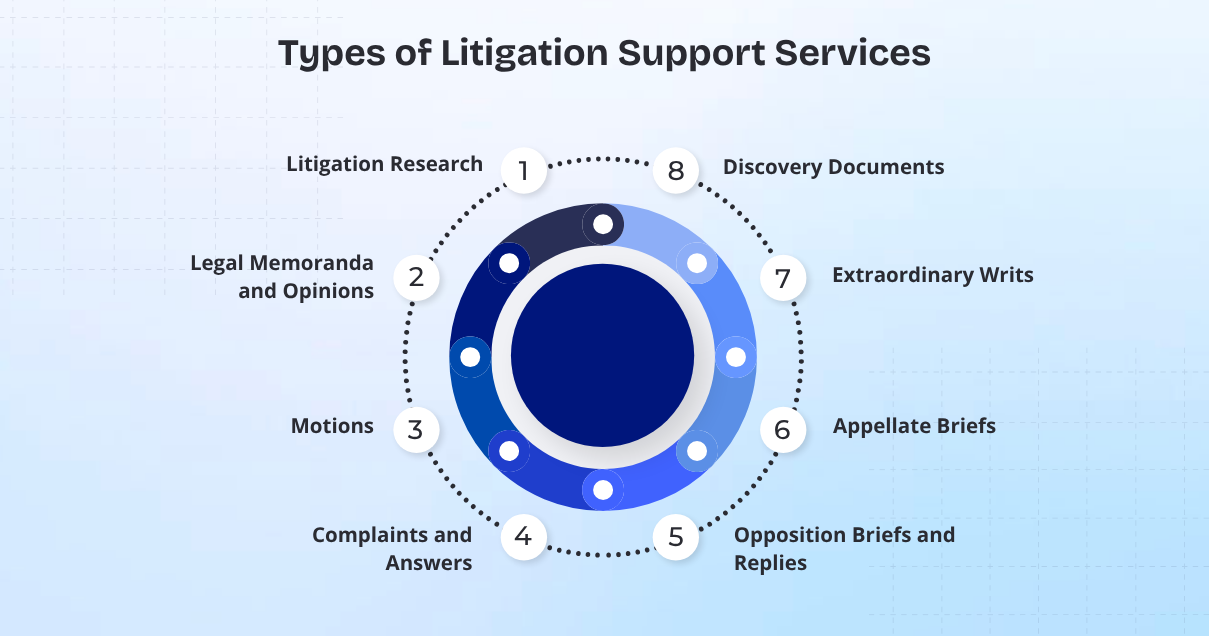
Litigation Research covers jurisdiction-specific case law research, statutory and regulatory analysis, and secondary source review. The output feeds directly into the drafting phase.
Legal Memoranda and Opinions range from a short, focused issue memo to a lengthy multi-issue analysis. They are used to advise clients, build internal strategy, and evaluate whether a position is worth taking.
Motions include motions for summary judgment, motions to dismiss, motions to compel discovery, motions for protective orders, and motions to reopen or reconsider. Each has its own procedural requirements. Each needs to be drafted with the specific court’s rules in mind.
Complaints and Answers are drafted to frame causes of action and defenses accurately, with the right jurisdictional allegations and correct pleading standards throughout.
Opposition Briefs and Replies respond directly to opposing arguments. The writing has to be controlled and precise, holding the client’s position without overreaching.
Appellate Briefs cover federal and state court briefs, Board of Immigration Appeals briefs, appeals to the Administrative Appeals Office. Precision is not negotiable here.
Extraordinary Writs including Writs of Mandamus, Habeas Corpus, and Certiorari. These require a clear-eyed understanding of the standards governing when these remedies are actually available.
Discovery Documents including requests for admission, requests for production, interrogatories, and responses, drafted to be strategically useful and procedurally sound.
Step-by-Step Litigation Support Process Explained
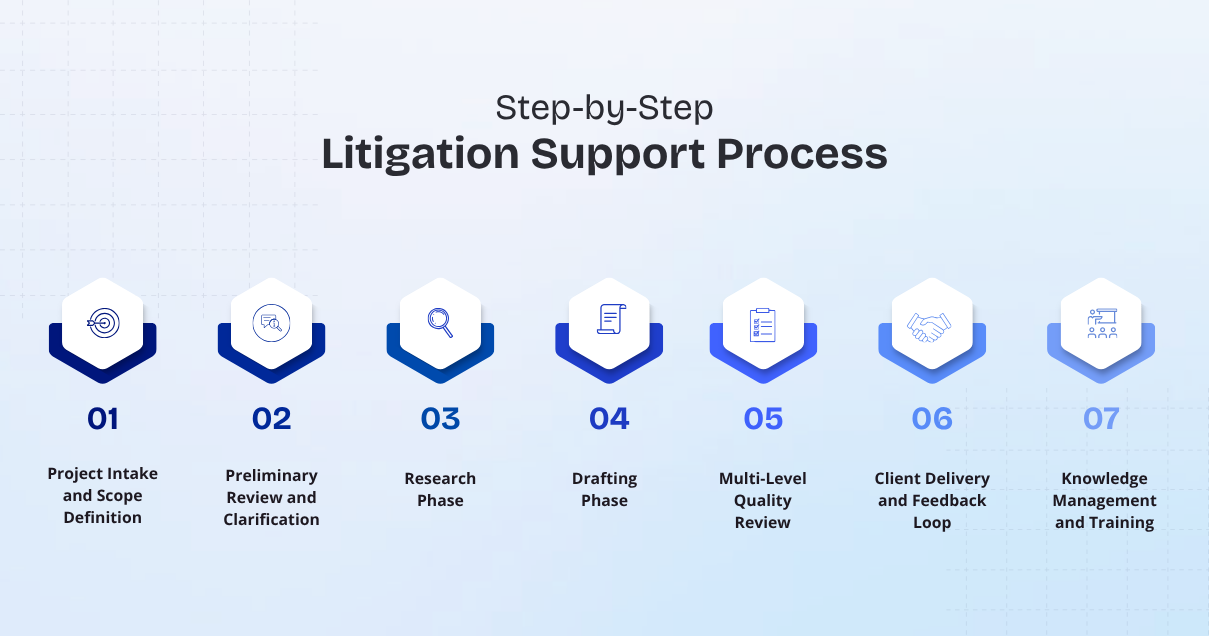
Phase 1: Project Intake and Scope Definition
The attorney briefs the team: the legal issue, the jurisdiction, the document type, the deadline. Conflict checks happen here. NDA compliance is confirmed. A project manager is assigned to the matter and stays on it from start to finish.
Phase 2: Preliminary Review and Clarification
The team reads everything. If the brief has gaps or ambiguities, they flag them immediately rather than guessing. This step saves everyone time later.
Phase 3: Research Phase
Jurisdiction-specific research runs on Westlaw, LexisNexis, Bloomberg Law, and other platforms depending on the matter. Every authority gets validated. Shepardized or KeyCited, no exceptions. The research is compiled into an internal memo that gets reviewed for accuracy and completeness before drafting starts.
Phase 4: Drafting Phase
Documents are drafted using the IRAC structure. Arguments are built fact-to-law, not law-then-hope-the-facts-fit. All citations are Bluebook-compliant. The writing is clear, concise, and persuasive, calibrated to the standards of the relevant court.
Phase 5: Multi-Level Quality Review
First, a senior legal associate reviews the draft for accuracy, logical flow, persuasiveness, and adherence to the brief. Then a second reviewer covers grammar, tone, formatting, structural integrity, jurisdictional accuracy, and consistency with client preferences. A final citation check and proofread close it out. Two sets of eyes, not one.
Phase 6: Client Delivery and Feedback Loop
The final deliverable goes out in the agreed format: clean version, redlined version, or both, with supporting research included if requested. Revisions are turned around quickly. Feedback gets documented so quality improves with every engagement.
Phase 7: Knowledge Management and Training
Internally, anonymized case studies feed continuous learning. Regular training covers US legal updates, research tools, citation standards, and writing. This is what keeps output quality consistent across the team and over time.
Top Benefits of Litigation Support for Law Firms
Attorneys work on what only they can do
Research and drafting are important. They are not, however, the highest-value thing a senior attorney does. Freeing up that time for client strategy, negotiations, and court appearances has a direct impact on outcomes and on revenue.
Capacity increases without the overhead
Taking on a large, complex matter no longer means immediately staffing up. The support scales to the work. That changes the economics considerably, especially for mid-sized firms competing against firms with much deeper benches.
The work product gets better
A team that does nothing but research and drafting, with no competing demands, produces more thorough work than an associate trying to squeeze research into whatever time is left at the end of a busy day. The research goes deeper. The drafts are tighter. Citations are cleaner.
Deadlines stop being a crisis
When research can be assigned out rather than deferred, deadline management becomes predictable rather than reactive. That matters for quality and, frankly, for the people doing the work.
Smaller firms can punch above their weight
A five-attorney boutique with solid litigation support can produce briefs that stand up against much larger firms. That is not an exaggeration. It genuinely shifts the competitive picture.
Common Challenges in Litigation Support (And How to Solve Them)
Briefing takes effort
Attorneys under pressure sometimes push back on spending time scoping an assignment. A simple intake template fixes this: legal question, jurisdiction, procedural context, document type, deadline, style preferences. It takes ten minutes and saves hours of revision.
Jurisdictional nuance is easy to miss
A provider who can search a database is not the same as one who understands how a specific court actually operates. For US matters, that means knowing local rules and circuit-level tendencies. For UK matters, it means understanding the structure of English civil procedure. Confirm actual jurisdictional experience, not just general legal capability.
Confidentiality cannot be assumed
NDAs, conflict checks on every matter, documented data handling protocols. These are baseline requirements. Treat any provider who cannot confirm these clearly as a non-starter.
Style mismatches slow things down
Every attorney writes differently. Share examples of existing work early in the relationship. The support team needs to calibrate to your voice, not produce something that reads like it came from a different firm entirely.
How to Choose the Right Litigation Support Provider
A few questions that actually tell you something:
Are their people legally qualified? There is a meaningful gap between someone with a law degree doing legal research and someone who learned to navigate legal databases. For substantive litigation work, qualifications matter. Ask directly and expect a direct answer.
Do they know your jurisdiction cold? Not generally. Specifically. US federal court briefing, Bluebook citation, and local rules. Or English commercial court procedure. Or cross-border EU litigation. Whatever your practice requires, they need genuine experience with it, not just familiarity.
What does their QC process actually look like? Multi-level review with documented steps is different from a single pass. Ask how quality is caught and corrected and what happens when something misses.
How do they handle urgency? Litigation runs on deadlines that do not move. Test responsiveness before you need it. A pilot on a lower-stakes matter is a reasonable way to find out whether they perform under pressure.
Are citations verified? Every authority should be Shepardized or KeyCited before it reaches a draft. If this is not part of their standard process, keep looking.
What are the commercial terms? Per project, per hour, or retainer. Each has trade-offs. Firms with consistent volume often prefer retainer. Firms with unpredictable caseloads often prefer per-project. Make sure the structure matches how your workload actually flows.
Conclusion
Litigation support is an operational decision, not a convenience. When the research is solid and the drafts are well-built, attorneys argue from a stronger position. Briefs hold up. Clients get better outcomes. The firm runs more efficiently.
For US, UK, and European law firms, strong litigation support services focused on research and drafting are one of the clearest levers available for improving quality and capacity at the same time.
Aeren LPO provides litigation research and drafting support for active litigation practices across all three markets. Qualified legal professionals, structured process, multi-level review, and output that is ready to use. If the research and drafting load at your firm is heavier than your team can carry without something slipping, that is the problem worth solving.
FAQ’s
It's the legal work behind the scenes. Research, drafting, memos, briefs, court submissions. Before any attorney stands up and argues a case, someone has to do the groundwork. That's what litigation services are. The prep that makes the argument possible.
Settling disputes when everything else has failed. Someone files a claim, the other side responds, and a court decides. It's structured, procedural, and yes, slow. But the outcome sticks. That's the point.
Lawyer is the broad label. A litigator is specifically someone who handles court disputes. Motions, hearings, and trial. Plenty of lawyers never go near a courtroom. They do deals, contracts, and advisory work. Different world entirely.
Pre-litigation review, filing, service, response, discovery, motions, and trial. Appeal if needed. Each stage has its own deadlines and rules, and missing one can hurt the case badly, no matter how strong the argument underneath it.
Weak research. Vague pleadings. Missing deadlines. Betting everything on one legal theory. Going into discovery without being properly prepared. Honestly, most cases that go wrong had warning signs early. Usually, in the preparation, not the courtroom.
Know the record cold. Research harder than feels necessary, including the parts that hurt your case. Write clearly. File on time. There is no secret to it, really. The attorneys who win consistently just outprepare everyone else.