



Litigation doesn’t wait for anyone to get organized. The moment a dispute turns serious, one question shows up almost immediately: what data do you have, where is it, and can you actually get to it without making things worse?
That’s the eDiscovery problem. And for legal teams, corporate counsel, and compliance officers across the US, it’s rarely hypothetical.
What is eDiscovery gets searched constantly, even by experienced legal professionals who want a cleaner answer than most resources actually give. So here it is.
What is eDiscovery?
Electronic discovery, or eDiscovery, is the process of identifying, preserving, collecting, reviewing, and producing electronically stored information (ESI) for use in litigation, regulatory investigations, or government audits.
Before everything went digital, discovery meant physical files. Boxes. Binders. You could see the scope of the problem sitting on a conference room table. Now the data is everywhere at once: email archives, Slack threads, Teams chats, SharePoint folders, CRM records, mobile devices, cloud storage. A single commercial dispute can pull relevant data from thirty different systems before anyone’s finished mapping custodians.
The legal foundation in the US comes from the Federal Rules of Civil Procedure. The 2006 amendments formally recognized ESI as discoverable. The 2015 amendments added proportionality as a governing standard, giving parties real basis to push back on overbroad requests. But the core obligation hasn’t moved: once litigation is reasonably anticipated, you preserve relevant data. Courts have issued case-terminating sanctions against parties who mishandled this. Not theoretical consequences. Actual ones, on real cases.
Why is eDiscovery Important?
Because the documents tell the story whether you want them to or not.
Every significant business decision leaves a digital trail. The email where someone flagged a product issue and got ignored. The Slack message approving a policy is now under challenge. The calendar invite places two people together when one of them later claims no involvement. That evidence exists, and in federal litigation, both sides have the right to get at it.
Compliance eDiscovery adds another layer entirely. The SEC, DOJ, and FTC carry their own data demands, often on tighter timelines with less procedural flexibility than civil discovery. Organizations without a real response capability find out just how exposed they are once they’re actually in it.
Cost is a serious factor, too. Document review is the single most expensive part of most litigation. When the collection is sloppy, reviewers wade through massive volumes of irrelevant material. Every document that shouldn’t have been collected costs money to review. A disciplined eDiscovery process cuts that waste.
Key Aspects of eDiscovery
A few things make eDiscovery genuinely different from paper-era discovery.
Volume doesn’t shrink: Enterprise litigation involving a mid-sized company over a three-year period can produce millions of files for review. That’s routine now, not exceptional. No team handles that without technology.
Metadata is evidence: A document isn’t just its content. It carries who created it, when it was last modified, which machine it came from, and whether it was altered after a key date. ESI metadata can corroborate or destroy testimony in ways the document text alone never could. Mishandling during collection can destroy that metadata silently.
The preservation duty is immediate: Legal holds don’t wait for counsel to finish assessing the situation. Once litigation is foreseeable, auto-delete policies stop, backup overwrites stop, and routine purge schedules stop for relevant custodians. Spoliation exposure starts the moment that doesn’t happen on time.
Chain of custody runs the whole process: Proper eDiscovery solutions document where every piece of data came from, who accessed it, and what was done to it. That record protects admissibility and shuts down spoliation arguments.
Key Stages of the eDiscovery Process
The industry has standardized around the EDRM (Electronic Discovery Reference Model). Here’s what each stage looks like in practice.
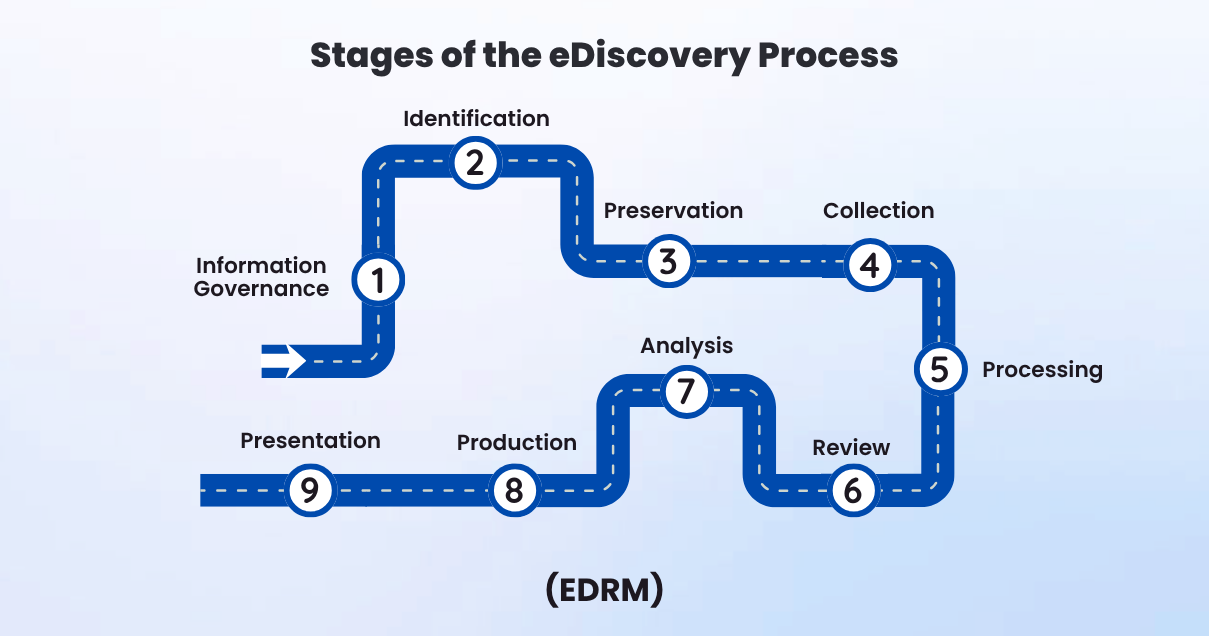
Information Governance happens before any litigation. Organizations that already know where their data lives and actually enforce retention policies start every eDiscovery engagement ahead. Everyone else scrambles.
Identification maps what data exists and where. Which custodians matter? Which systems did they use? What time period is relevant? A well-negotiated ESI protocol with opposing counsel here prevents enormous disputes later.
Preservation locks down the relevant universe. Legal hold notices go to custodians, automatic deletion suspends, and IT gets involved to protect backup schedules. The documentation of this process is as important as the process itself.
Collection is where forensic discipline matters. eDiscovery tools handle automated collection from email servers, cloud platforms, mobile devices, and endpoint systems while preserving metadata and maintaining the chain of custody. Manual exports handled informally are not collected. They’re liability.
Processing shapes the raw collected data into something reviewable. Deduplication, NIST filtering, date range culling, and keyword filtering. This is where a bloated collection becomes a focused review population.
Review is traditionally the most expensive phase. Attorneys assess documents for relevance, privilege, and responsiveness. Modern eDiscovery platforms use technology-assisted review (TAR), also called predictive coding, to prioritize documents by predicted relevance. Courts have accepted TAR as defensible when properly validated, and it cuts review costs meaningfully.
Analysis goes beyond basic coding. Sophisticated eDiscovery service providers apply email threading, near-duplicate detection, and communication mapping to surface patterns that a straight linear review misses.
Production delivers relevant, non-privileged documents to opposing counsel in agreed formats. What those formats are, and how metadata is handled, comes from the parties’ ESI discovery agreement or court order. Vague production specs create disputes that nobody needs.
Presentation is trial. A clean, documented process means evidence authenticates easily, chain of custody is airtight, and opposing counsel has fewer grounds to challenge admissibility.
Why is eDiscovery Important in Litigation?
The documents either help your case or they don’t. eDiscovery determines which ones surface and when.
The review finds the internal memo contradicting what a witness said under oath. It reconstructs timelines that key witnesses have suddenly stopped remembering. On the defensive side, a well-managed eDiscovery process lets you know early what the data actually shows, so litigation strategy is built on facts rather than assumptions.
Proportionality is a real tool when you have the numbers to back it up. If opposing counsel’s demands would cost more to fulfill than the case is worth, that’s a winnable argument in front of a judge. But you need actual collection cost data to make it credibly.
For in-house counsel, this is an operational readiness question as much as a legal one. What does a reactive, disorganized response to a litigation hold cost versus a prepared one? That gap is usually measured in seven figures when you add outside counsel fees, consultant costs, and the productivity drain on IT and key employees.
An eDiscovery attorney who understands both the legal obligations and how the technology works makes different and better strategic decisions than one who doesn’t. Knowing which data sources to fight over, how to negotiate ESI discovery terms, and when TAR is defensible requires dual fluency.
What Kind of Electronically Stored Information (ESI) Is Included?
More than most clients expect.
Email is still the anchor, including personal accounts used for business. Courts have not been sympathetic to the argument that a personal Gmail account makes business communications undiscoverable.
Text messages and mobile data are fully within scope when they contain relevant business communications. Employees who use personal phones for work created a collection challenge that requires specialized mobile forensic tools.
Collaboration platforms (Teams, Slack, Zoom chat) are where a growing share of business communication now lives. Each platform has its own export limitations and metadata structure. Producing this data requires platform-specific expertise.
Cloud storage, databases, structured CRM data, social media, voicemails, video files: all of it falls within electronically stored information when relevant. Deleted social media posts are often recoverable and have been produced in federal litigation.
Common Challenges in eDiscovery
Volume is the permanent problem. Enterprise data generation keeps growing, and litigation datasets grow with it. Without solid processing and culling workflows, review becomes unmanageable.
Custodian compliance is consistently underestimated. A legal hold notice is not compliance. Custodians forget, misunderstand scope, or don’t appreciate what preservation actually requires. Active follow-up and acknowledgment tracking are necessary, not optional.
Privilege review is high-stakes. Inadvertent production of privileged material can trigger waiver arguments that are hard to walk back. Clawback agreements under FRE 502(d) help, but they’re not a substitute for rigorous review.
Cross-border complexity comes up regularly in commercial disputes involving foreign subsidiaries. GDPR creates genuine legal tension with US discovery obligations. Data that must be produced under federal court order may be legally restricted from transfer under European law. Navigating that requires counsel who understands both sides.
How eDiscovery Reduces Legal Risks
Early case assessment is the first real payoff. Using eDiscovery tools to run a quick pass over the data before committing to a litigation strategy tells you what you’re actually dealing with. That’s how strategy should be built: on the documents, not client representations.
Spoliation protection is a process output. Documented, defensible preservation and collection drastically reduces the chance of a successful spoliation motion. Courts want to see reasonable steps. Technology provides the audit trail.
Cost predictability matters to everyone with a budget. Modern eDiscovery platforms generate actual data on processing volumes and review rates. That makes cost estimation reliable instead of a guess.
Regulatory response speed is an advantage that compounds. When a government agency sends a civil investigative demand, timelines aren’t flexible. Organizations with established processes respond faster, more completely, and with less scrambling.
Future Trends in eDiscovery
AI in review has moved well past first-generation TAR. Large language model integrations are appearing in commercial eDiscovery solutions, handling nuanced privilege identification and issue-coding at scale. Courts are starting to require disclosure about how AI was used in the review process, which raises procedural questions still being worked out.
Collaboration platform data keeps growing as a share of total litigation data. The tools built around email aren’t always well-suited for Teams and Slack, and the gap shows.
Information governance as a strategic investment is the shift serious legal departments are making. The organizations that map their data, enforce retention policies, and build litigation readiness before any dispute arrives consistently outperform those that treat eDiscovery as something to figure out after the subpoena lands.
Final Thoughts
So, what is eDiscovery? There is a technical definition and a practical definition. The technical definition is that it is the management of electronically stored information through the litigation life cycle. The practical definition is that it is the difference between a legal team that is in charge of the information environment and one that is always in reaction to it.
Companies that make the right technology investments in eDiscovery, work with experienced vendors, and develop real processes before litigation occurs are in a fundamentally better position. Aeren LPO is an experienced eDiscovery provider that works with law firms and corporate legal departments across the United States. We provide the entire gamut of eDiscovery services, including legal hold, collection, processing, review, and production. Whether you need to improve your existing process or are starting from scratch, we are a good place to start.
FAQ’s
Law firms, corporate law departments, and even the government all utilize eDiscovery. It is utilized by litigators in civil proceedings, compliance professionals in responding to investigations, and in-house legal teams in conducting investigations. In other words, anyone who is involved in litigation and/or has legal obligations with regard to electronic data needs it.