



Most legal teams know contracts are critical. But knowing and managing are two very different things. If your firm is still tracking renewal dates in spreadsheets, chasing approvals over email threads, or finding out about missed obligations after the fact, you are not alone. But you are leaving real risk on the table.
That is where contract lifecycle management comes in. Not as a buzzword, and not just as a software purchase. As a structured, repeatable way of handling every contract your organization touches, from the first draft request to the day it expires or gets renewed.
This blog gets into what CLM actually means, why it matters for legal teams in the US, where firms commonly slip up, and how a smarter approach, including offshoring certain CLM functions, can genuinely move the needle.
What is Contract Lifecycle Management?
Let’s get right to it. The contract lifecycle management (CLM) process entails all aspects of managing a contract from the moment it’s requested to the moment it closes out or renews. This includes drafting, reviewing, negotiating, executing, storing, tracking compliance, etc.
Many people think that contract lifecycle management means equates to software. However, it’s more accurate to say that the software supports the process. The contract management lifecycle process entails a process that’s repeatable, auditable, and minimizes manual processes to keep your team in control.
Here is how it actually flows:
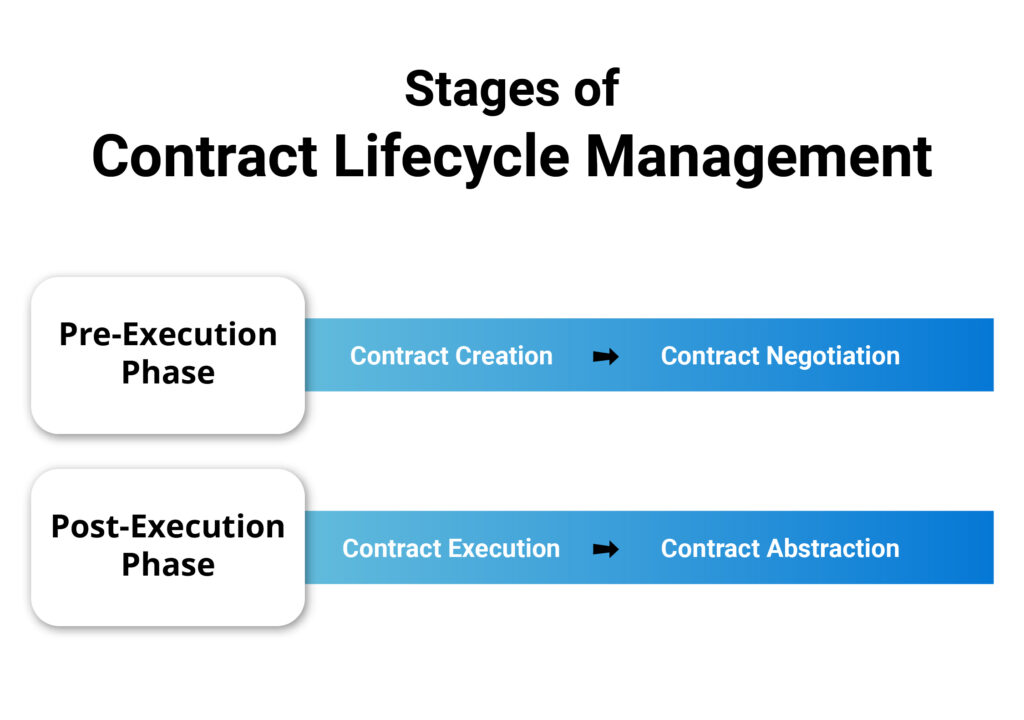
Pre-Execution Phase
Contract Creation
This is where the request comes in, and the contract gets drafted. The goal is speed without cutting corners on accuracy. Without an efficient contract creation process, every contract becomes its own custom project, and that gets expensive fast.
Contract Negotiation
Contracts most often stall during the contract negotiation stage. Redlines, competing versions, counterparty requests piling up. A good CLM process means every change is tracked, there is a clear audit trail, and everyone knows which version is the one currently in play. Without that structure, things get messy, and mistakes get made.
Post-Execution Phase
Contract Execution
Once both sides agree on terms, the contract moves to signature. Electronic signature tools have made this part faster. But contract execution is not just about signing. It is about logging the fully executed contract correctly, assigning clear ownership, and getting obligation tracking set up right away.
Contract Abstraction
This step is skipped far too often, and it hurts teams later on. Abstraction of contracts refers to the extraction of key information from a contract, such as parties, key dates, payment terms, indemnification provisions, termination rights, and renewal rights. When you do this correctly, you can search, report, and act on the information in the contract. A contract without abstraction is simply a piece of paper in a folder.
Beyond abstraction, the post-execution phase covers ongoing contract compliance monitoring, obligation management, and making sure renewals and terminations happen on schedule. This is where most legal risk actually lives, and where most teams are the least prepared.
Also read: In-House vs. Outsourced Contract Abstraction Process: What Legal Teams Need to Know
Why Contract Lifecycle Management Actually Matters
Here is a number worth knowing. The World Commerce and Contracting Association estimates that companies lose around 9% of annual revenue from poor contract management. That is not a small rounding error. That is a real, preventable problem.
For law firms and legal departments, the risks are just as concrete:
- Missed renewal deadlines lock clients into unfavorable terms, or let valuable agreements lapse completely.
- Non-standard clauses that get through negotiation create compliance headaches months or years later.
- Disconnected approval workflows slow down deal timelines and frustrate clients.
- Untracked obligations, whether SLAs, reporting requirements, or indemnification terms, quietly turn into liability.
Good contract risk management is not about being overly cautious. It is about knowing exactly what your organization has committed to and when. That kind of visibility only exists when a structured CLM process is running underneath everything.
Real Benefits of a Strong CLM Process
Here is what well-run contract lifecycle management services actually deliver:
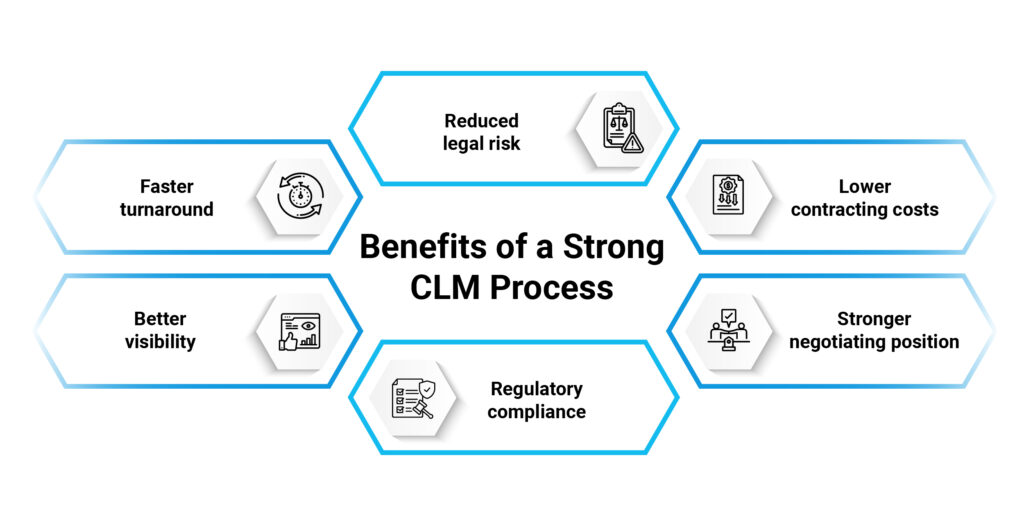
- Reduced legal risk: Consistent processes mean fewer missed deadlines, fewer compliance gaps, and a clear paper trail when something gets disputed.
- Faster turnaround: Standardized templates and automated workflows can move contracts from weeks to days.
- Better visibility: A central contract repository with search and reporting means no one has to guess where things stand.
- Lower contracting costs: Fewer manual hours, fewer errors, and fewer surprise renewals add up to real savings.
- Stronger negotiating position: When your team can pull historical contract data quickly, negotiations become more strategic and less reactive.
- Regulatory compliance: In healthcare, finance, and government contracting, especially, compliant contract management is not optional. CLM makes it systematic.
These are not wishful outcomes. They are what legal teams report after putting a proper contract management lifecycle process in place.
CLM Challenges in Law Firms: What Actually Gets in the Way
CLM challenges in law firms are real, and they do not always get talked about openly. Here is what most legal teams are actually dealing with:
1. Volume and Complexity
Law firms and large legal departments handle contracts across dozens of practice areas, jurisdictions, and contract types. No two contracts are exactly alike. Managing that volume without the right systems is genuinely hard.
2. Siloed Teams and Tools
In many firms, contracts live across email, shared drives, matter management software, and sometimes paper files. There is no single source of truth. That fragmentation makes contract data management nearly impossible to do well.
3. Poor Adoption of CLM Software
Firms invest in contract lifecycle management software and contract lifecycle management tools and then watch them sit largely unused. Technology only works when the right process is wrapped around it. Without training, governance, and clear ownership, even a good CLM platform delivers very little.
4. Bandwidth Constraints
Senior attorneys should not be spending their time on contract abstraction, routine clause review, or chasing renewal dates. But when there is no operational support structure, that is exactly what happens. The result is burnout and a bottleneck on the legal work that actually matters.
5. Inconsistent Standards
Without a standardized approach, different attorneys handle the same contract types differently. That inconsistency creates risk and makes contract governance very hard to enforce as the organization scales.
Tips for Running a More Efficient CLM Process
Whether you are building a CLM process from the ground up or fixing one that is not working, these principles apply across firm sizes and practice types.
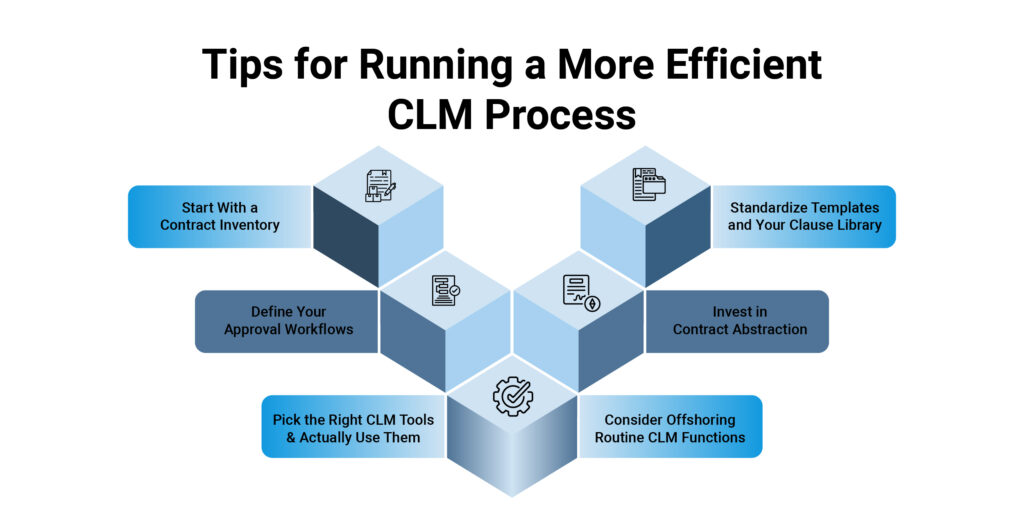
Start With a Contract Inventory
You cannot manage what you have not mapped. Do a full audit of where your contracts currently live, who owns them, and what their status is. That baseline is essential before changing anything else.
Standardize Templates and Your Clause Library
It is not only inefficient and inconsistent if you draft from scratch each time. You want to develop a template library of pre-approved wording for your most common types of contracts. It is worth spending some time upfront on a strong clause playbook. It will reward you in every negotiation that follows.
Define Your Approval Workflows
Know who needs to review and approve each contract type, and at what dollar value or risk threshold that changes. Document those workflows. Then automate them wherever your contract lifecycle management software supports it.
Invest in Contract Abstraction
Do not just store contracts. Extract the data from them. Key dates, obligations, termination rights, renewal terms. Without abstraction, your contracts are black boxes. With it, you have a functioning contract intelligence system.
Pick the Right CLM Tools and Actually Use Them
The market for contract lifecycle management tools has grown significantly. From lightweight options to full enterprise platforms with AI-assisted review, there is something for every firm size. The key is choosing tools that fit how your team actually works, not tools that require your team to work differently around them. And once you pick them, invest seriously in adoption.
Consider Offshoring Routine CLM Functions
This is something more US law firms and in-house legal teams are taking seriously: not every part of the contract management lifecycle needs to happen in-house, handled by senior staff, at US billing rates.
Routine but essential tasks like contract abstraction, metadata extraction, initial review, contract migration, and renewal tracking are well-suited for legal process outsourcing. Offshore teams trained in US contract standards can handle this work accurately and at scale, freeing your internal team for higher-complexity legal work.
Providers like Aeren LPO specialize in exactly this: supporting US legal teams with structured, reliable contract lifecycle management services that fit into your existing processes and tools without disruption.
In-House vs. Offshore CLM: An Honest Comparison
The in-house vs offshore CLM debate often gets treated as an either/or. It is not. The better question is which tasks belong where.
Here is how the split typically looks in practice:
- Contract negotiation and strategy: Best handled in-house by senior legal staff.
- Complex legal review: Stays in-house.
- Contract abstraction and data entry: Overqualified work in-house. Ideal fit for an offshore LPO team.
- Metadata extraction: Low strategic value internally. High efficiency gain when offshored.
- Renewal and deadline tracking: Easy to miss at volume in-house. Very scalable through an LPO.
- Contract migration projects: Resource-intensive internally. High efficiency when handled offshore.
- Template standardization: Works well as a shared effort between in-house and offshore.
The math is fairly clear. When you offshore high-volume, process-driven CLM tasks to qualified legal professionals in a structured environment, costs drop significantly while quality stays consistent. Your in-house team gets their bandwidth back. And the overall contract management lifecycle runs better because every stage gets the right level of attention from the right people.
For US law firms where billing pressure and talent costs are constant concerns, this is not just a good idea. For many, it is becoming a competitive necessity.
The Bottom Line
Contract lifecycle management is not glamorous work. It does not win cases or close deals on its own. But when it is done well, it protects deals, prevents losses, and gives legal teams the visibility they need to do their jobs effectively.
Firms that treat CLM as a real operational discipline, not just a folder structure or a software subscription, are the ones with fewer surprises, cleaner compliance records, and more efficient teams.
And firms that figure out how to combine the right internal expertise with the right contract lifecycle management services from external partners? Those are the firms that scale smartly, without having to grow headcount at the same rate.
Whether you are evaluating CLM software, rethinking your internal process, or exploring what offshoring your contract operations could look like, the starting point is the same: take CLM seriously. Your contracts already do.
Aeren LPO is a legal process outsourcing company serving US law firms and corporate legal departments. Our contract lifecycle management services are designed to integrate with your existing workflows, helping you manage contracts more efficiently, accurately, and cost-effectively.