



If you’ve been practicing law for more than a decade, you already know that discovery was never the fun part. Mountains of paper, storage units full of bankers’ boxes, and a team of paralegals reviewing documents around the clock. That was just how it worked. But eDiscovery, or electronic discovery, did not simply modernize the way that discovery was conducted. It changed what discovery means, what discovery costs, and what discovery means in terms of winning or losing cases.
So let’s get into it. What’s actually different between traditional discovery and eDiscovery, and why should it matter to you?
The Core Difference: Volume, Velocity, and Format
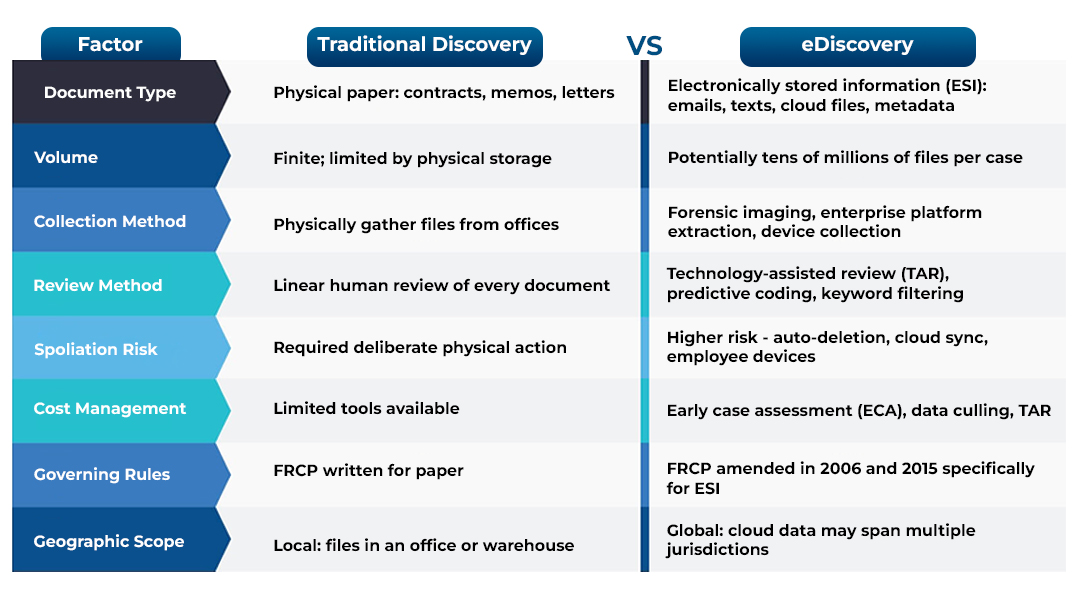
Traditional discovery dealt with physical documents such as contracts, letters, memos, and invoices. You could see, touch, and review them at a rate that human reviewers could reasonably handle.
eDiscovery deals with electronically stored information (ESI), and that changes everything. We’re talking about emails, Slack communications, text messages, databases, metadata, cloud storage, voicemail, social media. In a large commercial litigation case today, a case that’s worth tens of millions of dollars, it’s not an exaggeration to say that there could be tens of millions of documents involved in that case.
This is the core issue. It’s not just that the format changed. The volume and velocity of data in the modern workplace have made traditional review methods structurally impossible. A team of lawyers doing manual review at the pace traditional discovery demanded would take years and cost more than most cases are worth.
What Traditional Discovery Actually Looked Like
To understand why eDiscovery is such a shift, it helps to first remember what came before it.
In traditional discovery, a party received a document request, identified relevant physical files, reviewed them for privilege and relevance, made copies, and produced them to opposing counsel. The scope was limited by what physically existed and what could be reasonably gathered.
The rules governing this process, developed over decades of civil litigation procedure, were built around paper. Proportionality arguments were easier because the universe of documents was finite and visible. Spoliation concerns existed, but destroying evidence took deliberate, physical action.
There was also a simpler chain of custody to trace. You knew where the documents came from. You could walk into a file room and see them.
How eDiscovery Changed the Game
eDiscovery introduced an entirely new lifecycle for handling evidence. Under the Electronic Discovery Reference Model (EDRM), the process is currently divided into specific stages, including information governance, identification, preservation, collection, processing, review, analysis, production, and presentation.
Each of these stages has its own degree of complexity as well as its own degree of risk.
Preservation, by itself, is a whole different animal. Under traditional discovery, a litigation hold meant telling people to stop shredding documents. Under eDiscovery, it means identifying custodians, halting auto-delete, preserving backup tapes, capturing cloud data, and so forth. Miss something, and you’re looking at sanctions.
Collection used to mean physically gathering files. Now it means forensically imaging hard drives, extracting data from enterprise platforms like Microsoft 365 or Salesforce, collecting from personal devices if relevant, and doing all of it in a way that doesn’t alter metadata — because metadata is often evidence.
Processing is entirely new to the eDiscovery world. Before data can be reviewed, it has to be converted into a reviewable format, deduplicated, filtered, and indexed. None of that existed in traditional discovery.
And then there’s review, which is where the real transformation is happening.
Technology-Assisted Review: The Biggest Shift
In traditional discovery, every document was reviewed by a human. That was the only option. In eDiscovery, technology-assisted review (TAR) also called predictive coding allows machine learning models to prioritize and categorize documents based on attorney decisions on a seed set.
This is a fundamental shift in how legal review works. Instead of a linear review, where every document gets equal time, TAR allows a much smaller number of documents to be reviewed while achieving statistically defensible results across the full dataset. Courts have increasingly accepted TAR as a valid review methodology, and for large document sets, it’s often more accurate than exhaustive manual review.
Keyword search was the first technological tool applied to ESI. While still used today, experienced practitioners know its limitations: keywords miss synonyms, slang, and context. TAR goes further by learning from human judgment rather than relying on pre-set terms.
This doesn’t mean humans are out of the loop. Privilege review, relevance determinations, and final quality control still require attorney judgment. But where that judgment is applied has changed dramatically.
eDiscovery and the Federal Rules: A Legal Framework Built for ESI
The traditional system of discovery was governed by the Federal Rules of Civil Procedure, which were written for a paper-based system. The 2006 rules amendments and the substantial changes made to the FRCP in 2015 addressed ESI issues explicitly, and these changes have impacted the discovery rules for all litigants.
Rule 26(b)(1) now requires courts to consider proportionality in determining the scope of discovery. This matters in eDiscovery because the potential cost of collecting and reviewing millions of documents can easily become disproportionate to the stakes. Proportionality arguments are now a core part of the discovery strategy.
Rule 37(e) governs spoliation of ESI and the sanctions that follow. It’s more nuanced than the old spoliation doctrine because it distinguishes between negligent and intentional loss of ESI. But the underlying message is the same: once litigation is reasonably anticipated, you have a duty to preserve, and ESI creates many more opportunities to get that wrong.
Meet and confer obligations under Rule 26(f) now include discussions about ESI discovery, including what forms of production are acceptable, whether certain sources of data are not reasonably accessible, and how to handle inadvertent disclosure of privilege. These discussions were not necessary in traditional discovery because there was nothing to negotiate.
Cost: The Elephant in the Room
Traditional discovery was expensive. eDiscovery services can be orders of magnitude more expensive or dramatically cheaper depending on how well it’s managed.
The cost drivers in eDiscovery are collection volume, processing costs, hosting fees, and review hours. A case with 10 million documents reviewed at traditional per-document rates would cost millions. Apply TAR intelligently, and you might review a fraction of that with equal or better results.
Early case assessment (ECA) using analytical tools to understand the data before full review is now standard practice for sophisticated litigants. It lets you make informed decisions about the scope of production, settlement strategy, and resource allocation before you’re already deep into an expensive review.
Data culling through date filtering, custodian selection, and keyword filtering before review is also a cost lever that didn’t exist in traditional discovery. The ability to narrow a 10-million-document set to 500,000 reviewable documents before human eyes ever touch it is a capability that changes the economics of litigation.
Cross-Border and Cloud Complications
Traditional discovery operated within clear geographic boundaries. Files were in an office or a warehouse. eDiscovery doesn’t respect those lines.
Cross-border data transfers, particularly relevant when dealing with multinational companies, create conflict between US discovery obligations and international data privacy laws like GDPR. Collecting data from a European server to satisfy US discovery requests can expose parties to liability under foreign law.
Cloud storage adds another layer. Data in Microsoft Azure, AWS, or Google Cloud may be stored across multiple jurisdictions simultaneously. Identifying where data resides, who has legal custody of it, and what law governs its collection is a question that never came up in traditional discovery
What This Means for Litigation Strategy
eDiscovery isn’t just an operational issue; it’s a strategic one. The attorney who understands ESI data sources, knows how to argue proportionality, and can structure a smart collection and review workflow has a real advantage.
A weak eDiscovery strategy shows up in a few ways: over-collection that drives up costs, under-preservation that creates spoliation risk, and inadequate privilege review that waives protections. Strong eDiscovery strategy turns discovery into a competitive edge.
The gap between traditional discovery and eDiscovery isn’t just technological. It’s a different way of thinking about evidence, risk, and litigation itself. The fundamentals of civil discovery, i.e., relevance, privilege, and proportionality, haven’t changed. But how you apply them in a world of ESI demands a completely different set of skills and tools.
That’s why working with an experienced partner like Aeren LPO on eDiscovery matters. The difference between a well-managed review and a chaotic one isn’t just money; it’s case outcomes.